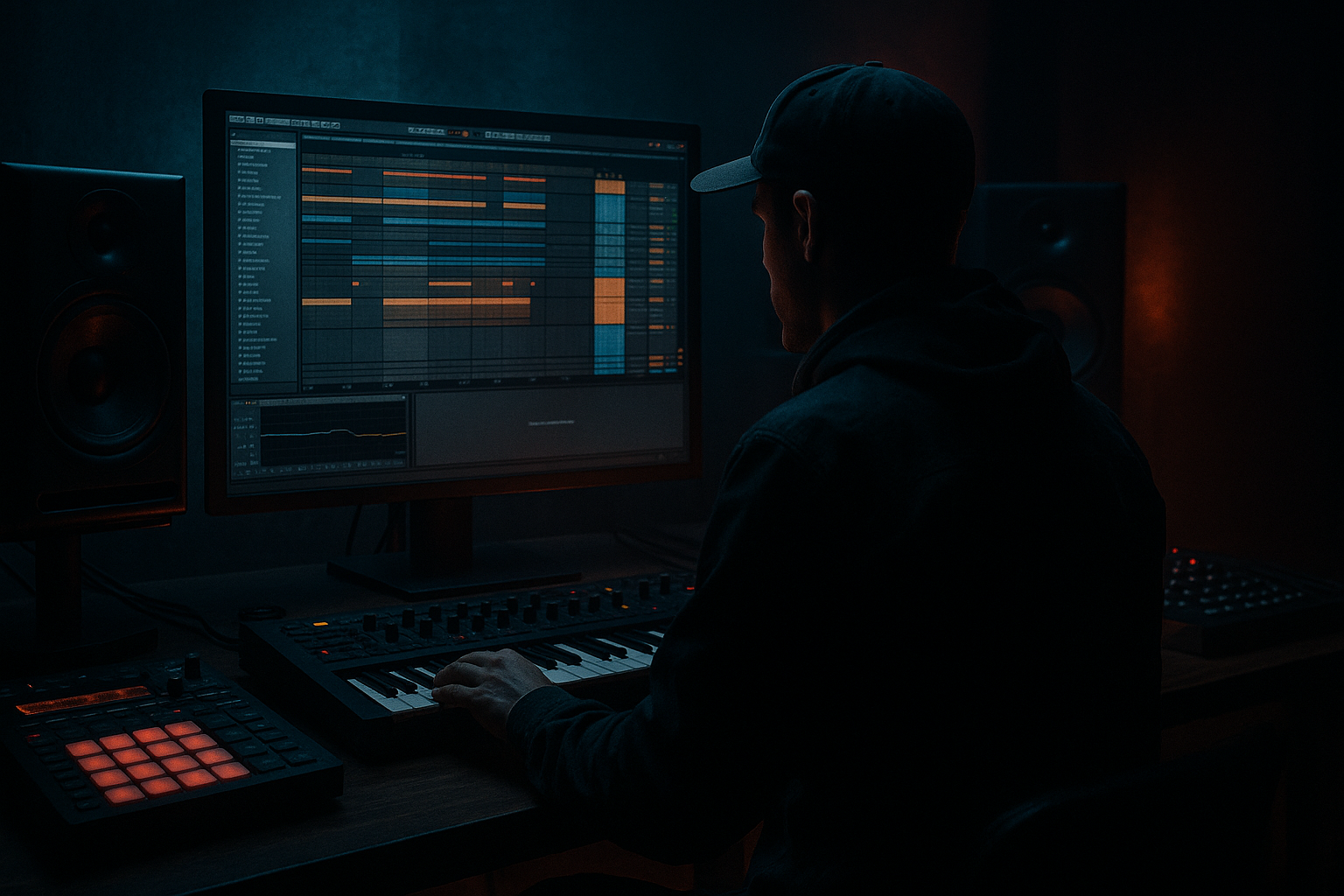
Main tutorial
```markdown
Heatwave: SubSine Arrange for Deep Jungle Atmosphere in Ableton Live 12 (FX)
1. Lesson overview
In this lesson you’ll build a “Heatwave SubSine” arrangement technique: a controlled, evolving sub sine that breathes with your jungle drums and creates that humid, late-night atmospheric pressure—without muddying the mix. 🌫️🔥
This is not “make a sine and loop it.” We’ll treat the sub like an arrangement + FX instrument:
- Micro-automation for tension/release
- Dynamic sub emphasis on phrases (not constantly)
- Psychoacoustic movement that reads on small speakers but stays clean
- Jungle-aware: works with busy breaks, rolls, and atmospheric pads
- A SubSine track (Operator/Wavetable) locked to your bass notes
- A Sub Control Rack with:
- Arrangement automation (“Heatwave Moves”) that evolves across 16–64 bars:
- Write sub notes that follow the root of your bass phrase, but simplify:
- EQ Eight (as above)
- Saturator (subtle)
- Utility (Width 0%, final safety)
- EQ Eight
- Saturator
- Chorus-Ensemble (Live 12 stock)
- Utility
- EQ Eight
- Hybrid Reverb
- Auto Filter
- Macro 1: `SUB LEVEL` (Utility gain on SUB CLEAN)
- Macro 2: `DUCK` (Compressor threshold)
- Macro 3: `HEAT` (Saturator drive on HEAT HARM)
- Macro 4: `SHIMMER` (Chorus amount or rate)
- Macro 5: `AIR` (Hybrid Reverb mix)
- Macro 6: `LOW TIGHT` (EQ Eight low dip freq/gain if needed)
- Bars 1–9 (Intro): No sub, only atmos + break hints
- Bars 9–17 (Build): Introduce HEAT HARM quietly (no true sub yet)
- Bar 17 (Drop 1): Full sub comes in, but not maxed
- Bars 25–33: “Heatwave lift”: sub intensity rises (automation)
- Bars 33–49 (Breakdown): Remove sub fundamental, keep ghost harmonics + air
- Bar 49 (Drop 2): Sub returns heavier + tighter, less air
- In the last 1/2 bar before a drop, automate:
- Stereo sub: widening below ~120 Hz = phase weirdness + lost energy in clubs.
- Over-saturating the fundamental: you’ll get “blur bass” that steals headroom.
- Constant full sub: no tension, no story. Jungle thrives on contrast.
- Sidechain too deep: if you’re ducking 8–12 dB constantly, the bass will feel weak and unstable.
- Letting the break own the same fundamental: choose who’s “king” at 50–70 Hz.
- Add a “sub drop-out” trick: for 1 bar before Drop 2, mute `SUB CLEAN` but keep `HEAT HARM + GHOST AIR`. The return feels monstrous. 🧨
- Automate Saturator “Soft Clip” ON only for the heaviest 8 bars (macro it). It creates perceived loudness without raising peak too much.
- Use Roar (if you have it in Live 12 Suite) on `HEAT HARM` only:
- Dark vibe = less top-end reverb:
- Sync the pump to groove:
- The sub fundamental stays mono + clean
- Harmonics + subtle modulation create atmosphere and translation
- Sidechain and arrangement automation make the bass feel alive
- The sub becomes a phrase-based FX element, not just a constant tone
Skill level: Advanced
Category: FX (but applied to bass/sub arrangement in DnB)
---
2. What you will build
A complete Ableton Live 12 setup with:
- Sidechain pumping (clean, predictable)
- Saturation that translates (without “bass fuzz”)
- Stereo-safe “air” harmonics (mono sub preserved)
- Sub swells, dropouts, pressure ramps
- Filter/drive micro changes on phrase edges
- “Underwater/heat shimmer” via subtle phase/time modulation (on harmonics only)
You’ll end with a deep jungle atmosphere where the sub feels alive and intentional—especially in breakdowns, pre-drops, and second drops. 🥁⚡
---
3. Step-by-step walkthrough
Step 0 — Session prep (so the sub behaves)
1. Tempo: 160–172 BPM (jungle sweet spot: ~165–170)
2. Set monitoring: put a Spectrum on Master temporarily.
3. Create groups:
- `DRUMS (breaks + tops)`
- `BASS (mid + sub)`
- `ATMOS (pads, FX, vox)`
Why: you’ll sidechain the sub to drums, and automate against phrases cleanly.
---
Step 1 — Create the SubSine instrument (Operator: clean + reliable)
1. Create a MIDI track: “SUBSINE”
2. Add Operator:
- Osc A: Sine
- Level: 0 dB (adjust later)
- Voices: 1 (Mono)
- Glide: 40–90 ms (taste; jungle tends to like subtle glide)
3. Amp Envelope:
- Attack: 0.0–3 ms
- Decay: ~300 ms
- Sustain: -inf or low sustain if you want held notes
- Release: 50–120 ms (avoid clicks but keep tight)
MIDI writing tip (advanced):
- Use fewer note changes than the mid bass
- Let drums provide motion; sub provides pressure
---
Step 2 — Lock the sub to mono + protect headroom
Add these devices after Operator in this order:
1. EQ Eight
- HP filter: 20–25 Hz, 24 dB/Oct (remove rumble)
- Optional: tiny bell dip ~45–70 Hz if kick/break fundamental clashes
2. Utility
- Width: 0% (yes, hard mono)
- Bass Mono: (Live 12 Utility has Bass Mono options; if available in your build) set <120 Hz mono.
- Gain: start at -6 dB for headroom while building
Goal: sub stays consistent on clubs and doesn’t “wobble” in stereo.
---
Step 3 — Sidechain “breathing” that feels like jungle (but controlled)
You want the sub to bounce with the break without vanishing.
Option A (clean): Compressor sidechain
1. Add Compressor on SUBSINE
2. Enable Sidechain:
- Input: `DRUMS` group (or just your main break track)
3. Settings (starting point):
- Ratio: 3:1
- Attack: 3–10 ms (let a bit of transient through)
- Release: 80–160 ms (sync to groove)
- Threshold: adjust for 2–5 dB gain reduction on hits
- Knee: soft-ish if you want smoother pumping
Option B (more “heatwave” shape): Auto Pan as volume shaper
1. Add Auto Pan (yes) after Compressor (or instead of it)
2. Turn Phase = 0° (so it becomes tremolo)
3. Rate: 1/8 or 1/16 (try 1/8 for classic roll)
4. Amount: 10–25%
5. Shape: closer to sine for subtle, square-ish for aggressive gating
DnB tip: Combine light compressor ducking + tiny tremolo for that “alive” sub without over-pumping.
---
Step 4 — Build the “Heatwave Sub Rack” (harmonics that shimmer, sub stays pure)
Create an Audio Effect Rack on the SUBSINE track called: HEATWAVE SUB RACK.
Inside, make 3 chains:
#### Chain 1: `SUB CLEAN` (the foundation)
- Mode: Soft Sine
- Drive: 1–3 dB
- Output: trim to match
- Soft Clip: ON (lightly)
#### Chain 2: `HEAT HARM` (harmonics for translation)
This chain should NOT add low-end—only upper harmonics.
- HP: 90–130 Hz, 24 dB/Oct (important)
- Drive: 4–10 dB (push until you hear it on small speakers)
- Color: ON
- Amount: 10–20%
- Rate: 0.15–0.35 Hz
- Width: 70–120%
- Mix: 10–25%
- Width: 120–160% (safe because low end is filtered out)
This gives the “heat shimmer” effect while the sub remains mono and stable. 🌡️
#### Chain 3: `GHOST AIR` (barely-there atmosphere)
- HP: 250–400 Hz
- Algorithm: Hall or Shimmer (subtle!)
- Decay: 1.5–3.5 s
- Pre-delay: 20–40 ms
- Low Cut: 300 Hz+
- Mix: 5–12%
- LP: 6–10 kHz (remove fizz)
- Envelope: tiny amount for motion (optional)
Keep this chain quiet. It’s a vibe layer, not a reese.
Rack Macros (map these):
---
Step 5 — Arrangement: “SubSine as atmosphere” (the actual Heatwave technique)
Now we automate phrases, not just sound.
#### A) 32-bar blueprint (works for jungle rollers)
#### B) The 3 key automations (do these every time)
1. Macro 1: SUB LEVEL
- Drop 1: slightly restrained
- End of phrase (last 2 bars before a fill): +0.5 to +1.5 dB
- Immediately after fill: pull it back slightly
This makes the drop feel like it’s pressurizing.
2. Macro 2: DUCK
- For busier break sections: increase ducking a touch (clean groove)
- For halftime moments / sparse fills: reduce ducking so sub feels huge
3. Macro 3/4: HEAT + SHIMMER
- Automate up into transitions (4–8 bar ramps)
- Cut back on the downbeat of the drop for “snap” (contrast = impact)
Micro-move (advanced but gold):
- `HEAT` up slightly
- `SUB LEVEL` down slightly
Then at the drop: reverse it (sub up, heat down).
It feels like the room “inhales” then the sub hits. 💨➡️🔊
---
Step 6 — Glue it to the drums (jungle interaction)
Your sub should respect the break.
1. On DRUMS group, add a Drum Bus (stock):
- Drive: 5–15%
- Boom: Off or very low (sub already exists)
2. Make sure the break/kick fundamental is not fighting sub:
- If your break has big low thump, use EQ Eight on the break:
- gentle cut ~50–80 Hz (1–3 dB) or
- HP 30–40 Hz to clean rumble
Rule: Either the break supplies “thud” or the sub does—don’t let both dominate the same exact zone.
---
Step 7 — Final checks (translation + phase sanity)
1. On Master, add:
- Spectrum: confirm sub fundamental sits stable (often 43–55 Hz for F–G, or 55–65 Hz for A–C)
- Utility (temporary): Width 0% to check mono compatibility
2. Bypass `HEAT HARM` chain: ensure the drop still works.
3. Listen quietly: can you still feel the bass movement? If not, your sub arrangement is too static.
---
4. Common mistakes
---
5. Pro tips for darker/heavier DnB
- Multiband: distort mids/highs, keep lows clean
- Great for ominous presence while sub stays disciplined
- Keep `GHOST AIR` filtered (LP around 6–9 kHz) so it feels smoky, not splashy.
- If the break is swung, adjust Compressor release and/or Auto Pan phase so the sub bounce matches the shuffle.
---
6. Mini practice exercise (15–25 minutes)
1. Make an 8-bar rolling break loop.
2. Write a 2-note sub phrase (root + one step) with Operator.
3. Build the HEATWAVE SUB RACK (3 chains).
4. Create a 16-bar arrangement:
- Bars 1–8: `SUB CLEAN` muted, only `HEAT HARM` at -18 to -24 dB
- Bars 9–16: bring in `SUB CLEAN`, automate:
- `SUB LEVEL`: +1 dB over bars 9–16
- `HEAT`: ramp up bars 13–16 then drop back on bar 9 of next loop
5. Export and listen on phone speakers:
- If you hear nothing, increase `HEAT HARM` saturation slightly (not sub volume).
---
7. Recap
You built a deep jungle “Heatwave” sub system where:
If you want, tell me your track key (e.g., F, G, A) and whether your break is old-school chopped or modern clean, and I’ll suggest a sub note range + automation map that fits your exact vibe. 🎛️
```

