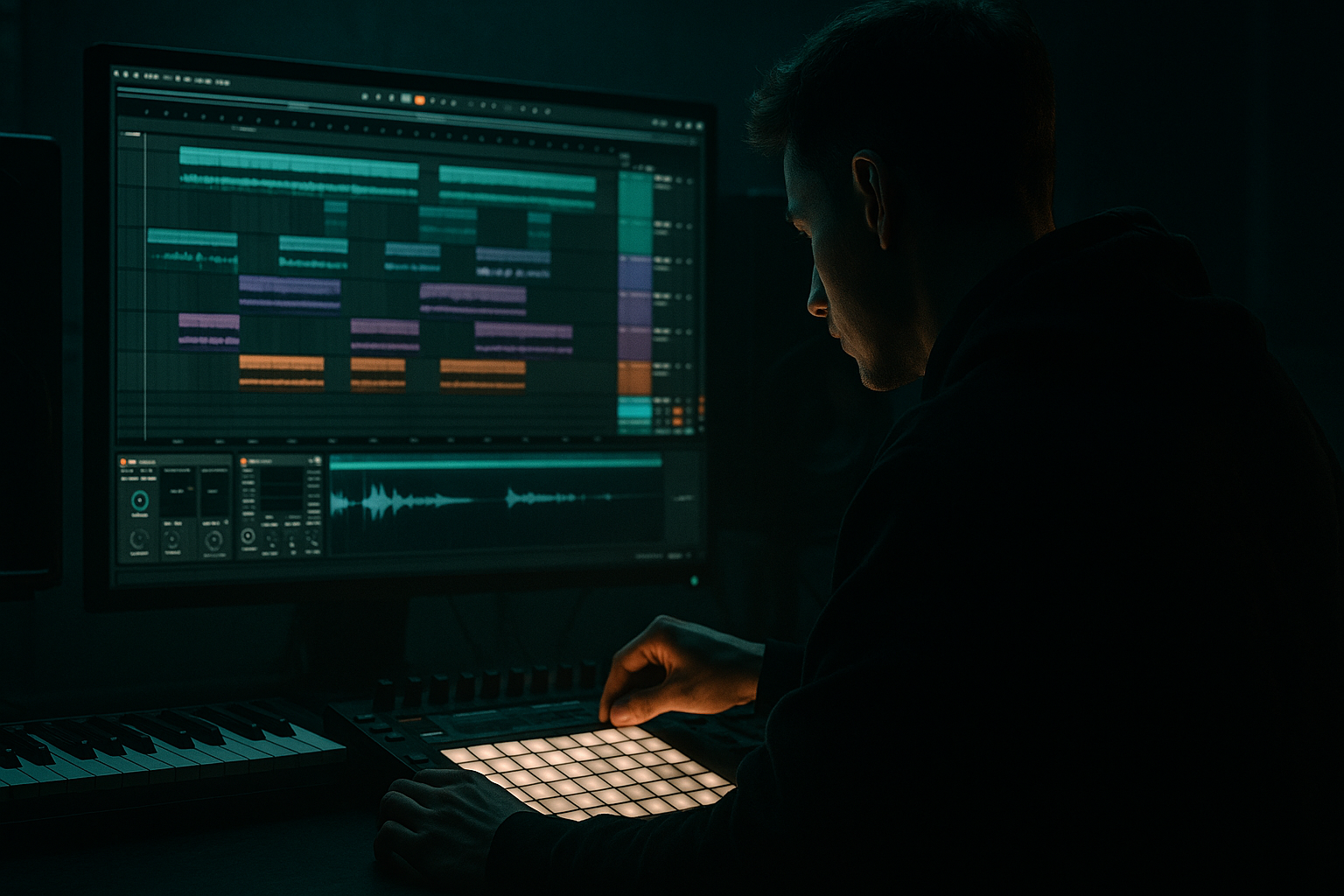
Main tutorial
Guide to Ghost Notes for Timeless Roller Momentum (Ableton Live 12) 🥁⚡
Advanced • DJ Tools • Jungle / Oldskool DnB vibes
---
1. Lesson overview
Ghost notes are the “micro-groove engine” of rolling jungle and classic DnB. They’re not random extra hits—they’re quiet, purposeful accents that create forward momentum, tension, and swing without cluttering the main break.
In this lesson you’ll build a timeless roller-style drum framework in Ableton Live 12, focusing on:
- Ghost note placement (snare/kick/hats) for continuous push
- Velocity shaping and groove extraction for human roll
- Layer control so ghost notes support instead of stealing energy
- Practical DJ-tool thinking: patterns that loop forever without getting stale 🎛️
- A main break layer (think classic jungle break feel)
- A clean “drum backbone” layer (kick/snare reinforcement)
- Ghost-note network (snare/tom/percs + hat whispers) that creates motion
- A DJ-friendly arrangement (intro, drop-ready loop, variation bars)
- Kick: Bar 1 beat 1, beat 3 (and optionally a pickup)
- Snare: Beat 2 and 4 (hard, consistent)
- Kick: `1.1.1`, `1.3.1`
- Snare: `1.2.1`, `1.4.1`
- Kick main: `110–127`
- Snare main: `115–127`
- Drum Rack
- Glue Compressor:
- Saturator (Soft Clip ON): Drive `1–3 dB` (adds density like old hardware)
- Use a classic-style break sample (Amen-ish / Think-ish / generic jungle break)
- Warp mode: Beats (Transient loop) or Complex Pro (if it smears less for your sample)
- If slicing: Right-click → Slice to New MIDI Track (use “Transient” slicing)
- EQ Eight:
- Drum Buss:
- Create motion between the loud anchors (kick/snare)
- Suggest implied percussion (like a drummer’s left hand)
- Reinforce swing without sounding “shuffly disco”
- Ghost snare (lighter snare or rim)
- Low tom / conga / perc tick
- Closed hat (soft)
- Optional: ride or open hat micro-splash
- Just before snare: `1.1.4` → leading into `1.2.1`
- Between snare and kick: `1.2.3` or `1.2.4`
- Just before snare 4: `1.3.4` → leading into `1.4.1`
- Pre-snare ghosts: `25–45`
- Mid-gap ghosts: `15–35`
- Nudge some ghost notes late by 5–12 ms (creates drag + roll)
- Nudge pre-snare ghosts slightly early (1–6 ms) to increase urgency
- Put a short “knock” kick or filtered low tom as a ghost.
- `1.1.3` (between kick and snare)
- `1.3.3` (between kick and snare 4)
- Accents: `1.1.1`, `1.2.3`, `1.3.1`, `1.4.3`
- Everything else: very quiet
- Accents `40–70`
- Ghost hats `8–25`
- EQ Eight: HP `300–600 Hz`
- Auto Filter: subtle LP movement
- Utility: Width `120–150%` (ONLY for hats/ghosts, not kicks/snares)
- Group Track 1, 2, 3 → “DRUM BUS”
- Glue Compressor: Attack `10 ms`, Release `Auto`, Ratio `2:1`
- EQ Eight: tiny shelf if needed (don’t wreck your break brightness)
- Compressor (sidechain from Clean Snare track):
- Bars 1–4: main roller loop (stable)
- Bars 5–8: add 1 extra ghost snare fill (1 note per bar)
- Bars 9–12: mute break for 1 bar, let clean+ghost carry (classic tension)
- Bars 13–16: bring break back + add tiny hat lift on bar 16
- Break layer: automate Auto Filter LP slightly (open 1–2 kHz over 8 bars)
- Ghost rack: automate Utility gain +1 dB into bar 16 only
- Add Reverb send to a single ghost snare hit at bar 16 for a “space cue” 🌌
- Make ghosts more “felt” with distortion + filtering:
- Use spectral space like a pro:
- Layer a dark room tone:
- Contrast “tight” main hits with “loose” ghosts:
- The roller feel is anchors + ghost motion: strong 2/4 snares, consistent kicks, and a controlled ghost network.
- Use ghost notes strategically: pre-snare leads, mid-gap ticks, and hat whispers.
- Make it timeless by combining break groove extraction, velocity sculpting, and micro-timing nudges.
- Mix like a DJ tool: stable loop with small, repeatable variations—not constant fills.
---
2. What you will build
You’ll end up with a 16-bar “roller momentum” drum tool:
---
3. Step-by-step walkthrough
Step A — Project + timing foundation (make it roll first)
1. Set tempo: `168–174 BPM` (classic roller sweet spot: 172 BPM)
2. Global Groove (optional but recommended):
- Open Groove Pool → start with Swing 16-55 or MPC 16 Swing 57
- Set Groove Amount ~ 20–35% (advanced tip: keep swing subtle; let ghost notes do the talking)
3. Create tracks:
- Track 1: Break Layer (Audio or Drum Rack slice)
- Track 2: Clean Drums (Drum Rack: kick/snare)
- Track 3: Ghost Rack (Drum Rack: rim, ghost snare, tom, hat shuffles)
---
Step B — Build a roller backbone (your “truth” grid)
On Track 2 (Clean Drums) → MIDI clip length: 2 bars
Classic roller backbone (2-step-ish):
Practical MIDI placement (1 bar in 4/4):
Velocity targets:
Device chain (Track 2):
- Attack `3 ms`, Release `Auto`, Ratio `2:1`
- Aim for 1–2 dB GR (just knit)
---
Step C — Add the break layer (oldskool glue + texture) 🧷
Track 1 (Break Layer):
Important: Your break layer provides character; your clean drums provide consistency. The ghost notes will tie them together.
Quick shaping (stock devices):
- High-pass around `80–120 Hz` (leave sub space for bass + kick)
- Small notch if harsh around `3–6 kHz`
- Drive `5–15%`, Crunch `0–10%` (light)
- Boom OFF or very low (rollers don’t need huge “Boom” on breaks)
---
Step D — The ghost note mindset (what they do in rollers) ✅
Ghost notes should:
Rule of thumb:
> Ghost notes live around velocity 10–45 (sometimes up to 60 if heavily filtered).
They should be felt, not clearly heard.
---
Step E — Program the ghost network (the actual roller magic) 🔥
Track 3 (Ghost Rack) → MIDI clip length: 2 bars
Load these into a Drum Rack:
#### 1) Ghost snares: place them to “pull into” the backbeat
You’re supporting the main snares on beats 2 and 4.
Core placements (16th grid):
Velocities:
Micro-timing (advanced):
In Live: select note → Nudge in the MIDI Note Editor (or use Track Delay subtly).
#### 2) Ghost kicks (careful—this can wreck your low end)
Instead of full ghost kicks, use midrange “thump” layers:
Placements to try:
Velocities: `10–30`
Then high-pass the ghost kick around `140–220 Hz` so it doesn’t fight the sub.
#### 3) Hat ghosts: rolling air without hiss
Use 16ths but vary velocities heavily.
Pattern idea (1 bar 16ths):
Velocity example:
Hat shaping chain (Track 3):
- LP `8–12 kHz`, Envelope small, or LFO very slow (0.05–0.15 Hz)
---
Step F — Groove extraction from the break (make it “human” fast) 🎚️
If you’re using a break loop that already swings nicely:
1. Right-click the break clip → Extract Groove
2. In Groove Pool:
- Apply to Ghost Rack track and/or Clean Drums
- Timing `30–60%`
- Velocity `10–25%` (don’t overdo or it gets messy)
3. Optionally Commit (freeze the feel) once it’s right.
This is how you get that “timeless” push: the break dictates micro-timing, ghost notes follow.
---
Step G — Keep ghosts controlled with bussing + compression
Ghosts often get lost or get spiky. Make them consistent.
Create a Drum Group:
On DRUM BUS:
- Aim for 1–3 dB GR on peaks
On Ghost Rack (Track 3) specifically:
- Sidechain input: Clean Drums → Snare chain
- Ratio `2:1`
- Attack `1–5 ms`, Release `60–120 ms`
- Just enough so main snare punches through while ghosts “duck politely”
This keeps the momentum without blurring the backbeat.
---
Step H — DJ-tool arrangement: 16 bars that never get boring 🔁
You want a loop that DJs can ride while mixing and it still feels alive.
Suggested 16-bar structure:
Automation ideas (subtle):
---
4. Common mistakes 🚫
1. Ghost notes too loud → ruins the pocket. If you hear them as “extra snares,” they’re probably too hot.
2. Too many ghosts everywhere → momentum becomes clutter. Pick 2–4 key ghost placements per bar.
3. Low-end ghost kicks → mud + weak sub. High-pass ghost thumps aggressively.
4. Swing on everything equally → makes it sloppy. Often: swing ghosts/hats more than main kick/snare.
5. Over-compressing the drum bus → flattens break transients, kills that oldskool snap.
---
5. Pro tips for darker/heavier DnB 🖤
- On Ghost Rack: Saturator Drive `2–6 dB` → then Auto Filter LP `6–10 kHz`
This turns ghosts into a textured “chatter” behind the drums.
- Ghost snares live nicely around `200 Hz–4 kHz`, but keep them out of the snare crack zone (`~2–5 kHz`) if your main snare is aggressive. Use EQ Eight dips.
- Put Hybrid Reverb on a Return track (short dark room: 0.4–0.8s), HP the verb return at `300 Hz`, LP at `6–8 kHz`.
- Send only select ghosts → instant “warehouse roller” depth.
- Main kick/snare: tighter envelopes, less reverb.
- Ghosts: slightly longer tails, more room.
---
6. Mini practice exercise (15 minutes) ⏱️
1. Create a 2-bar loop at 172 BPM with kick on 1/3 and snare on 2/4.
2. Add 3 ghost snares per bar (choose from: `1.1.4`, `1.2.3`, `1.3.4`).
3. Add 16th hats, but set velocities so only 4 hits per bar are clearly audible.
4. Extract groove from a break and apply it to the ghost rack at Timing 45% / Velocity 15%.
5. Bounce the drum loop and listen quietly:
- If the loop still “moves” at low volume, your ghost system is working.
---
7. Recap ✅
If you want, paste a screenshot of your MIDI drum lanes (or describe your current pattern), and I’ll suggest exact ghost placements and velocity curves to push it into a proper oldskool roller pocket.

