Main tutorial
Future Jungle: Intro Resample for Deep Jungle Atmosphere in Ableton Live 12
1. Lesson overview
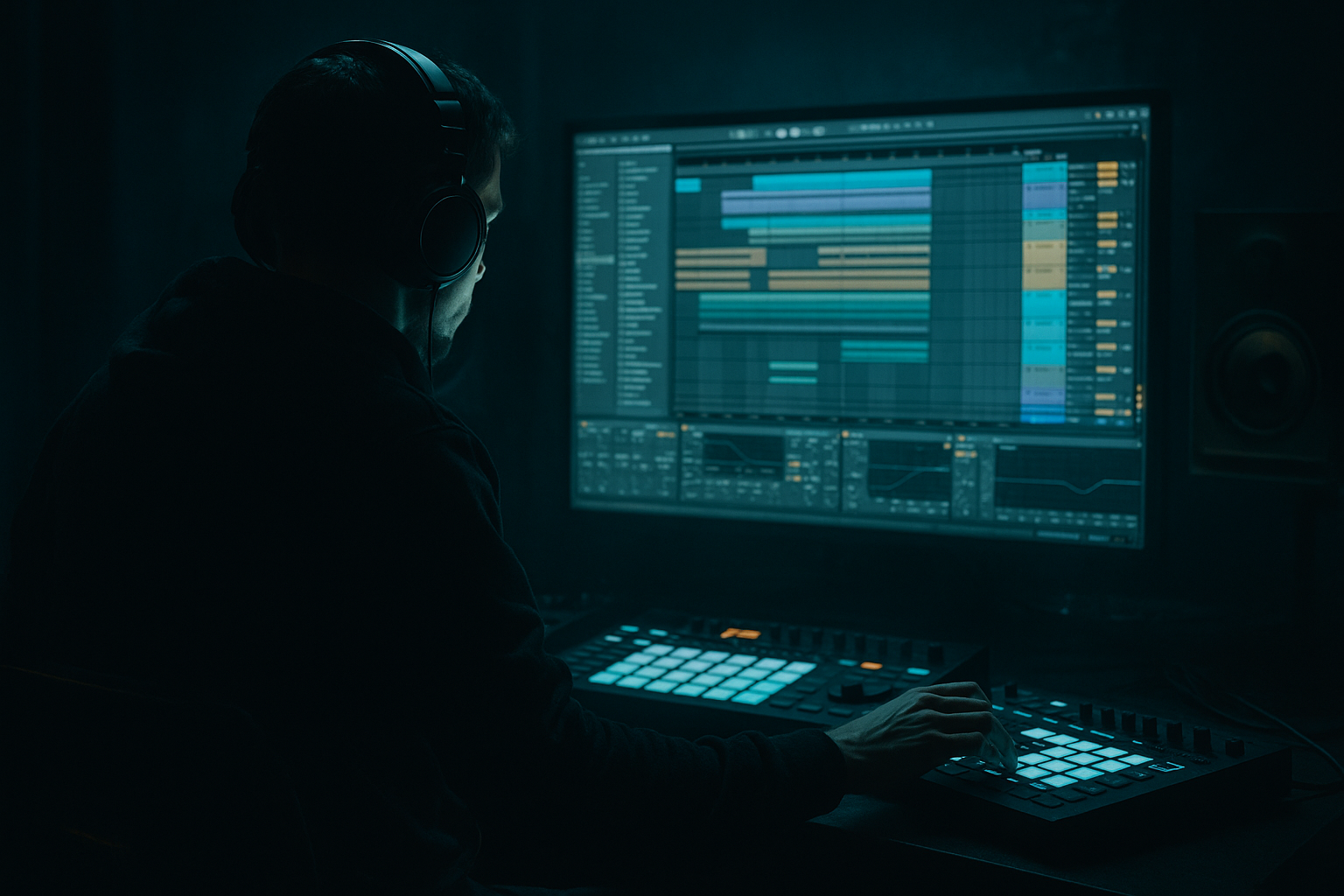
In this lesson, we’re building a Future Jungle intro resample: a textured, moody atmospheric intro made from resampling, degradation, filtering, and layered FX inside Ableton Live 12. This is the kind of intro that feels like it came from a forgotten dubplate, but with modern clarity and weight.
This approach is ideal for drum and bass, especially:
- future jungle
- dark rollin’ DnB
- halftime jungle hybrids
- old-school jungle intros with modern sound design
- Sampler / Simpler
- Wavetable
- Operator
- Auto Filter
- Hybrid Reverb
- Echo
- Redux
- Drum Buss
- Saturator
- Granulator III (if you have Max for Live)
- Resample recording workflow
- Audio effects racks for control and performance
- a dense intro ambience stem
- a lo-fi resampled layer
- a deep jungle pad/textural bed
- a filtered movement pass
- a dubby delay tail
- a pre-drop tension swell
- an arrangement-ready intro that can lead cleanly into a break or bass drop
- foggy jungle canopy
- ruined tape loop
- haunted sub harmonics
- distant radio fragments
- aquatic echo chambers
- crushed vinyl hiss
- ghost break textures
- 170–174 BPM for classic/future jungle energy
- If you’re leaning more cinematic and half-time, try 165–172 BPM
- Create an Audio track labeled `RESAMPLE PRINT`
- Create a MIDI track labeled `SOURCE ATMOS`
- Create a return track for reverb or delay if you want a shared space
- Set the audio track input to Resampling
- Osc 1: Saw or Jungle-ish wavetable
- Osc 2: Sine, slightly detuned
- Unison: 2–4 voices
- Filter: Low-pass 24 dB
- Env amount: moderate
- Glide: slight, if you want movement
- Osc 1 level: 0 dB
- Osc 2 level: -8 to -12 dB
- Filter cutoff: around 400–1.5 kHz
- Resonance: 10–20%
- Amp envelope: slow attack, medium release
- Add subtle Pitch Drift if available
- minor 7
- minor 9
- sus2 tension shapes
- pedal note under shifting upper tones
- D minor 9
- C minor 7
- F major 7 over D
- A minor add9
- Mode: LP24
- Cutoff: automate between 300 Hz and 6 kHz
- Resonance: 15–30%
- LFO: very subtle if used
- Drive: 2–6 dB
- Soft Clip: On
- Color: slightly warmer if needed
- Amount: low/moderate
- Rate: slow
- Dry/Wet: 10–25%
- Time: 1/8D or 3/16
- Feedback: 25–45%
- Filter: roll off some highs
- Noise: a little if you want more tape feel
- Modulation: moderate
- Algorithm mode or convolution blend
- Decay: 4–8 seconds
- Pre-delay: 10–30 ms
- High cut: around 6–10 kHz
- Low cut: around 150–300 Hz
- small note variations
- delay tails
- filter motion
- reverb bloom
- accidental texture
- automation on cutoff
- occasional chord inversions
- note length changes
- extra silent gaps
- rich reverb tails
- nice chord bloom
- tape-like noise swells
- transients or little tonal peaks
- interesting delay repeats
- one long bed
- one tension swell
- one high texture
- one low murky tail
- one “hit” or punctuation moment
- Warp markers
- Slice to New MIDI Track
- manual splitting with `Cmd/Ctrl + E`
- High-pass: 30–60 Hz if needed
- Gentle dip around 250–400 Hz if muddy
- Soft shelf cut above 10–12 kHz if too bright
- Bit reduction: subtle, around 10–14 bits equivalent feel
- Downsample: light to moderate
- Use sparingly, or automate it for transitions
- Drive: 5–20%
- Crunch: very low or moderate
- Boom: use carefully; tune to song key if it helps
- Damp: control highs
- This helps glue and thicken the resample
- Use as a performance tool
- Sweep from low-pass to open mid-high range over 4–8 bars
- Put a small resonance bump on the cutoff movement
- Time: 1/4 or 3/16
- Feedback: 20–35%
- Filter delay repeats so they sit behind the dry texture
- Add some modulation if the part feels too static
- Shorter decay than before if needed
- Keep it wide and eerie
- Use early reflections for depth
- vinyl crackle
- rain field recording
- tape hiss
- short break fragment
- distant amen ambience
- jungle FX hit
- reversed cymbal
- sub rumble drone
- spoken word slice or dub plate vocal
- Operator with noise oscillator
- Simpler loaded with noise sample
- Erosion for fizzy grit
- Auto Filter to narrow bandwidth
- Use an amen or think break chop
- Filter heavily
- Add Beat Repeat in controlled bursts
- Print the result into the resample lane
- Drop a chopped break under the atmosphere
- Low-pass heavily around 2–6 kHz
- Reduce transient sharpness with Drum Buss
- Add tiny reverb and room tone
- Amount: 20–50%
- Rate: 1/8, 1/4, or synced dotted rate
- Phase: 0° if you want volume tremolo
- This creates subtle movement like a broken dub pulse
- Gate
- sidechain from a ghost kick
- or a rhythmic MIDI clip triggering a grainy sampler
- reduces clinical clarity
- glues layers together
- creates accidental artifacts
- sounds more like a single finished record
- one version dry-ish
- one version over-echoed
- one version reversed
- one version filtered thin
- one version low and murky
- very filtered atmosphere
- vinyl/tape noise
- distant pad
- no sub yet
- introduce broken break ghost
- open the filter slightly
- add echo tails and tonal fragments
- let the main resampled atmosphere bloom
- stronger chord movement
- maybe a vocal stab or dub echo
- tension rises
- automate reverb dry/wet or filter cutoff
- tease a drum fill or riser
- cut low end right before drop
- keep the intro evolving every 2 bars
- avoid a static loop
- use automation on:
- add one or two “events” that feel like markers, e.g. a rewind, hit, or reverse swell
- leave room below 120 Hz for sub
- don’t overfill the 200–500 Hz area
- keep top end controlled so the drums can cut later
- avoid too much stereo width in the low mids
- turn on Bass Mono or narrow the low end if needed
- use width automation for opening up the intro
- high-pass unnecessary sub
- notch muddy resonances
- keep the atmosphere clear enough to transition into the drop
- 12 semitones = darker and weightier
- 7 semitones = tense, haunted feel
- automate tiny pitch moves for instability
- clip transpose
- Simpler
- Sampler
- warping with creative pitch shifts
- Operator sine wave
- low-pass it hard
- keep it very subtle
- sidechain it if needed
- bed = long filtered pad
- motion = delay/reverb fragments
- dust = noise, vinyl, break grit
- Version A: cleanest
- Version B: darkest and most degraded
- Version C: most rhythmic and broken
- Start with a musically rich source
- Process before resampling
- Use resampling as a compositional tool
- Add degradation, movement, and rhythmic dust
- Re-sample again for extra glue and character
- Arrange the intro so it evolves toward the drop
- a device-by-device Ableton rack recipe
- a follow-along 8-bar MIDI clip template
- or a future jungle intro + drop arrangement blueprint
The goal is to create an intro that sounds like a broken memory: dusty pads, distant breaks, tape noise, dub echoes, and tonal movement that sets up the drop. We’re not just making ambience — we’re building a cinematic resampled atmosphere that already feels like part of the tune.
We’ll use Ableton stock devices like:
---
2. What you will build
By the end, you’ll have:
Sound character target
Think:
This is not clean ambient music. It should feel gritty, worn, and rhythmic, even when it’s mostly atmosphere.
---
3. Step-by-step walkthrough
Step 1: Set the project up for jungle-friendly resampling
Before sound design, get your session ready.
#### Recommended tempo
#### Project setup
This gives you a direct recording lane for printing your processed sound. In jungle production, this is essential — you want to commit to texture and move fast.
---
Step 2: Build the source material
A strong intro resample needs a source with harmonic motion.
You have a few excellent options:
#### Option A: Synth pad source
Use Wavetable or Operator.
Wavetable patch idea:
Suggested settings:
Play simple dark voicings:
For example:
Keep it sparse. Jungle intros breathe.
---
Step 3: Add tonal grit before resampling
Don’t resample a clean pad straight away — shape it first.
Insert the following chain on the source MIDI track:
#### Suggested device chain
1. Auto Filter
2. Saturator
3. Chorus-Ensemble or Phaser-Flanger
4. Echo
5. Hybrid Reverb
#### Example settings
Auto Filter
Saturator
Chorus-Ensemble
Echo
Hybrid Reverb
This creates a source with enough movement that the resample will feel alive.
---
Step 4: Print the first pass
Now route the source track into your RESAMPLE PRINT audio track and record 8–16 bars.
#### Why record a long pass?
Because jungle atmosphere sounds best when it includes:
Don’t aim for perfection. Aim for interesting artifacts.
Let the source play with:
The silence between events is part of the intro.
---
Step 5: Chop the resample into usable fragments
Once recorded, go into Arrangement or Session and work the audio.
#### What to look for
Find moments with:
Slice the resample into 4–8 useful fragments:
You can use:
For a future jungle intro, the best results often come from layering a long texture with a short broken fragment.
---
Step 6: Degrade the resample for vintage jungle character
Now process the audio resample itself. This is where the intro becomes jungle.
#### Suggested audio chain on the resampled audio
1. EQ Eight
2. Redux
3. Drum Buss
4. Auto Filter
5. Echo
6. Hybrid Reverb
#### Example settings
EQ Eight
Redux
Drum Buss
Auto Filter
Echo
Hybrid Reverb
This chain gives you a smoked-out, worn atmosphere without losing musical intent.
---
Step 7: Layer in jungle-specific noise and texture
Future jungle intro resamples need more than chords. They need a believable environment.
Add one or two of these layers:
#### Layer ideas
You can generate these using stock tools:
For noise layers:
For break fragments:
#### Processing suggestion for noise
Noise track chain:
1. EQ Eight – band-limit it
2. Auto Pan – slow movement for stereo life
3. Utility – narrow or widen as needed
4. Reverb – short, dark
Keep noise tucked under the musical bed. It should suggest atmosphere, not dominate it.
---
Step 8: Create a broken rhythmic pulse
A jungle intro often feels alive because it has ghost rhythm.
You can make this in a few ways:
#### Method A: Ghost break under the pad
#### Method B: Tremolo-style pulse
Use Auto Pan:
#### Method C: Gate the atmosphere rhythmically
Use:
This can make the intro breathe with the groove that will later hit in the drop.
---
Step 9: Resample again for depth
This is the key advanced move.
Once you’ve got your processed atmosphere, resample the resample.
Why?
Because second-generation resampling:
#### Workflow
1. Route the processed atmosphere to `RESAMPLE PRINT`
2. Record 4–8 bars
3. Export or keep the new audio in a fresh track
4. Re-chop, reverse, and layer
Try this:
Then stack them quietly. That’s how you get a deep jungle fog wall 🌫️
---
Step 10: Build the intro arrangement
Now arrange the intro like a proper DnB opening.
#### Example 16-bar intro structure
Bars 1–4
Bars 5–8
Bars 9–12
Bars 13–16
#### Arrangement tips
- filter cutoff
- reverb size
- delay feedback
- pitch offset
- stereo width
In jungle and future jungle, the intro should feel like it’s telling you where the drop came from.
---
Step 11: Make it sit with the bass and drums
Even though this is an intro, you should design it with the later drop in mind.
#### Key checks
Use Utility:
Use EQ Eight:
---
4. Common mistakes
1. Resampling something too clean
If the source is pristine, the intro can sound like generic ambient pads instead of jungle atmosphere.
Fix: add saturation, delay, filtering, and noise before printing.
2. Overusing reverb
Huge reverb without control turns everything into mush.
Fix: high-pass the reverb return and keep the low end clean.
3. Too much high-end fizz
Redux, noise, and vinyl layers can become harsh fast.
Fix: use EQ Eight and automate the brightness instead of leaving it fully open.
4. No rhythmic movement
Atmosphere alone can feel static.
Fix: add ghost breaks, Auto Pan, rhythmic gating, or chopped repeats.
5. Forgetting arrangement progression
A jungle intro must evolve.
Fix: change something every 2–4 bars, even if subtly.
6. Clashing with the eventual drop
If the intro occupies the same sonic space as the bass, the transition will feel weak.
Fix: carve space now for the sub, snare, and bass roll.
---
5. Pro tips for darker/heavier DnB
Tip 1: Print the FX return, not just the dry source
Route your reverb or delay return to resample too. Those tails often sound better when printed and reprocessed. This is classic jungle behavior — commit early, then destroy tastefully.
Tip 2: Use pitch as atmosphere
Pitching the resampled audio down:
You can do this with:
Tip 3: Add a sub drone under the atmosphere
A quiet sine or triangle note under the intro can make it feel huge.
Use:
Tip 4: Make the intro “speak” in layers
Try three layers:
That layering makes the intro feel like a full environment instead of a single pad.
Tip 5: Abuse resampling timing
Resample slightly before or after the bar line. Tiny timing imperfections make the intro feel more human and more dubplate-like.
Tip 6: Use Drum Buss on atmospheres
A little Drum Buss can make pads and FX feel more record-like and glued, especially if you’re going for darker, heavier DnB.
Tip 7: Mute the obvious
If your atmospheric loop is too pretty, remove the obvious top layer and keep the murk. Jungle tension often comes from what you don’t fully reveal.
---
6. Mini practice exercise
Exercise: Create a 12-bar future jungle intro resample
#### Goal
Build a 12-bar intro that evolves from murky texture into pre-drop tension.
#### Steps
1. Make a 2-bar minor chord progression in Wavetable or Operator
2. Add:
- Auto Filter
- Saturator
- Echo
- Hybrid Reverb
3. Record 8 bars to a resample track
4. Slice the best 2–3 moments
5. Process the audio with:
- EQ Eight
- Redux
- Drum Buss
- Auto Filter
6. Add a break ghost layer underneath
7. Print the whole thing again
8. Arrange the final intro across 12 bars with automation changes every 2 bars
#### Bonus challenge
Make three versions:
Then choose the best parts from all three and combine them into one final intro.
---
7. Recap
You’ve now built a Future Jungle intro resample workflow in Ableton Live 12 that can generate deep, moody, and release-ready atmosphere.
Key takeaways
The big idea
In jungle and DnB, atmosphere is not just background. It’s part of the groove, part of the identity, and part of the tension. A strong intro resample should already feel like it belongs to the record before the drums even arrive. 🔥
If you want, I can also turn this into:

