Main tutorial
Lesson Overview
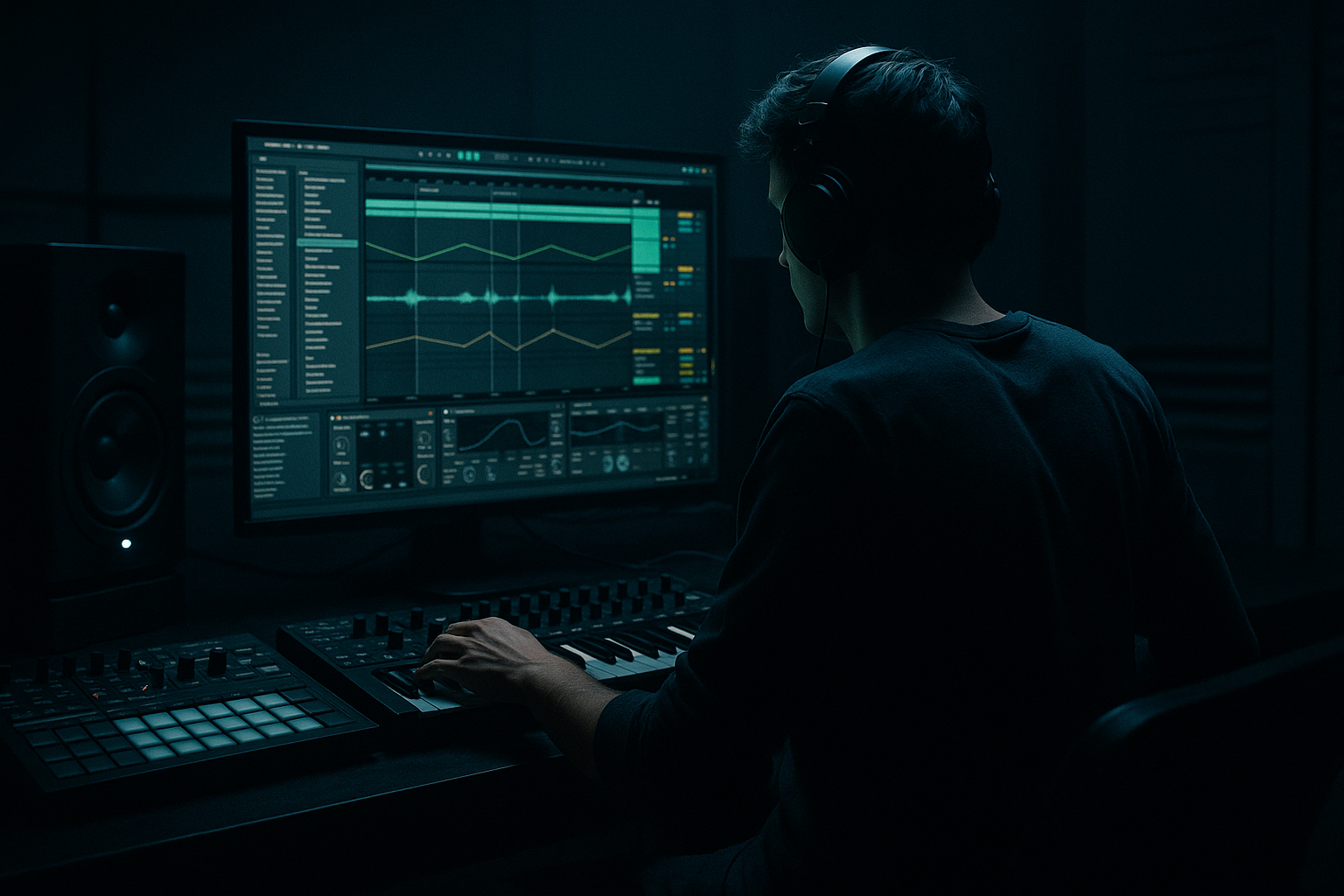
This lesson is about building a Funky Drummer-style DJ intro glue layer for a Drum & Bass tune in Ableton Live 12 — the kind of intro that makes an oldskool rave pressure drop feel earned before the main bassline lands. We’re not just chopping a break for nostalgia. We’re designing a functional intro ecosystem: break fragments, tape-worn percussion, filtered energy, and resampled movement that can carry a DJ mix, hold tension, and seamlessly hand over into a full DnB drop.
In real DnB arrangement terms, this is the “you can mix into this, but it still sounds like a record” zone. It sits between clean intro utility and characterful jungle memory. The Funky Drummer break is useful here because its ghost notes, snare lift, and human swing can create momentum without needing a full drum loop blasting from bar one. That matters in DnB because the genre often depends on controlled escalation: DJs need mixable intros, but ravers need emotional and rhythmic payoff. A strong intro glue section gives you both.
We’re using resampling as the core technique. That means you’ll deliberately print, mangle, and re-capture your own break processing inside Ableton — not just stack effects live and hope it works. Resampling is ideal here because it lets you commit to movement, create new one-shots from processed loops, and design intros that feel more like a finished record than a looped project.
Why this matters in DnB: the best intros often hint at the drop’s sonic language early. A Funky Drummer intro can preview the groove of a roller, the grit of a jungle edit, or the pressure of a darker neuro section without giving away the full bassline too soon.
What You Will Build
By the end of this lesson, you’ll have a DJ-friendly intro section built from a Funky Drummer-derived break that:
- opens with filtered, tape-worn drum glue
- evolves through resampled fills, snare ghosts, and rhythmic atmospheres
- creates an oldskool rave pressure feel without sounding thin or dated
- transitions cleanly into a heavier DnB drop
- can be arranged as a 16-, 32-, or 64-bar intro
- includes optional call-and-response cue points for bass or Reese hints
- stays mixable for DJ transitions while still sounding like a proper record
- Over-processing the original break
- Too much low end in the intro
- Busy drums that sound like a full loop from bar one
- Automation that opens too fast
- No separation between intro and drop
- Resampling without a plan
- Use Drum Buss on the intro drum group with light Drive and minimal Boom to thicken break ghosts without wrecking the sub zone.
- Layer a very quiet room-tone or vinyl-style texture above 8 kHz to make the intro feel continuous and “air-locked.”
- For a darker edge, add a short, filtered delay throw on the last snare before the drop using Echo with low feedback and a dark filter.
- Resample a version with more saturation than you think you need, then blend it back underneath the cleaner print. This gives density without forcing the mix to stay dirty.
- Use Utility to mono the intro bass teaser entirely. Wide low-end kills club translation.
- If the break feels too polite, clip the resampled audio lightly with Saturator Soft Clip or very controlled Limiter gain reduction to enhance urgency.
- For neuro-leaning pressure, automate tiny filter or pitch changes on the break fragments rather than broad FX washes. Small motion reads as intent; big motion can feel generic.
- In rollers, leave the intro more hypnotic: fewer fills, more groove consistency, and subtle evolution over 32 bars.
Musically, think: a 174 BPM roller or jungle hybrid where the intro starts with a clipped break loop, filtered hats, and room tone, then gradually introduces a re-amped snare crack, a reversed downbeat, and a teaser of the bass note shape before the drop.
Step-by-Step Walkthrough
1. Choose and prep the Funky Drummer source for DnB tempo
Drop your Funky Drummer sample into an Audio Track and warp it carefully before doing anything creative. For this style, you want the break to feel rhythmic, not over-quantized into a sterile loop.
- Set the project tempo around 172–176 BPM.
- Use Complex Pro only if the source is harmonic or has room bleed you want to preserve; otherwise try Beats for drum clarity.
- In the Warp section, tighten the main transient grid, but leave some micro-slop in ghost notes.
- If the break is drifting, slice it into 1-bar or 2-bar segments rather than forcing the whole thing into one perfect loop.
Advanced move: duplicate the source clip and make one version for tight foundational loop duty and another for texture resampling later. Keep the original untouched.
2. Build a three-layer drum intro: core break, support hats, and glue percussion
Create a Drum Rack or separate audio tracks for:
- Core Funky Drummer loop
- High-frequency support: shakers, hats, light ride ticks
- Glue percussion: rim clicks, percussion hits, vinyl noise bursts, or chopped break crumbs
On the core break track, use EQ Eight:
- High-pass around 30–40 Hz to clear sub rumble
- Cut a little mud around 180–300 Hz if the break sounds boxy
- Add a small presence lift around 3–5 kHz if the snare needs edge
For support hats, keep them lighter than the break. The point is not to turn the intro into a full drum barrage. You’re creating motion around the break so the DJ intro feels alive at low density.
Why this works in DnB: the genre relies on sub bass dominance, so the intro needs rhythm without stealing low-end space from the eventual bass drop. A modular intro lets the kick/snare story breathe while keeping the spectrum open.
3. Create a resampling print track and commit your first processed pass
Add a new Audio Track named something like “FD Intro Print.” Set Audio From to the source break or a grouped drum bus. Arm the track and record your processed loop in real time.
Before printing, insert a simple processing chain on the break bus:
- Drum Buss: Drive around 5–15%, Boom low or off for now, Crunch subtle
- Saturator: Drive 2–6 dB, Soft Clip on
- Glue Compressor: slow-ish attack, medium release, just 1–2 dB gain reduction
- Optional Redux very lightly for grit, but don’t destroy transients
Print 8 bars of the loop while automating filter, saturation, and send levels. The goal is to capture a version with movement baked in. Once printed, you’ve got audio you can slice, reverse, stretch, and re-trigger without relying on live processing forever.
Advanced note: resampling is where this lesson becomes powerful. Instead of endlessly tweaking a loop, you’re creating new source material from your own arrangement moves.
4. Slice the resampled audio into DJ-friendly intro events
Take the printed audio and chop it into short events:
- 1-bar phrases
- 1/2-bar snare lead-ins
- 1/4-bar ghost fills
- isolated snare tails or hat flurries
Use Simpler in Slice mode if you want fast triggerability, or do manual clip slicing if you prefer arrangement control. For advanced DnB, manual slicing often wins because you can shape phrase logic more precisely.
Put the slices on a new track and sequence them so the intro evolves:
- Bars 1–8: mostly filtered loop + sparse ghosts
- Bars 9–16: add sliced snare pushes and open hats
- Bars 17–24: introduce short fill fragments and reverse tails
- Bars 25–32: strip back one layer and create tension for the drop
Keep the pattern readable for a DJ. An intro should feel like it is breathing toward the drop, not just randomly busy.
5. Use Auto Filter and Envelope shapers to design pressure
Put Auto Filter on the printed intro bus or on individual slice tracks. This is where the oldskool rave pressure begins to lock in.
Suggested settings:
- Start with a low-pass filter around 200–600 Hz
- Automate resonance modestly, around 10–25%
- Open the filter slowly over 16 or 32 bars
- In darker sections, dip the cutoff back down before the drop to create a final inhale
If the break feels too soft after filtering, use Envelope Follower or Shaper-style movement via automation to make the filter openings respond to the kick/snare peaks. You can also use Transient shaping through Drum Buss to make the snare assert itself when the filter opens.
Concrete move: automate the low-pass cutoff from 250 Hz to 8–10 kHz across 16 bars, then quickly pull it back down to about 700 Hz on the last 1–2 bars before the drop. That sudden removal of brightness makes the impact hit harder.
6. Print a second-pass texture layer for oldskool grime
Duplicate your resampled print and process it differently to create a hidden texture layer. This is where you make the intro feel like it came from a more lived-in rave archive.
On the duplicate track:
- Add Erosion subtly for hiss or metallic grain
- Use Redux very lightly for bit-crushed edges
- Add Echo with very short feedback for a smeared room feel
- High-pass this layer aggressively, often 250–500 Hz, so it doesn’t clutter the midrange
Then resample this layer too. Now you have a second-generation audio file that’s more damaged, more specific, and more “record-like.”
Blend it under the main intro at low level. Think of it like a ghost of the break rather than a second drum part. In jungle and oldskool-influenced DnB, this kind of texture sells authenticity fast.
7. Shape the bass tease without giving the drop away
For a DJ intro, a tiny hint of bass can increase anticipation massively. Build a restrained Reese or sub teaser that only appears in select bars.
Use Operator or Wavetable to create a low, simple note or held tone. Keep it mono, narrow, and controlled.
- Sub layer: sine or near-sine, low-passed, centered
- Mid layer: detuned oscillator or saw pair, filtered heavily
- Saturation: gentle, just enough for audibility on small systems
Route this into the intro only in short call-and-response moments:
- a 1-bar fill before the drop
- the last 2 beats of an 8-bar section
- a single off-beat note under a snare pickup
Keep it sparse. The point is to suggest the drop’s bass character, not announce the full phrase. For a darker roller, a short descending Reese stab in the last 2 bars can make the intro feel like it’s locking into the main groove.
8. Arrange the intro like a DJ tool, but make it feel like a record
A strong DnB intro needs utility and drama. Here’s a solid arrangement template:
- Bars 1–8: filtered break loop, almost no bass, minimal top percussion
- Bars 9–16: add printed fills, more hat motion, subtle room ambience
- Bars 17–24: introduce the bass tease and reverse snare or crash tail
- Bars 25–32: reduce one layer, increase tension, then hard handoff to drop
If your track is more oldskool jungle pressure, keep the intro more chopped and restless. If it’s a roller, make the glue smoother and more continuous. If it’s neuro/darker bass music, leave more negative space and let the automation do the work.
Practical arrangement trick: use markers for “DJ Mix In,” “Break Peel,” “Bass Hint,” and “Drop Cue.” This speeds up decision-making and keeps your intro functional when revisiting the arrangement later.
9. Bus the intro and control the mix like a finished record
Route all intro drums, textures, and bass teaser elements into an Intro Bus group. On that bus, use:
- EQ Eight to clear any low-mid buildup
- Glue Compressor with gentle reduction for cohesion
- Utility to check mono compatibility and reduce width where needed
- Optional Limiter only for safety, not loudness chasing
Keep your intro headroom sensible. If your intro is fighting the drop, it’s probably too loud in the midrange or too wide in the wrong places. The best DnB intros feel powerful because they are organized, not because every element is huge.
Use automation to gradually open the stereo image:
- start narrow
- widen hats and texture slightly
- keep low-end and main snare anchor centered
- collapse the final pre-drop moment for impact
10. Final resample the full intro pass and audition it like a DJ transition
Once the intro is arranged, resample the entire intro section to a fresh audio track. Listen back as if you’re mixing into it from another tune.
Ask:
- Does the first 16 bars give a DJ enough room?
- Does the groove feel stable at 174 BPM?
- Does the drop still feel bigger after hearing the intro?
- Is there enough tension without overcrowding the top end?
This final print is valuable because it reveals whether your automation and resampling choices actually work as a record. If the resampled intro feels strong on its own, it usually performs well in a set too.
Common Mistakes
Fix: print a clean version first, then mangle the resampled copies. Keep one source with preserved transients.
Fix: high-pass non-bass layers and keep any bass teaser narrow, short, and mono.
Fix: reduce density. Let ghost notes and filters do the work.
Fix: slow the main filter rise and reserve a sharper opening for the final pre-drop bars.
Fix: remove one key layer right before the drop so the impact has contrast.
Fix: commit to specific passes: one clean, one gritty, one transitional. Don’t just record random processing.
Pro Tips for Darker / Heavier DnB
Mini Practice Exercise
Spend 10–20 minutes building a functional intro blueprint:
1. Load a Funky Drummer-style break and warp it to 174 BPM.
2. Create a clean 8-bar loop with just enough groove to be mixable.
3. Add Drum Buss and Saturator, then resample one processed pass.
4. Slice the resampled audio into 1-bar and 1/2-bar pieces.
5. Arrange a 16-bar intro with a slow filter opening.
6. Add one bass teaser note or Reese stab in bars 13–16.
7. Print the whole intro and listen back with the drop muted.
Goal: make the intro feel like a DJ can mix into it, while a listener still feels tension and identity.
Recap
The core idea is simple: use Funky Drummer as the rhythmic DNA, then resample your processing into a believable DnB intro. Keep the break human, the movement controlled, and the low end disciplined. Build tension with filters, prints, and tiny bass hints, not with overcrowding. If the intro works as a DJ mix tool and still sounds exciting on its own, you’ve nailed the balance between oldskool rave pressure and modern DnB arrangement logic.

