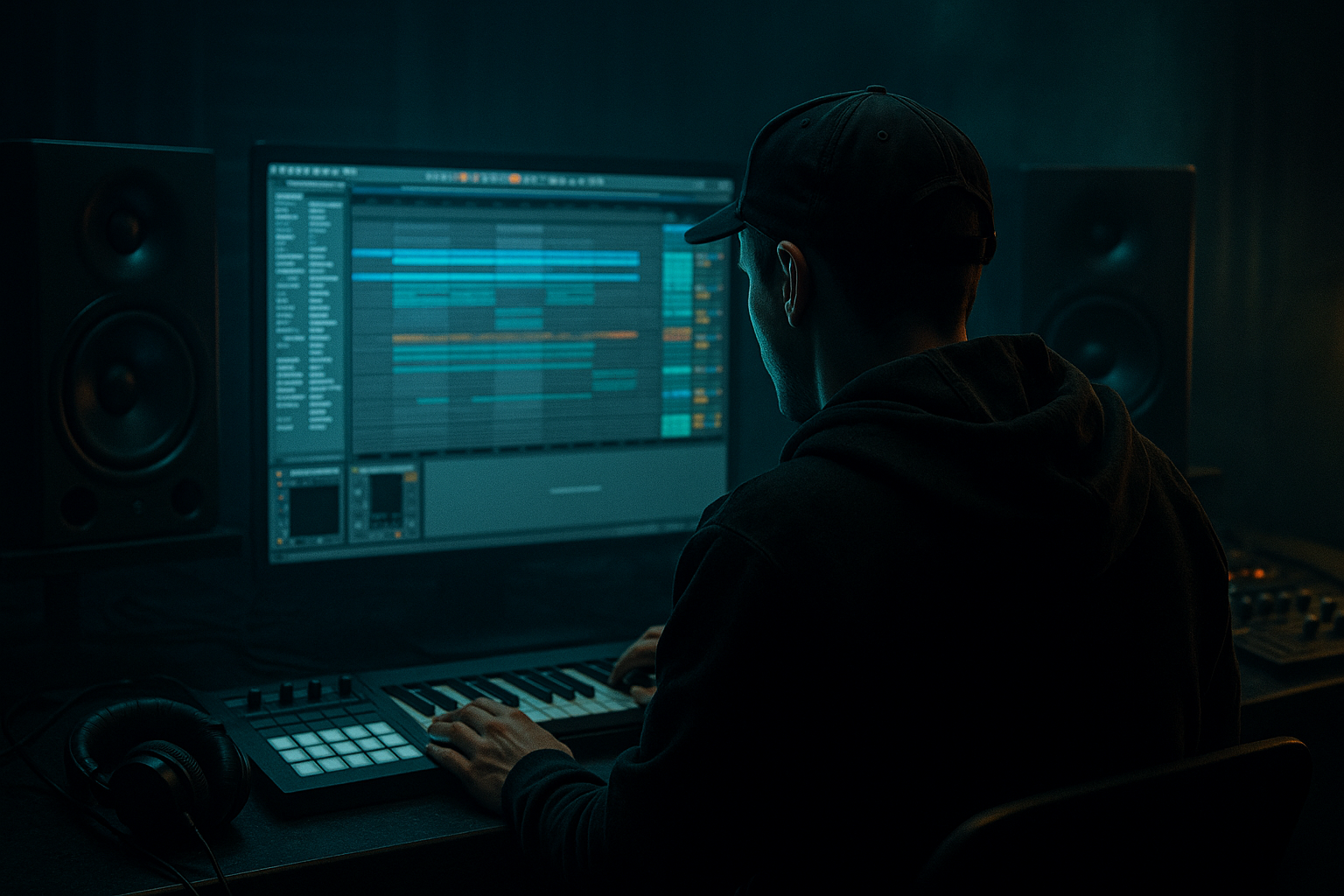
Main tutorial
Framework for Sub for Timeless Roller Momentum in Ableton Live 12
Jungle / oldskool DnB edits tutorial for intermediate producers 🥁🔊
1. Lesson overview
A great roller sub in drum and bass is not just a low note pattern — it is the engine that keeps the track moving without stealing attention from the breaks, FX, and top-line movement. For jungle and oldskool DnB vibes, the sub needs to feel:
- Solid and centered
- Rhythmic but not overcomplicated
- Warm, controlled, and slightly animated
- Able to support edits, drops, and arrangement changes
- Locks with the drums
- Leaves room for the break edits
- Moves enough to stay interesting
- Works in a classic 90s/early-2000s jungle-DnB context
- A clean sine-based sub
- A MIDI pattern built around kick/snare interaction
- Small note pushes and syncopations
- A sub layer that can be edited for arrangement
- Optional light saturation and dynamic control
- A workflow that lets you clone, mutate, and arrange the sub through the track
- rolling jungle pressure
- warm subs under chopped breaks
- oldskool movement without over-modern sound design
- bass that feels like it could live under a breakbeat all day
- Set tempo between 162–172 BPM
- For this tutorial, use 170 BPM
- Work in 4/4
- Build around a 2-bar loop
- Load Operator
- Set Oscillator A to Sine
- Turn off other oscillators
- Set Filter off or bypassed
- Set Voices to 1 for monophonic sub
- Add a tiny bit of Glide/Portamento if needed, but keep it subtle
- Choose a Basic Sine or near-sine waveform
- Turn on Mono
- Add a small amount of Glide
- Keep unison off for the sub
- Base the sub around the root note
- Let the kick and snare influence note timing
- Avoid constant 1/16 note runs unless you want more modern aggression
- Use space as part of the groove
- Bar 1 beat 1: Root note
- Bar 1 beat 1.3 / 1.4: Optional short pickup note or octave dip
- Bar 1 beat 3: Root or fifth
- Bar 2 beat 1: Root
- Bar 2 beat 2.4 or 3.1: Small movement note
- Bar 2 beat 4: Root or passing tone into loop restart
- C1
- C1
- G0 or Bb0 as a passing support
- C1
- Eb1 or G0 for motion
- C1
- Kick hits
- Snare backbeats
- Ghost notes
- Chopped amen hits or edited break slices
- Let the sub answer the kick
- Avoid fighting the snare transient
- Add small sub pickups before important break hits
- Leave gaps when the break needs space to breathe
- Try MPC 16 Swing or a light groove from your own break
- Apply groove at 20–40%
- Don’t overdo it on the sub — just enough to breathe with the drums
- Shorter notes create more bounce and definition
- Longer notes create weight and continuity
- Root notes: medium length
- Passing notes: short
- Tension notes before a fill/drop: slightly longer
- Root hits: 1/8 to 1/4 note
- Passing notes: 1/16 to 1/8 note
- Sustains: only when you want a held-down tension moment
- Drum Buss
- Roar in gentle mode
- Redux very carefully
- Drive: 1.5 dB
- Curve: default or soft
- Soft Clip: On
- Dry/Wet: 60–100% depending on how audible you want the harmonics
- Keep the original pure sub
- Create a second layer with mids/harmonics only
- Add EQ Eight
- Add Saturator or Roar
- Optionally add Chorus-Ensemble very lightly for width in the upper harmonics
- Keep this layer quieter than the sub
- Intro: filtered or reduced sub
- First drop: full sub pattern
- Second 8 bars: add a pickup or extra note variation
- Breakdown: strip back the sub
- Re-drop: add a slightly more aggressive version
- Remove the last note of the 2-bar phrase to create anticipation
- Add a quick octave drop into the snare
- Insert a 1-beat mute before a fill
- Swap one root note for the fifth or minor seventh for tension
- Saturator Drive up slightly for the drop
- Utility gain down for breakdowns
- Filter movement on a parallel bass layer, not the pure sub
- Create a 2-bar clip
- Use duplicate, reverse, and transpose on short note fragments
- Try random small note variations only on non-root support notes
- Use the Scale features if you want fast note containment
- Sub masking the kick
- Low-mid buildup around 120–250 Hz
- Overlong sub notes smearing the groove
- Harmonics becoming too audible and losing sub authority
- Use EQ Eight to clean mud
- Shorten note lengths
- Reduce saturation drive
- Sidechain the sub lightly to the kick if necessary
- Sidechain input: kick
- Ratio: 2:1 to 4:1
- Attack: 1–10 ms
- Release: 50–120 ms
- Only aim for subtle ducking
- minor 2nd
- minor 5th
- octave jumps
- brief chromatic approaches into the root
- open the filter on the mid layer during the drop
- mute the mid layer in breakdowns
- keep the sub stable and reliable
- root
- fifth
- one passing note
- Bar 1: simple root movement
- Bar 2: add a pickup note into beat 1 or beat 3
- Bar 3: remove one note for space
- Bar 4: add a short tension note before the loop restarts
- Operator
- EQ Eight
- Saturator
- Utility
- headphones
- monitors
- a small speaker or phone reference
- Start with a clean mono sine sub
- Keep the MIDI pattern simple and groove-aware
- Let the break edits influence the rhythm
- Use note length and placement to create momentum
- Add light saturation for translation
- Arrange in small mutations across 8-bar sections
- Keep the low end tight, controlled, and musical 🎛️
In this lesson, you will build a timeless roller momentum framework in Ableton Live 12 using stock devices and practical MIDI/edit strategies.
The goal is to create a sub foundation that:
---
2. What you will build
You’ll make a 2-bar sub loop designed for a roller-style DnB section.
The framework will include:
Target vibe:
Think:
---
3. Step-by-step walkthrough
Step 1: Set up your drum and bass session
Project basics
Create these tracks:
1. Drums
2. Sub Bass
3. Reese / Mid Bass (optional for later layering)
4. FX / edits
For the sub lesson, focus on the Sub Bass track first.
---
Step 2: Build a clean sub instrument
The safest starting point is a pure oscillator. In Ableton Live 12, use:
Option A: Operator
Best for a precise, classic sub.
#### Operator setup:
#### Why this works:
A sine gives you the cleanest foundation for a roller sub. You can add harmonics later with saturation or a parallel layer.
Option B: Wavetable
Also works if you want easy shaping.
#### Wavetable setup:
Add stock utility devices
After the instrument, insert:
1. EQ Eight
- HPF at 20–25 Hz if needed
- Avoid boosting too much low end
2. Saturator
- Drive: 1–3 dB to start
- Soft Clip: On
3. Utility
- Bass mono management
- Width: 0% on the sub
---
Step 3: Program the core sub rhythm
The “timeless roller” feel comes from simple note choices with intentional placement.
Use these rules:
A good starting pattern
In a 2-bar loop, place notes like this:
Example in C minor:
Keep it musical but restrained. The sub should feel like it is driving, not performing.
---
Step 4: Align the sub with the break edits
This is where the roller momentum really starts.
Listen to where the break accents land:
Practical approach:
Example workflow:
1. Loop the break and sub together
2. Move sub notes slightly earlier or later if needed
3. Try nudging notes by 10–20 ms manually or using groove
4. Keep the groove human, not grid-locked
Ableton tip:
Use Groove Pool with a subtle swing if your break has swing energy:
---
Step 5: Shape note length for momentum
Sub note length matters a lot in DnB.
General rule:
For rollers, try a balance:
Suggested note lengths:
Important:
If the sub is too long, it will blur with kick drums and breaks.
If it is too short, the track can lose the “roll.”
---
Step 6: Add subtle harmonic movement
A timeless roller sub is usually still mostly clean, but a tiny bit of harmonic richness helps it translate on smaller speakers.
Add one of these stock devices after Saturator:
- Drive very lightly
- Boom usually off for pure sub control
- Use only if you want a bit more density
- Great for controlled harmonic excitement
- Keep it subtle for sub duties
- Not usually first choice for oldskool sub
- Can work in parallel for grit
Safer choice:
Use Saturator first. It is the classic move.
#### Suggested Saturator settings:
If you hear the sub getting fuzzy or losing focus, back off immediately.
---
Step 7: Build a parallel mid layer for translation
This is optional, but very useful if you want the sub to remain audible on smaller systems.
Duplicate the sub track:
On the parallel layer:
- High-pass around 100–150 Hz
Purpose:
The pure sub handles the foundation.
The parallel layer helps the bass feel present without turning the low end into mud.
---
Step 8: Use automation and arrangement edits
This tutorial is about edits, so arrangement matters.
In the arrangement view, create bass variation across sections:
Easy edit ideas:
Automation suggestions:
---
Step 9: Use MIDI editing tools in Live 12
Ableton Live 12 is excellent for quick bass edits.
Useful workflow:
Strong method:
1. Build a 2-bar root framework
2. Duplicate it to bars 3–4
3. Change only 1–2 notes
4. Add a pickup into the next phrase
5. Repeat with small mutations every 8 bars
That is how you get an evolving roller instead of a looping drone.
---
Step 10: Check the mix against the kick and break
Listen for:
Quick fixes:
Sidechain suggestion:
Use Compressor on the sub:
For oldskool jungle rollers, heavy pumping usually feels too modern. Keep it discreet.
---
4. Common mistakes
1. Making the sub too busy
If your subline sounds like a lead, it is not a roller foundation anymore. Keep the pattern simple and purposeful.
2. Using too much distortion
Too much saturation turns a clean sub into a fuzzy low-end mess. Add harmonics carefully.
3. Forgetting mono control
Sub bass should be mono. Always check with Utility.
4. Long notes that clash with the break
If the sub overlaps too much with kick and snare edits, the groove loses definition.
5. No arrangement variation
A great 2-bar loop can become boring fast if you do not mutate it across the track.
6. Not checking on small speakers
If the bass disappears entirely, add controlled harmonics in a parallel layer.
---
5. Pro tips for darker/heavier DnB
Tip 1: Use tension notes sparingly
For darker material, use:
This adds menace without losing roller continuity.
Tip 2: Pair the sub with break edits, not against them
A heavy jungle tune often feels powerful because the sub and break are interlocking. Let the bass leave holes where the break is doing something important.
Tip 3: Add a ghost-note pickup before the downbeat
A very short note just before beat 1 or 3 can make the loop feel like it is pulling forward.
Tip 4: Try call-and-response between sub and mid-bass
Let the sub hold down the root while a reese or mid layer answers on the offbeat. That creates depth without overcrowding the low end.
Tip 5: Use automation on the parallel layer, not the pure sub
For darker impact:
Tip 6: Reference classic energy, not modern loudness
Oldskool jungle rollers often feel powerful because of groove and space, not because everything is huge all the time.
---
6. Mini practice exercise
Exercise: Build a 4-bar roller sub framework
#### Step A
Set your tempo to 170 BPM.
#### Step B
Create a 4-bar break loop using a chopped amen or a classic break edit.
#### Step C
Write a sub pattern using only:
#### Step D
Make these variations:
#### Step E
Process the sub with:
#### Step F
Render the loop and listen on:
Goal:
Get the sub to feel like it is rolling under the break, not competing with it.
---
7. Recap
A timeless roller sub for jungle and oldskool DnB is built from a few core principles:
If you get the sub framework right, the whole track instantly feels more professional. The drums can breathe, the bass can roll, and the tune will carry that classic jungle pressure without sounding dated in a bad way.
If you want, I can turn this into a repeatable Ableton Live 12 template, or give you a MIDI note example for a specific key like D minor or F# minor.

