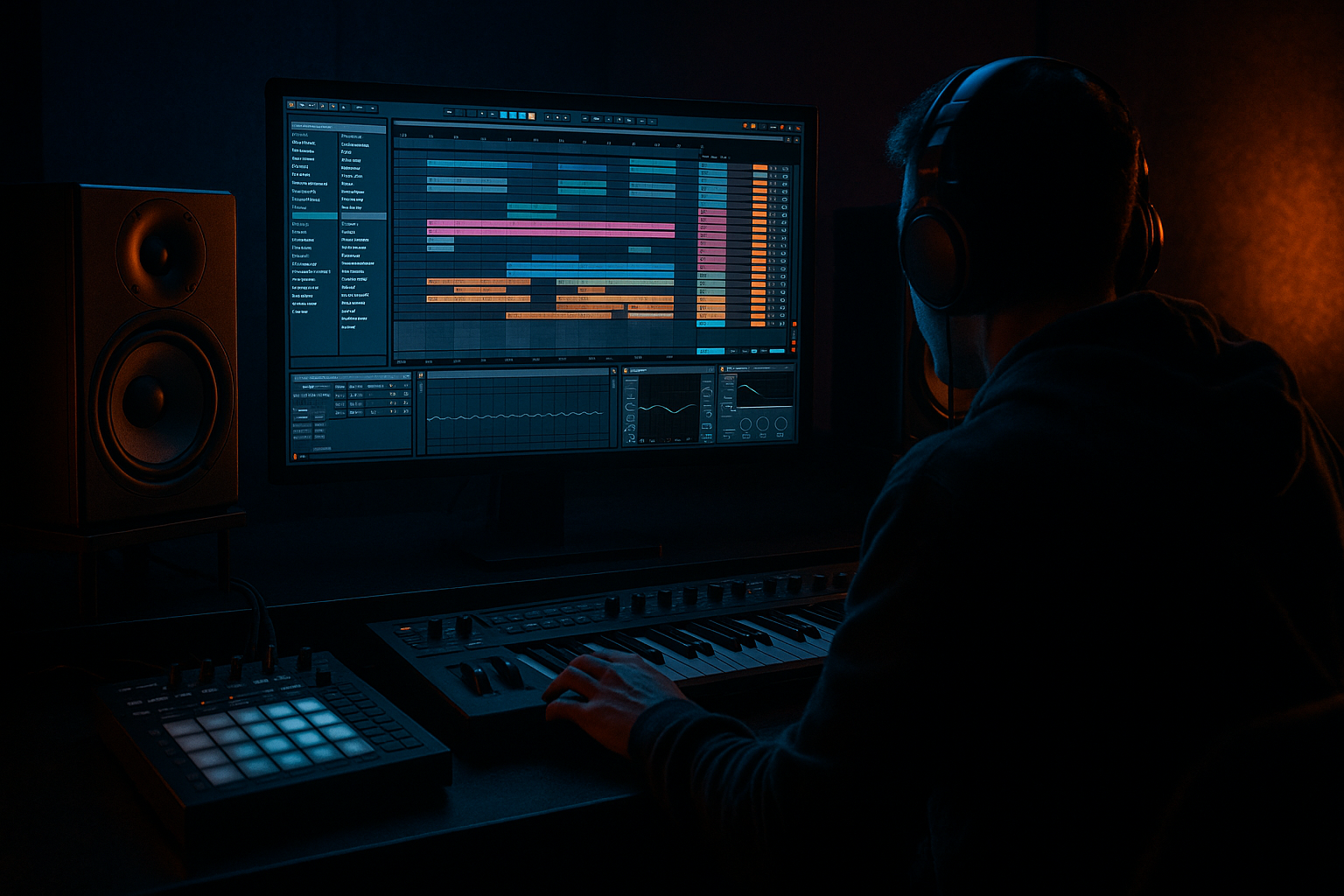
Main tutorial
```markdown
Fill Saturate Lab: Modern Punch + Vintage Soul (Ableton Live 12)
Category: Ragga Elements | Skill level: Advanced | Vibe: Jungle / Oldskool DnB 🔥🧨
---
1. Lesson overview
In jungle and ragga-leaning DnB, fills are more than “drum decoration”—they’re impact moments: turnarounds into the next phrase, dub-style hype cues, and texture bursts that keep a loop feeling alive.
This lesson is a fill saturation lab: you’ll build a dedicated Fill Bus that blends modern punch (transient-forward, clean low-end control) with vintage soul (tape-ish compression, grit, dubby space) while staying tight and mix-ready in Ableton Live 12.
We’ll focus on:
- Fill-only parallel saturation (so your main break stays intact)
- Resampling + micro-editing for classic jungle “chop energy”
- Ragga-style hype placement (call/response, air-horn-esque stabs, vocal chops)
- Device chains using stock Ableton tools (plus smart routing)
- Tempo: 165–172 BPM (classic jungle sits great at 168–170)
- Groove: pick a swing groove or extract groove from a break
- Meter/phrasing: build around 32-bar sections with fills at:
- Keep it tight and short. Jungle needs speed.
- Use Gate or Simpler with short decay to avoid muddy tails.
- On your DRUMS Group and any RAGGA VOCALS/FX tracks, send to FILL BUS.
- Start send levels low: -18 to -12 dB; fills will spike fast.
- Add Utility at end of rack:
- Chop the recorded audio into 1/2 beat, 1 beat, or 2 beat fills:
- Use Warp = Beats (Preserve: Transients)
- Reverse the last snare hit of the fill (tiny fade-in)
- Stutter 1/16 slice then slam back to downbeat
- Pitch one chop down -2 to -5 semitones for “dub weight”
- Create a “ghost” pre-echo by duplicating a hit 1/16 earlier at low volume
- Short “come again!” or “rewind!” one-shot before a drop
- Micro-chopped syllables on 16th-grid to answer a snare fill
- Pitch a vocal chop down and layer under the snare for “ragga snarl”
- Bars 1–8: establish groove (minimal fills)
- Bar 8: 1/2-beat mini fill (tiny stutter + quick clip)
- Bars 9–16: add ragga chops/hats variation
- Bar 16: 1-beat fill (resampled break chop + vocal throw)
- Bars 17–32: add bass variation + extra percussion
- Bar 32: 2-beat signature fill (big turnaround into next section)
- Parallel clip the fill, not the whole drum bus:
- Make fills narrower than you think (sometimes):
- Add a “sub-safe” policy:
- Distort mids, protect highs:
- Resample at multiple intensities:
- Build a Fill Bus so your core drums stay stable and your fills get character.
- Use parallel saturation for modern punch and Roar/Glue for vintage density.
- Treat dub space as automation throws, not constant wash.
- Resample + chop: that’s the authentic jungle workflow and it’s still the fastest way to get “oldskool energy” with modern control.
- Place fills with intention at 8/16/32 phrasing points so the track feels like it’s driving forward.
---
2. What you will build
A reusable setup with:
1) DRUMS group (your main breaks/one-shots)
2) FILL BUS return track for parallel dirt + punch
3) FILL RACK (Audio Effect Rack) with 3 chains:
- Modern Punch (controlled clipping + transient control)
- Vintage Grit (tape-ish warmth + compressed “soul”)
- Dub Space (classic ragga/jungle throw with echo + reverb filtering)
4) A set of arrangement templates: 1-bar, 2-beat, and 1/2-beat fills for 32-bar phrasing.
End result: fills that slam on a system but still feel authentically oldskool.
---
3. Step-by-step walkthrough
Step 0 — Session setup (so fills land like jungle)
- Right-click a break clip → Extract Groove → apply lightly to hats/perc (10–25%)
- bar 8 (small)
- bar 16 (medium)
- bar 32 (big turnaround)
---
Step 1 — Build your drum core (keep it stable first) 🥁
In a DRUMS Group, use two layers:
1) Break layer (Amen/Think/Hot Pants/etc.)
2) Punch layer (clean kick/snare reinforcement)
Break track chain (stock devices):
1. EQ Eight
- HP filter around 25–35 Hz (12 dB/Oct)
- Gentle dip 250–400 Hz if boxy (−2 to −4 dB, Q ~1.2)
2. Drum Buss
- Drive: 5–15% (taste)
- Boom: 0–10% (keep low-end clean; don’t overdo if you’ll add a sub)
- Transients: +5 to +20 for modern snap
3. Glue Compressor
- Ratio: 2:1
- Attack: 3 ms
- Release: Auto
- Aim: 1–3 dB gain reduction
Punch layer (kick/snare) tip:
---
Step 2 — Create a dedicated Fill Bus (parallel is the secret weapon) ⚙️
Add a Return Track called “FILL BUS”.
On the Return track, insert an Audio Effect Rack named FILL RACK with 3 chains:
#### Chain A: “Modern Punch” (controlled aggression)
Device order:
1) Saturator
- Mode: Soft Clip
- Drive: +3 to +8 dB
- Output: reduce to match (don’t let loudness fool you)
- Optional: turn on DC Filter
2) Drum Buss
- Drive: 5–20%
- Crunch: 0–20%
- Transients: +10 to +30
3) Limiter
- Ceiling: -0.8 dB
- Use it as a safety net, not to squash life
Why this works: Soft clip + transient push gives that “modern edge” while staying controlled.
#### Chain B: “Vintage Grit” (soul + density)
Device order:
1) Roar (Ableton Live 12)
- Start with a warm model (tube/tape-ish style)
- Drive: light-medium (aim for harmonic thickening, not fuzz)
- Filter: roll some top if it gets fizzy (LP around 10–14 kHz)
2) Glue Compressor
- Ratio 4:1
- Attack 10 ms (let the crack through)
- Release 0.1–0.3 s (or Auto if it breathes well)
- Aim 2–6 dB reduction for that “printed to tape” density
3) EQ Eight
- HP at 60–90 Hz (fills shouldn’t wreck your sub)
- Gentle boost around 1.5–3 kHz if you need presence
Why this works: The fill bus becomes a character print that feels older without making your entire drum mix grimy.
#### Chain C: “Dub Space” (ragga throw / jungle atmosphere) 🌫️
Device order:
1) Echo
- Time: 1/8 Dotted or 1/4 (classic jungle throw feel)
- Feedback: 25–45%
- Filter: HP 250–500 Hz, LP 4–8 kHz
- Modulation: low, just for movement
2) Reverb
- Decay: 1.2–2.5 s
- Pre-delay: 10–25 ms
- High Cut: 5–8 kHz
3) Auto Filter
- Map to a Macro for sweeping “send throws”
- LP mode, gentle resonance for dub character
Key routing note: Keep Dub Space subtle; you want throws, not wash.
---
Step 3 — Macro control (perform fills like an engineer + selector) 🎛️
In the FILL RACK, map key parameters to 6–8 macros:
Suggested macros:
1. Punch Amount (Saturator Drive + Drum Buss Transients)
2. Grit Amount (Roar Drive + Glue Makeup/threshold)
3. Dub Throw (Echo Dry/Wet + Reverb Dry/Wet)
4. Fill HP (EQ Eight HP frequency on rack output)
5. Clip Level (Saturator Output / rack output gain)
6. Stereo Spread (Utility Width or Roar stereo, keep low-end mono)
Advanced move:
- Width: 80–120% (fills can be wider than main groove)
- Bass Mono (if available) or manually keep lows centered via HP on side chain (or mid/side EQ)
---
Step 4 — Build fills using resampling (true jungle workflow) 🔁
This is where it becomes oldskool-authentic and modern-tight.
1) Create an audio track called “FILL RESAMPLE”
2) Set its input to “Resampling”
3) Arm it, loop a section, and perform sends/macros into the Fill Bus while recording.
Then:
- 1-beat fill at end of bar 8 or 16
- 2-beat fill at end of bar 31–32 for big transitions
- Transient loop mode: Forward
- Envelope: Short (tight)
Classic jungle edits to try:
---
Step 5 — Ragga elements: vocal hype fills that don’t clutter 🗣️
Ragga fills live in the gaps. Treat them like percussion.
Workflow:
1) Put vocals in Simpler (Slice mode)
2) Assign slices to pads/keys (or use MIDI)
3) Route vocals to FILL BUS only on fill moments via automation:
- Send automation jumps on bar endings
- Keep main phrases cleaner
Vocal processing chain (stock):
1) EQ Eight
- HP 120–200 Hz
- Dip harshness 3–5 kHz if needed
2) Saturator
- Soft Clip, Drive +2 to +6 dB
3) Gate (sidechain from drums optional)
- Tighten tails so the groove stays fast
4) Send a bit to Dub Space chain for classic echo throws
Placement ideas (very jungle):
---
Step 6 — Arrangement: where fills actually hit hardest 🧱
Use fills to announce structure:
32-bar template:
Technique:
Automate Fill Bus send more than the actual devices. Keep your main drums consistent; let the bus create excitement.
---
4. Common mistakes
1) Over-saturating the low end
- Fix: HP the Fill Bus around 60–100 Hz. Keep sub clean.
2) Fills are louder than the drop
- Fix: level-match after Saturator/Roar. Use meters, not vibes.
3) Too much reverb/echo (turns jungle into soup)
- Fix: filter your delays hard (HP 300–500 Hz, LP 4–8 kHz) and automate throws only.
4) Transient murder from over-compression
- Fix: slower attack on Glue (10 ms) and less GR.
5) No rhythmic intent (random chops)
- Fix: build fills that lead to beat 1. End with a clear “landing pad” (snare hit, reversed swell, or tight stop).
---
5. Pro tips for darker/heavier DnB 🌑
Keep main break dynamic; let fills be the “violent moments.”
For dark rollers, try Width 70–90% on Fill Bus so the center hits feel heavy.
If your bass is huge, sidechain the Fill Bus lightly to the kick/snare using Compressor:
- Ratio 2:1
- Attack 1–3 ms
- Release 50–120 ms
- Only 1–2 dB GR—just enough to keep the drop clean.
Dark DnB often needs controlled top end. Use EQ Eight post-saturation:
- Gentle shelf down from 10 kHz if hissy
- Boost 700 Hz–2 kHz slightly for growl presence
Print 3 versions of the same fill: Clean / Medium / Filthy. Swap them to build tension across the arrangement.
---
6. Mini practice exercise (15–25 minutes) ✅
1) Pick a break loop (Amen or Think works perfectly).
2) Create the FILL BUS + FILL RACK with the 3 chains.
3) Make a 16-bar drum section with stable groove.
4) Resample 5 fill candidates:
- (A) 1/2 beat stutter
- (B) 1 beat chop + clip
- (C) 2 beat big turnaround + dub throw
- (D) vocal chop answer fill
- (E) “stop” fill: everything cuts for 1/8 then slam back
5) Place them at bars 8 and 16, then A/B:
- Are they louder than the drop?
- Does the sub stay consistent?
- Can you feel the phrase reset?
Deliverable: export a 16-bar drum-only bounce and label which fill version you chose.
---
7. Recap
If you want, tell me your BPM and whether you’re using Amen, Think, or a modern break pack—I'll suggest a fill pattern and exact macro ranges tailored to your drum kit.
```

