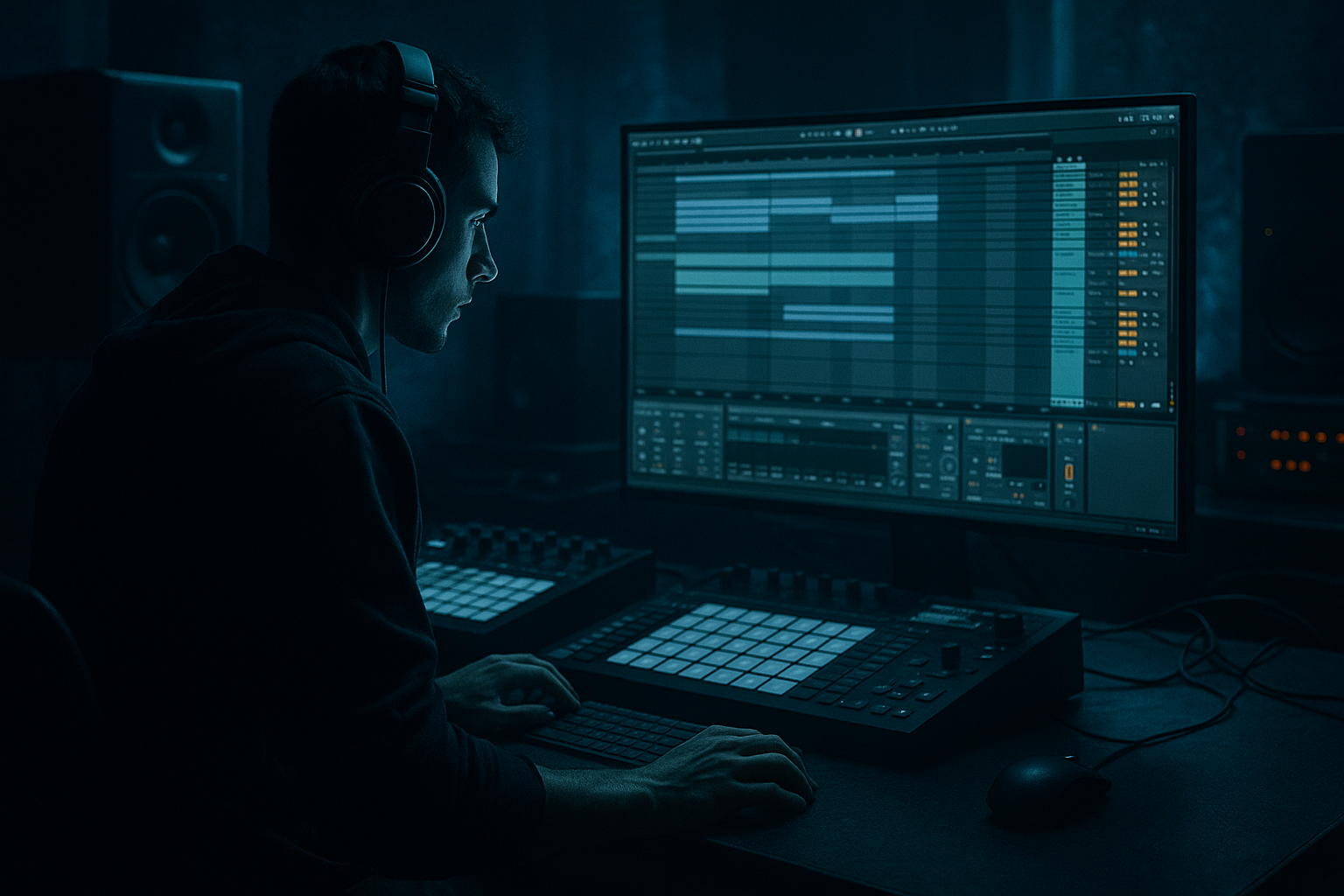
Main tutorial
Lesson Overview
This lesson shows you how to build a dubwise oldskool DnB jungle arp blueprint in Ableton Live 12, then move it cleanly from Session View into Arrangement View so it behaves like a real track section instead of a loop that never develops.
The goal is to create that classic ragga-meets-jungle, dubwise tension, where an arp or stab pattern sits on top of a break-driven drum grid and interacts with the bassline like a conversation. In DnB, this technique matters because it gives you:
- instant momentum in the intro and first drop
- call-and-response phrasing between drums, bass, and melodic hooks
- a strong foundation for arrangement automation and switch-ups
- a way to keep oldskool energy while still sounding tight and modern
- a dubwise arp or stab line built from a synth or sampled hit
- a jungle break loop with edited ghost notes and fills
- a sub bass / reese support layer that leaves space for the arp
- automation moves that open the intro, lift the drop, and create tension into switch-ups
- a DJ-friendly arrangement with clear 8- and 16-bar phrasing
- a sound that feels suitable for oldskool jungle, roller, or darker halftime-to-breakbeat crossover energy
- Making the arp too busy
- Letting the arp fight the snare or break accents
- Over-widening the bass
- Using too much reverb
- Not committing to an arrangement
- Ignoring headroom
- Use call-and-response phrasing
- Filter automation is your best friend
- Dirty the mids, not the sub
- Add tiny break edits under the arp
- Use delay throws sparingly
- Keep the drum transient sharp
- Resample your favorite 2-bar moments
- Build the groove in Session View first, then commit it to Arrangement View.
- Keep the drums and arp rhythmically connected so the pattern feels dubwise and authentic.
- Use stock Ableton devices like Arpeggiator, Auto Filter, Saturator, Utility, Echo, and EQ Eight to shape the sound.
- In DnB, space, phrasing, and low-end discipline matter as much as sound choice.
- Use automation, resampling, and clip variations to turn a loop into a proper jungle or rollers arrangement.
This is especially useful for darker / heavier rollers and jungle-infused DnB, where you need the track to feel alive without overcrowding the low end. The key is making the arp behave like part of the drum system: rhythmic, percussive, and arrangement-aware.
You’ll use Ableton stock tools like Arpeggiator, Auto Filter, Saturator, Drum Rack, Simpler, Echo, Utility, EQ Eight, Compressor, and resampling to build something that can sit in a proper DnB arrangement. 🔥
What You Will Build
By the end, you’ll have a playable Session View sketch that becomes a structured Arrangement View section with:
Musically, think: 16-bar intro with filtered atmospheres, 16-bar groove build, drop section where the arp stabs answer the snare and break accents, then a breakdown or switch-up with echo tails and dub delay throws.
Step-by-Step Walkthrough
1. Set up a DnB-friendly Session View foundation
- Start at 170–174 BPM. For oldskool jungle lean closer to 165–170, and for modern darker DnB push 172–174.
- Create three core tracks:
- Drums: Drum Rack or audio break loop
- Bass: simpler sub or synth bass
- Arp/Stab: your dubwise musical hook
- Add a separate Return track with Echo for dub throws and a second return with Reverb for short atmospheres.
- Keep the master peaking low; aim for about -6 dB headroom before mastering. That’s important in DnB because the kick, snare, bass, and break all fight for low-end space fast.
Why this works in DnB: clean session organization lets you improvise patterns, then commit to arrangement decisions without losing the groove. DnB relies on fast iteration, and Session View is perfect for testing break edits, bass phrasing, and arp variations before you print anything.
2. Build the drum engine first: break loop plus support hits
- Drag in a classic break, or slice one into Simpler or Slice to New MIDI Track if you want more control. A busy break like a classic amen-style pattern works well for jungle, while a tighter break with more space suits rollers.
- If using the break as audio:
- Warp it in Complex Pro only if needed; for punchy drums, try Beats and preserve transient attack.
- Use Warp Markers to lock the snare hits to the grid if the break drifts.
- On the drum bus, add:
- EQ Eight: cut a little around 250–400 Hz if the break is boxy
- Saturator: drive lightly, around 1–4 dB, to thicken the break
- Compressor or Glue Compressor: slow attack, medium release, just enough to glue the kit
- Layer a separate snare one-shot or rimshot on the 2 and 4 if the break needs more impact. Keep it subtle so the break still feels organic.
- Add tiny ghost notes or shuffled percussion in Drum Rack. These should be low in velocity and slightly off-grid to keep the groove breathing.
Workflow choice: if the break is central to the vibe, keep it as audio and edit the chops directly. If you want more control over fills and pitch, slice it into MIDI and rearrange individual hits.
3. Design the arp/stab as a dubwise rhythmic voice
- Create a MIDI track and load a stock instrument like Wavetable, Operator, or even Analog for a simple pluck/stab tone.
- Start with a short pattern: 1/8 or 1/16 notes with gaps. Don’t make it too busy; the space is what gives dubwise character.
- Insert Arpeggiator before the instrument:
- Rate: 1/8 or 1/16
- Gate: around 45–70%
- Style: Up, Down, or Converge/ Diverge if you want movement
- Retrigger: on, so each chord hit resets cleanly
- Put Auto Filter after the instrument:
- Low-pass cutoff around 200–800 Hz during intro
- Increase resonance slightly, but not so much that it whistles
- Add Saturator or Overdrive for bite, then use Utility to keep the low end mono and centered.
- Use a short MIDI chord shape: minor 7ths, sus2, or minor triads work well for moody jungle. A simple two-note chord can feel more authentic than a full lush voicing.
Musical context example: if your track is in F minor, try a two-note stab built from F–C or Ab–Eb, then let the arp pattern rhythmically punctuate the offbeats. That gives you classic tension without overharmonising the tune.
4. Make the arp interact with the drums instead of sitting on top
- In Session View, create a few clip variations for the arp:
- Clip A: sparse intro pattern
- Clip B: fuller drop pattern
- Clip C: fill or answer phrase
- Use different Clip Launch Quantization values if needed, but for DnB keep most clips on 1 Bar so the groove stays locked.
- Offset some notes slightly ahead or behind the grid to create push/pull. Be careful: too much swing can make the pattern feel late in fast DnB.
- Use Velocity to shape accents. Stronger hits should land where the snare or break accent supports them. Softer notes can fill the gaps around the break.
- If the arp feels too “MIDI perfect,” resample a few bars to audio and then cut it into phrase chunks. This is a great oldskool move because it gives the pattern a more tactile, chopped character.
Why this works in DnB: at 170+ BPM, even small rhythmic decisions matter. A well-placed arp can either reinforce the break or clutter it. The goal is a pattern that sounds like part of the drums, not a separate layer competing for attention.
5. Build the bassline around the arp, not against it
- Add a bass track using Operator for a clean sub or Wavetable for a more textured reese layer.
- Keep the true sub simple:
- sine-based tone
- mono
- minimal stereo processing
- low-pass filtering if the upper harmonics become obvious
- For movement, layer a mid bass/reese above it:
- detune slightly
- add light Saturator
- apply subtle Phaser-Flanger or Chorus-Ensemble only to the mid layer, not the sub
- Phrase the bass so it answers the arp:
- bass hits on the gaps after the arp
- sustain notes under snare hits if the arrangement needs weight
- leave room in the first half of a bar, then push into the second half for forward motion
- Sidechain the bass lightly to the kick/snare feel if needed, but in jungle and DnB you can also use volume shaping by note choice rather than heavy compression.
Practical settings:
- Utility on sub: keep below 120 Hz mono
- EQ Eight: cut unnecessary harmonics above the sub if the low layer is too wide
- Compressor: gentle sidechain, only enough to clear the kick, not pump the whole tune into oblivion
6. Use Session View to test arrangement energy before committing
- Build at least three scenes:
- Intro scene: drums filtered, arp filtered, bass absent or minimal
- Drop scene: full drums, full arp, bass active
- Switch-up scene: break variation, arp fill, bass dropouts or response notes
- Trigger scenes and listen like a DJ would. Ask: does each 8-bar block create a reason to keep going?
- In DnB, arrangement is about phrasing and contrast. Try an intro where the arp enters only after the break has established the groove, then let the bass “open” the drop.
- Add short automation clips for:
- filter cutoff on the arp
- delay feedback on the return send
- reverb send amount for transitional bars
- Keep transitions short and deliberate. Jungle and rollers work best when the listener feels the groove evolving every 8 or 16 bars, not every half bar.
Arrangement suggestion:
- Bars 1–16: filtered intro, drums teased
- Bars 17–32: drop with arp and bass established
- Bars 33–48: variation with extra break chops and echo throws
- Bars 49–64: breakdown or halftime-feeling respite, then reload energy
7. Resample and commit the best moments
- Once the arp, drums, and bass are working, route the arp or bass to an audio track and record a few bars of movement.
- Slice the recording and keep the best accidental moments: delayed echoes, offbeat chord tails, or distorted transients.
- Use these resampled pieces as fills, risers, or turnaround hits.
- This is especially powerful in oldskool jungle workflows because imperfect resamples create that organic chopped feel without needing endless MIDI editing.
Good places to resample:
- right before a drop
- at the end of a 16-bar phrase
- during a breakdown where the delay tail can morph into the next section
8. Turn the Session View sketch into Arrangement View structure
- When the groove feels right, record scene launches into Arrangement View.
- Don’t just lay clips down flat. Use arrangement to create:
- intro filter opening
- drum edits that intensify every 8 bars
- bass mutes or half-bar gaps before impact points
- arp automation that makes the tune feel alive
- Cut the arrangement into sections and clean up the transitions:
- use mute drops before key hits
- automate send levels for dub echoes
- shorten the intro if the track needs club energy faster
- Keep the structure DJ-friendly. A strong DnB arrangement usually gives the mix DJ enough bars to blend, then delivers the hook with confidence.
Mixing note: check the full arrangement with mono compatibility on the master using Utility. If the arp disappears or the bass blooms too wide, fix the source layers instead of forcing the master.
Common Mistakes
- Fix: reduce note density and let the drums breathe. In DnB, a few well-placed notes often hit harder than a constant stream.
- Fix: shift note timings or remove notes around the main snare hits. Your arp should answer the drums, not obscure them.
- Fix: keep the sub mono and only widen the upper bass layer. Use Utility to control stereo width.
- Fix: shorten decay, roll off low frequencies in the reverb return, and use delay throws instead of washing everything out.
- Fix: move from Session View to Arrangement View as soon as the core loop works. DnB needs structure, not endless looping.
- Fix: leave space on the master. If the drop is already slammed in the sketch, the final mix will fight you later.
Pro Tips for Darker / Heavier DnB
- Let the arp answer the snare or bass rather than playing continuously. This creates tension and makes the tune feel more intentional.
- Open the arp cutoff slowly over 8 or 16 bars. A movement from around 300 Hz to 2–4 kHz can create a dramatic lift without adding more notes.
- Use Saturator or Overdrive on the arp or mid-bass layer to create grit, but keep the sub pure. That’s how you get weight without muddying the mix.
- Little kick ghosts, snare drags, or reverse break slices can make the groove feel deeper and more underground.
- Send only the last note of a phrase into Echo with a high-feedback tail. Dubwise character comes from selective delay, not constant wash.
- If your break loses bite, reduce overly aggressive compression and restore attack with careful EQ and saturation. DnB depends on punch.
- Then rearrange them like audio phrases. This gives your track a more authentic jungle collage feel and helps you build variation quickly.
Mini Practice Exercise
Spend 10–20 minutes building a mini section using this method:
1. Set tempo to 172 BPM.
2. Create a 2-bar drum loop with a break and one supporting snare layer.
3. Program a 4-note minor arp using Arpeggiator + Wavetable.
4. Make two clip versions:
- one filtered intro version
- one fuller drop version
5. Add a simple sub bass that only plays under the second bar of each phrase.
6. Record 8 bars into Arrangement View.
7. Automate the arp filter opening over the last 4 bars.
8. Add one Echo throw on the final arp note before the loop resets.
Goal: make the arp feel like it belongs to the drums, not like a separate melody on top.

