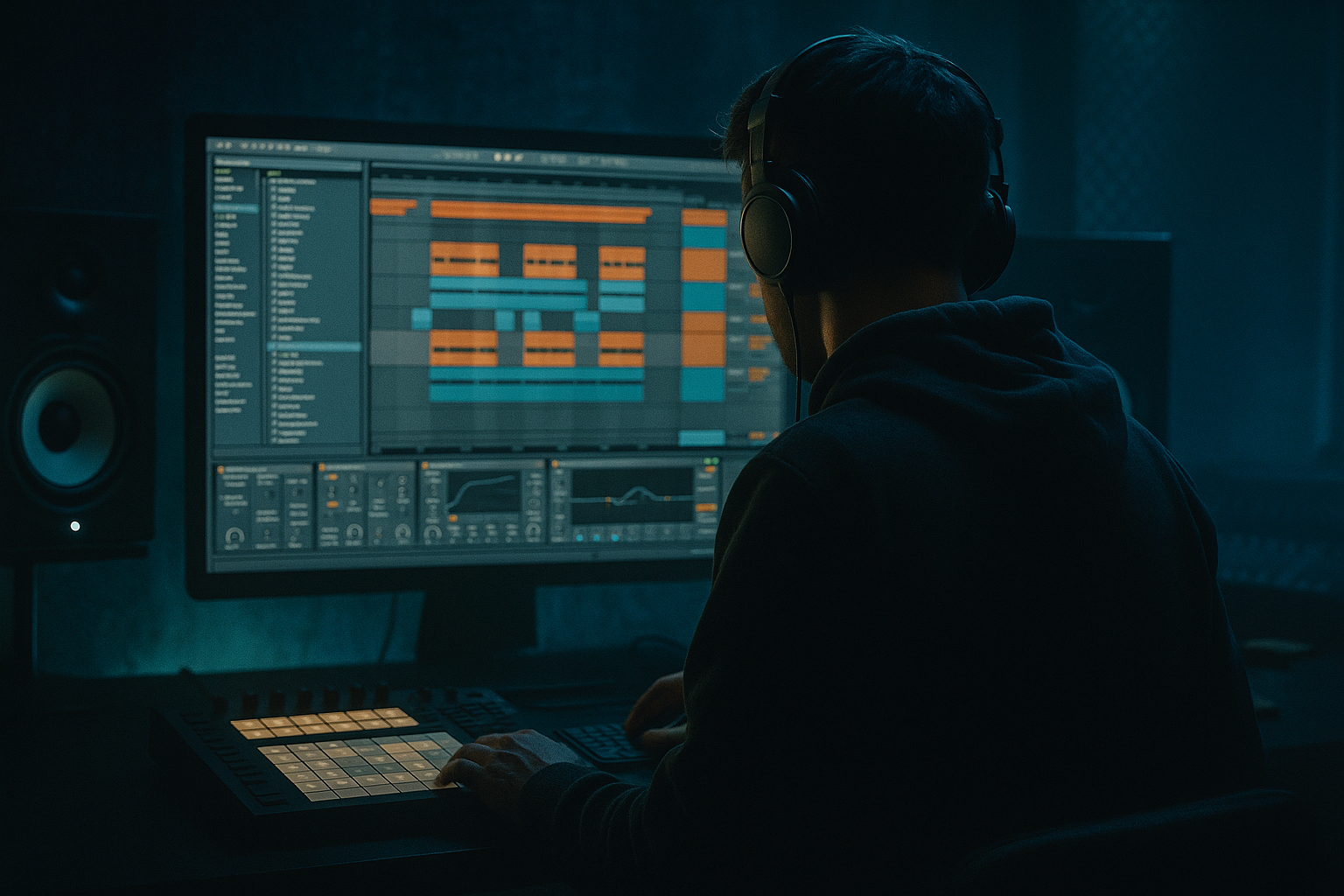
Main tutorial
Drop Clean System for Floor-Shaking Low End in Ableton Live 12
Jungle / oldskool DnB sound design tutorial for beginners 🔊🥁
1. Lesson overview
In jungle and oldskool drum and bass, the low end has to do two jobs at once:
- hit hard and feel huge on club systems
- stay clean enough that the kick, sub, and bass don’t blur into one muddy mess
- build a sub + mid-bass + drum support setup
- control low-end energy using EQ, utility, saturation, and sidechain
- make space for breakbeat drums without killing the vibe
- arrange your drop so the bass lands with impact
- jungle
- 90s oldskool rave DnB
- rolling DnB
- dark garage-influenced bass music
- kick
- snare
- breakbeat layers
- optional percussion
- sub layer: clean sine/triangle style low end
- mid-bass layer: character, movement, reese, growl, or filtered rewind-style bass
- optional ghost layer: tiny top harmonics for translation on small speakers
- Utility for mono control
- EQ Eight for sub cleanup
- Saturator or Drum Buss for harmonic thickness
- Compressor or Glue Compressor for sidechain
- optional Limiter for safety
- intro with filtered elements
- tension build
- drop where sub and drums hit together cleanly
- variation every 8 or 16 bars to keep it moving
- Drum Rack for programming one-shots
- Simpler for breakbeats
- Audio Tracks if you’re working with chopped loops
- Kick on beat 1 and 3, or a more syncopated break-based kick
- Snare on beat 2 and 4
- Breakbeat chops around the snare and offbeats
- EQ Eight
- Utility
- Oscillator A: Sine wave
- Octave: usually -1 or -2
- Envelope: short attack, medium decay, sustain around 0 to full, release short or medium
- Filter: usually unnecessary for pure sub
- Keep notes simple
- Follow the root notes of the chord or bass movement
- Use long notes for rolling pressure
- Use shorter notes if you want more classic chopped jungle energy
- a sine-based waveform
- very low filter movement
- minimal unison
- Mono only
- No stereo widening
- No chorus
- No reverb
- No unnecessary distortion
- Analog
- Wavetable
- Operator
- Roar in Live 12 for controlled saturation and grit
- Osc 1: saw wave
- Osc 2: saw wave
- Slight detune between oscillators
- Add a low-pass filter
- Use a slow LFO to gently move the filter cutoff
- EQ Eight
- Saturator
- Utility
- Sub track = pure low end
- Mid-bass track = character and movement
- Top layer = optional texture for translation
- Sub: roughly 20–90 Hz
- Mid-bass: roughly 90–300 Hz
- Top texture: above 300 Hz
- Put each layer on its own track
- Use EQ Eight on each layer
- Make sure the sub stays clean and mono
- Let the mid-bass carry the aggression
- sub bass
- mid-bass
- pads or atmos if they mask the drop
- Remove any accidental low rumble below what your track needs
- Avoid harsh boosts
- Keep it very simple
- high-pass below 80–120 Hz
- cut muddy frequencies around 200–400 Hz if needed
- reduce harshness around 2–5 kHz only if the sound is piercing
- kick may need emphasis around 50–100 Hz
- snare often lives around 180–250 Hz and 2–5 kHz
- breaks often need low cut to avoid clashing with sub
- Saturator
- Drum Buss
- Roar
- Overdrive for more aggressive textures
- Drive: 2–6 dB
- Soft Clip: On
- Output: reduce to match level
- Drive: low to moderate
- Crunch: light use
- Boom: use carefully, especially on bass layers
- Transients: can help drums punch
- 4–8 bars of tension
- bass filter opens or drops in
- drums hit with more energy
- variation every 8 bars
- mute the sub for the last 1/2 bar before the drop
- use a short riser or snare fill
- automate a filter opening on the mid-bass
- bring in the full bass on the first strong kick/snare impact
- breakbeat chop
- filtered bass stab
- then let the full sub enter after 1 or 2 bars
- Put Utility on the master
- Temporarily set width to 0% or use mono
- Listen to the bass and drums
- Does the bass disappear?
- Does the kick lose power?
- Does the break become thin?
- Sub should be mono
- Mid-bass can have some width
- Low frequencies should stay centered
- sub strength
- drum clarity
- bass movement
- overall space
- filter cutoff
- saturation drive
- reverb sends on fills only
- volume dips before impact
- kick
- snare
- a chopped breakbeat
- Operator
- sine wave
- write a 4-bar bassline using only 3–4 notes
- Wavetable
- saw-based reese patch
- high-pass it above 100 Hz
- sub: Utility + EQ Eight
- mid-bass: EQ Eight + Saturator
- bass group: Compressor sidechained to kick
- 2 bars of tension
- 2 bars of drop
- automate a filter opening on the mid-bass
- use Utility on master
- check whether the drop still works
- build your drums first
- keep the sub mono and clean
- let the mid-bass carry character
- use sidechain so kick and bass work together
- clean mud with EQ Eight
- add weight with Saturator, Drum Buss, or Roar
- arrange the drop so the impact lands properly
That’s what this lesson is about: building a drop clean system in Ableton Live 12 so your bass drops feel heavy, controlled, and properly DJ-friendly.
You’ll learn how to:
We’ll keep it beginner-friendly, but rooted in real DnB workflow. This is especially useful for:
---
2. What you will build
By the end, you’ll have a simple but strong drop system made of:
A. Drum group
B. Bass group
C. Clean low-end control chain
D. Arrangement structure
---
3. Step-by-step walkthrough
Step 1: Start with the drums first 🥁
In DnB, the drums often define how the bass should behave.
Build a simple drum rack or audio track setup:
Use these stock Ableton options:
Typical oldskool DnB drum starting point:
Practical tip:
If you are using a breakbeat, do not let the low end of the break fight the sub.
You can clean breaks with:
- high-pass around 80–120 Hz
- adjust by ear depending on the break
- reduce gain if the break is too hot
Goal:
Your drum section should punch through before the bass comes in.
If the drums already sound muddy, the bass will only make it worse.
---
Step 2: Create the sub bass layer
This is the foundation of the whole drop.
Option A: Simple sub with Operator
Use Operator because it’s clean and easy.
#### Settings:
MIDI writing tips:
Option B: Wavetable sub
If you prefer, use Wavetable with:
Sub rules:
Recommended chain on sub track:
1. Utility
- Width: 0% or Mono on
2. EQ Eight
- high-pass only if needed, very gently
- remove anything below useful range only if there’s unwanted rumble
3. Compressor or Glue Compressor
- only if needed for dynamic control
4. Limiter
- last safety device, very light use
Important:
Your sub should be felt more than heard.
If you can hear a buzzy sub on laptop speakers, it’s probably too distorted for a clean system.
---
Step 3: Add a mid-bass layer for character
This is where the bass gets attitude. Jungle and oldskool DnB often use a mid-bass that has movement, bite, and personality.
Good stock devices for this:
Mid-bass design idea:
Try a simple reese-style patch:
#### In Wavetable:
#### Then process it:
- high-pass around 80–120 Hz
- cut harsh resonances if needed
- Drive: light to medium
- Soft Clip: on
- Width: keep moderate, but avoid huge stereo in the low mids
Important concept:
The mid-bass should live mostly above the sub range.
Think of it like the attitude layer, while the sub is the foundation layer.
---
Step 4: Split your bass into clean layers
This is a huge beginner win.
Layer structure:
Why split layers?
Because one sound often can’t do everything well.
If you try to make one bass do sub, punch, stereo width, and grit, you usually get muddy results.
Simple frequency split idea:
You do not have to treat these numbers as strict rules, but they are useful starting points.
How to implement in Ableton:
---
Step 5: Use sidechain to make room for the kick 🦵
A clean drop needs space. In DnB, sidechain is essential.
What to sidechain:
Use Ableton’s stock Compressor:
1. Put Compressor on the bass group
2. Turn on Sidechain
3. Select your kick as the input source
4. Start with these settings:
- Attack: 1–5 ms
- Release: 50–120 ms
- Ratio: 2:1 to 4:1
- Threshold: set so the bass ducks clearly when the kick hits
DnB tip:
For rolling bass, don’t overdo the ducking.
You want the bass to breathe, not disappear.
If using a breakbeat:
You may need to sidechain to the main kick or a dedicated ghost kick trigger, rather than the full break.
---
Step 6: Clean the low end with EQ Eight
This is where the “clean system” starts to really work.
On the sub:
On the mid-bass:
Use EQ Eight to:
On the drum group:
Use EQ to make room:
Clean EQ mindset:
Don’t just boost everything.
A floor-shaking low end is usually made by removing problems, not by adding endless bass.
---
Step 7: Add saturation for weight, not mess
A little harmonic content helps bass translate on small speakers and gives the drop more density.
Stock devices to try:
Safe starting settings:
#### Saturator:
#### Drum Buss:
Important:
If the saturation starts making your sub fuzzy or your low end unstable, back it off.
Saturation should add presence and density, not smear the groove.
---
Step 8: Make the drop arrangement hit properly
A clean low end is not just sound design. It’s arrangement.
Classic DnB drop structure:
Great arrangement tricks:
Very effective jungle-style idea:
Start the drop with:
That creates impact because the listener hears the groove first, then the heavy low end lands.
---
Step 9: Check your mix in mono
This is essential for club bass.
How:
What to listen for:
If yes, your stereo processing is causing problems.
Rule:
---
Step 10: Build a simple group chain for the bass bus
Once your layers work separately, group them.
Bass group chain example:
1. EQ Eight
- light cleanup
2. Saturator
- subtle thickness
3. Compressor
- very gentle glue
4. Utility
- ensure mono compatibility in low end
5. Limiter
- safety only
Tip:
If the bass group sounds good before the limiter, you’re on the right track.
The limiter should not be fixing a broken low end.
---
4. Common mistakes
1. Making the sub too loud
A huge sub soloed in your headphones may sound impressive, but in a mix it often overwhelms everything.
Fix: balance it against drums, not in isolation.
---
2. Stereo widening the sub
Stereo sub can sound big on headphones and terrible in clubs.
Fix: keep sub mono with Utility.
---
3. Using too much distortion on the low end
This turns the bass into a cloudy mess.
Fix: distort the mid-bass, not the sub.
---
4. No sidechain or weak sidechain
Without space, the kick and bass fight constantly.
Fix: use Compressor sidechain or careful volume shaping.
---
5. Overcrowded low mids
The 150–400 Hz area can get muddy very fast.
Fix: use EQ Eight to carve space in the bass, break, and drum group.
---
6. Huge bass sound in solo, weak in the full mix
This happens a lot for beginners.
Fix: always test bass with the drums and arrangement playing together.
---
5. Pro tips for darker/heavier DnB
Tip 1: Use short sub notes for tension
Instead of long sustained notes all the time, try short rhythmic sub hits under the breakbeat.
This can sound very oldskool and aggressive.
Tip 2: Layer a low-passed reese under the sub
Keep it subtle.
The reese adds movement, while the sub carries the weight.
Tip 3: Automate a low-pass filter into the drop
Close the filter in the intro, then open it at the drop.
This gives a much bigger impact when the bass arrives.
Tip 4: Use resampling for character
Bounce a bass line to audio, then chop it or reverse it.
That is very jungle-friendly and can create gritty drops fast.
Tip 5: Let the drums breathe
A lot of heavy DnB comes from the contrast between sharp drums and controlled bass, not from maximum bass volume.
Tip 6: Keep checking against references
Listen to classic jungle or oldskool DnB tracks and compare:
Tip 7: Add tension with automation, not just more layers
Sometimes the heaviest drop is the one with smart automation:
---
6. Mini practice exercise
Try this quick 20-minute exercise in Ableton Live:
Exercise goal:
Build a 4-bar DnB bass drop that stays clean and hits hard.
Step 1
Make a drum loop:
Step 2
Create a sub track:
Step 3
Create a mid-bass track:
Step 4
Add processing:
Step 5
Arrange:
Step 6
Test in mono
Challenge:
Try making the bass feel bigger without increasing the sub level.
Use arrangement, saturation, and drum groove instead.
---
7. Recap
A clean, floor-shaking DnB low end in Ableton Live 12 comes from control, layering, and arrangement.
Remember these core points:
If you want jungle and oldskool DnB vibes, don’t chase “big” in isolation.
Chase tight, controlled, and rhythmically powerful. That’s what shakes floors 🔥
If you want, I can also turn this into:
1. a screen-by-screen Ableton Live 12 workflow, or
2. a template rack chain for sub + mid-bass + sidechain.

