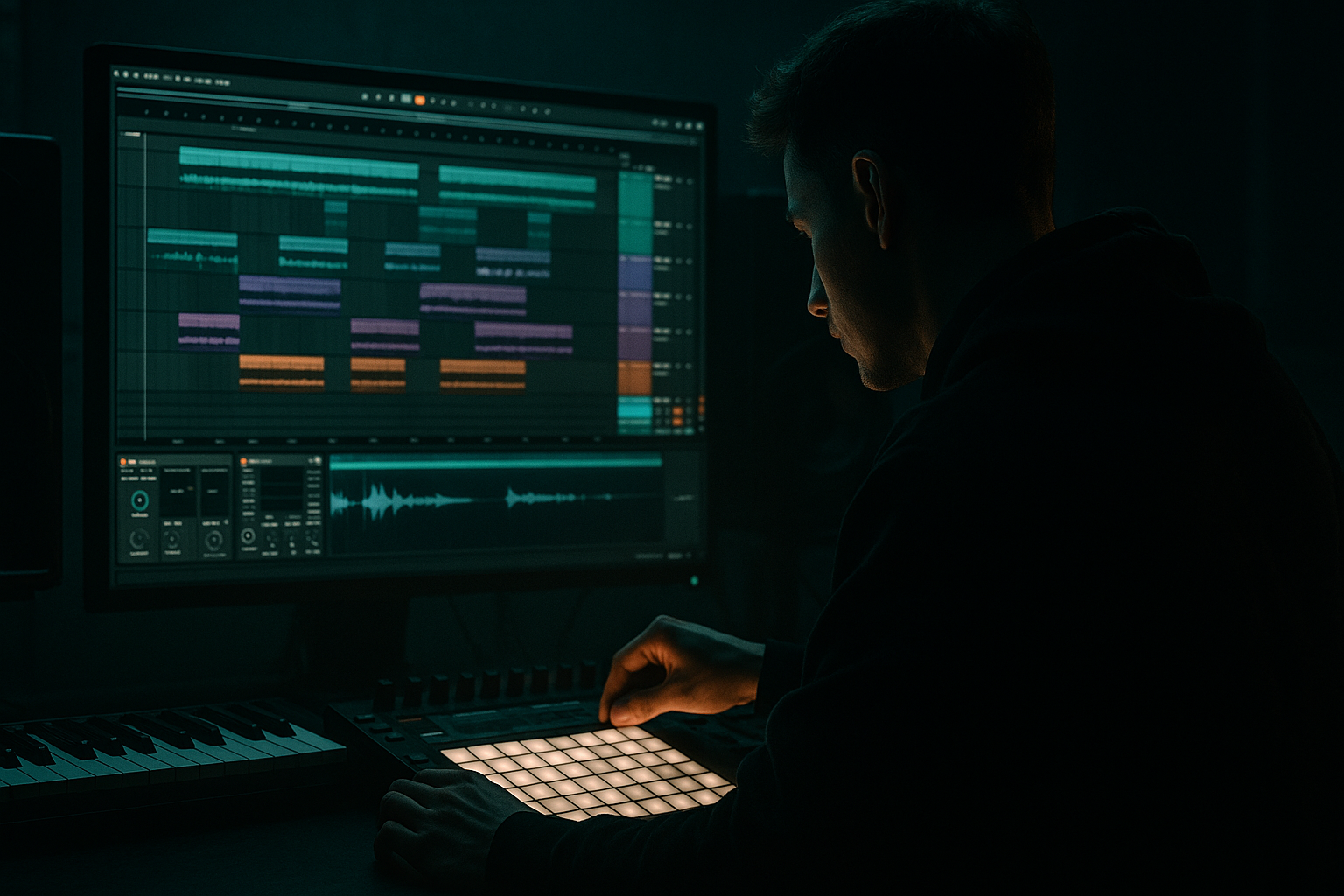
Main tutorial
Lesson Overview
Oldskool DnB ghost notes are one of the fastest ways to make a break or bassline feel like it came from a proper dubplate-era session instead of a clean loop pack. In this lesson, you’ll build a chopped-vinyl style ghost note layer in Ableton Live 12 that sits behind your main drums and bass as an atmosphere element: a dusty, flickering movement bed that adds swing, history, and tension without stealing the spotlight.
This technique matters because in Drum & Bass, the space between the main hits is just as important as the hits themselves. A well-placed ghost note can glue a break together, hint at a groove before the drop fully lands, and give your loop that “someone actually played and cut this” feel. In darker DnB, rollers, and jungle-influenced tracks, this kind of micro-detail helps the track feel alive and menacing at the same time.
We’ll use stock Ableton devices and a workflow that’s practical for real sessions: sampling, slicing, warping, resampling, vinyl-style degradation, and atmospheric placement. The goal is not just to make a ghost note—it’s to make it behave like a chopped bit of a chopped record, with enough grime and movement to work in a full DnB arrangement.
What You Will Build
You’ll build a short, loopable ghost note texture made from a tiny sliced fragment of a break or bass stab, processed to sound like a chopped-vinyl artifact.
Musically, it will:
- sit behind your main break or drum loop as a subtle atmospheric layer
- provide off-grid, syncopated “ghost” hits in the gaps between snare and kick anchors
- carry oldskool vinyl character: pitch wobble, filtered top end, transient smear, and slight saturation
- work as a transition bed for 8- or 16-bar phrases in jungle, rollers, or darker neuro-influenced DnB
- remain low in the mix so it feels like movement, not a second main drum loop
- Making the ghost layer too loud
- Using full-range samples without filtering
- Quantizing everything perfectly
- Overprocessing with too much distortion or Redux
- Not arranging it in phrases
- Letting the stereo image get messy
- Layer a second, even quieter ghost note octave
- Use Drum Buss for subtle aggression
- Resample the processed layer
- Automate filter resonance carefully
- Use ghost notes as transition glue
- Pair it with a restrained sub drop
- one subtle atmospheric ghost layer
- one slightly dirtier transition version
- Slice a short break or stab and turn it into a sparse ghost-note pattern.
- Use velocity, timing, and pitch variation to create oldskool chopped-vinyl character.
- Shape the tone with stock Ableton devices like Simpler, EQ Eight, Saturator, Redux, Auto Filter, and Glue Compressor.
- Keep it filtered, narrow, and low in the mix so it functions as an atmosphere.
- Automate movement across phrases to make the layer feel alive in DnB arrangement.
- Use it to add tension, grit, and authenticity without cluttering the drums or bass.
By the end, you’ll have a reusable chain that can be dropped into intros, breakdowns, pre-drop tension sections, or right under the first 8 bars of a drop.
Step-by-Step Walkthrough
1. Start with a short source that already feels “sampled”
In Ableton Live, drag in a breakbeat or a single bass stab phrase from your own library. Good source material for this technique is something with a definite transient and a bit of tail: an oldskool break, a dusty amen hit, a chopped funk snare, or a short reese stab with texture.
Keep it short: 1–2 bars max. If you’re using a break, focus on one or two hits that can become ghost notes rather than the whole loop. The more limited the source, the more convincing the chop will feel.
Set the clip Warp mode to Beats for drum material, then try Transients around 8–30 ms depending on how sharp you want the chop. If you’re working with a tonal stab, Complex Pro can help, but for ghost-note grit, Simpler or a resampled audio clip often feels better.
Why this works in DnB: the classic jungle and oldskool feel often came from tiny recycled fragments, not pristine full-length loops. Micro-sampling creates motion and authenticity fast.
2. Slice the audio into playable fragments
Right-click the sample and choose Slice to New MIDI Track. For DnB, use transient slicing first, then manually trim anything that doesn’t behave well.
You want 3–8 useful slices, not 30 tiny pieces. Keep the slices that have:
- a clean transient
- a bit of noise or room tone
- a pitched or tonal tail
- a natural off-beat feel
Put the slices into Simplers on the new MIDI track. If one slice is particularly useful, duplicate it into multiple pads and vary pitch later. This gives you a quick way to create ghost-note patterns without overcomplicating the sound design.
Suggested workflow: rename the track to something like VINYL GHOSTS or CHOP ATMOS so you can find it instantly in a busy session.
3. Build the ghost-note rhythm against the drum grid
Program a 1- or 2-bar MIDI pattern that lives around your main kick/snare structure. In a typical DnB phrase, place ghost notes:
- just before the snare
- just after the snare
- between kick anchors
- on occasional off-beat 16ths to suggest shuffle
A simple starting point:
- bar 1: one ghost note before beat 2, one after beat 3
- bar 2: a quicker pair leading into beat 4
- leave some gaps so the groove breathes
Use velocity variation aggressively. Aim for roughly 20–60 velocity for ghost notes, with one or two accents at 70–90 if you want a stronger chop. In DnB, this dynamic contrast is what sells the “played” feel.
If your main break is busy, keep the ghost layer sparse. If the main drums are stripped-back rollers, you can let the ghost notes do more rhythmic work. The key is to complement the groove, not mirror it.
4. Shape the chop with Simpler and clip envelopes
Open the Simpler on each slice and set the playback mode to One-Shot if you want the full slice to fire cleanly, or Gate if you want more control over note length. For a chopped-vinyl feel, One-Shot usually works best because it allows the tails and clicks to breathe.
In Simpler:
- turn on Filter and low-pass the top end around 6–10 kHz
- reduce the Transpose slightly, often -3 to -7 semitones, for a darker pocket
- shorten the Amp Release if the slice is too long, around 40–120 ms
- add a touch of Glide only if you want pitch smears between repeated notes
Then use the Clip Envelope for Volume or Transposition if you want one ghost hit to feel more “worn.” A tiny pitch dip of -1 to -3 semitones on selected notes can make it feel like the sample is sagging off an old turntable.
Optional but effective: automate Start Position in Simpler for a few notes so each ghost hit begins a few milliseconds later or earlier. That tiny offset creates a chopped edit feeling.
5. Add vinyl-style degradation with stock Ableton devices
Now make it feel like it came from a battered record, not a clean WAV.
Use this stock chain:
- EQ Eight
- Saturator
- Redux
- Auto Filter
- Glue Compressor or Drum Buss
Suggested settings:
- EQ Eight: high-pass around 120–200 Hz so the ghost layer never fights the kick and sub; dip 2–4 dB around 2.5–5 kHz if the chop is pokey
- Saturator: Drive +2 to +6 dB, Soft Clip on, Output compensated
- Redux: Bit Reduction very lightly, often 10–14 bits; Downsample just enough to roughen the edges without destroying intelligibility
- Auto Filter: low-pass somewhere between 4–9 kHz, with subtle envelope motion if you want the chop to “breathe”
- Glue Compressor: 1.5:1 to 2:1, slow attack, medium release, only 1–2 dB gain reduction
- Drum Buss: very subtle Crunch, low Drive, and a touch of Transients if the ghost notes need more bite
The point is to create a narrow band of texture that reads as atmosphere. You’re not designing a lead element; you’re designing a shadow of one.
6. Make the vinyl character move with automation
Static grit gets boring fast. The oldskool feeling comes from instability, so automate a few parameters over 8 or 16 bars.
Good automation targets:
- Auto Filter cutoff: slowly open before a drop, then clamp down after the snare fill
- Saturator Drive: increase slightly during transition bars, then ease off in the drop
- Simpler Transpose: automate brief pitch nudges on repeated ghost hits
- Reverb send: increase only on a couple of tail notes for distance
- Utility Width: keep this mostly narrow, but you can open it slightly in intros or breakdowns
A nice DnB arrangement move: automate the ghost layer from very filtered and distant in the intro to more present in the 4 bars before the drop. Then cut it sharply on the first downbeat of the drop if you want the main drums to hit harder.
This is especially effective in atmospheric sections where you want tension without adding a full pad. The ghost note becomes part rhythm, part texture, part memory of the groove.
7. Place the ghost layer in a proper atmospheric context
Don’t treat this as a drum bus layer alone. Make it live like an atmosphere.
Route the track to a Return with a short, dark Reverb:
- Reverb decay: around 0.8–1.8 seconds
- Pre-delay: 10–25 ms
- High cut: around 4–7 kHz
- Low cut: around 150–300 Hz
Add Echo on a separate Return if you want a few “ghosted” repeats to trail behind the chops. Keep it filtered and low in feedback so it doesn’t clutter the groove.
In an atmospheric DnB arrangement, this layer works well:
- under an intro with filtered pads
- behind a break-only section before the bass enters
- during a 2-bar tension lift before a drop switch
- in a breakdown where you want urban, haunted movement instead of a full melody
Musical context example: if your track is a 174 BPM dark roller in F minor, place the ghost note layer in the 8-bar intro, slowly open the filter over bars 5–8, then mute it right when the main reese and sub hit on the drop. That contrast makes the drop feel heavier.
8. Tighten the low-end separation and stereo discipline
Ghost notes can wreck the low mids if you’re not careful, especially if the source sample has bass content. Use EQ Eight to clear space:
- high-pass at 120–250 Hz depending on the source
- remove mud around 250–450 Hz if needed
- tame harshness around 3–6 kHz if the chop clicks too hard
Keep the layer mostly mono or narrow. Use Utility and set Width to 0–40% if the sample has wide stereo noise that fights the main mix. In DnB, the sub and main drum image should stay controlled; the atmospheric detail can be wide only if it isn’t muddy.
If the layer still pokes too much, lower it and let the transient detail do the work. Ghost notes should be felt as groove, not heard as a separate sample loop.
Common Mistakes
- Fix: pull it back until you miss it when muted. It should support the groove, not compete with the snare.
- Fix: high-pass aggressively and remove clutter in the low mids. Keep sub and main bass separate.
- Fix: add a little push-pull with note placement or groove. Oldskool feel depends on human timing.
- Fix: degrade in small amounts. If the chop stops reading as a ghost note, you’ve gone too far.
- Fix: automate the layer in and out around 4-, 8-, or 16-bar sections. DnB needs tension/release, not endless loops.
- Fix: narrow the layer, especially if the source has lots of top-end wash. Save width for pads, atmospheres, or FX returns.
Pro Tips for Darker / Heavier DnB
- Duplicate the MIDI and transpose the slice down 12 semitones, then low-pass it hard. Blend very quietly for extra weight and haunted depth.
- A little Drive and Crunch can make the chop feel more like a battered break than a clean sample. Keep the Transients control modest so you don’t lose the vintage smear.
- Once you like the movement, resample 8 bars of it and cut new phrases from the audio. This often sounds more authentic than endless live MIDI tweaking.
- A tiny bump in resonance can make a ghost note “speak,” but too much turns it into whistle territory. Keep it subtle, especially in darker tracks.
- In a heavier drop, use the layer to bridge between a fill and the return of the main bassline. It can hide edit points while increasing tension.
- Let the ghost note flicker above a clean sub hit, rather than trying to carry the low end itself. That contrast is classic in rollers and neuro-adjacent arrangements.
Mini Practice Exercise
Spend 10–20 minutes building a ghost-note atmosphere from one break sample.
1. Choose a 1-bar break or stab with a clear transient.
2. Slice it to MIDI and keep only 4–6 useful slices.
3. Program a 2-bar pattern with sparse ghost hits around the snare.
4. Add EQ Eight, Saturator, Auto Filter, and a touch of Glue Compressor.
5. High-pass the layer and reduce the top end until it sits behind your drums.
6. Automate the filter cutoff across 8 bars.
7. Resample the result and make a second variation with a different pitch or chop pattern.
8. Drop it into an intro or pre-drop section of one of your current DnB projects.
Goal: create two usable versions—
If you finish early, test the layer against a kick/snare loop and check whether it improves the groove when muted and unmuted. If you barely notice it soloed but feel its absence in context, you’ve nailed it.

