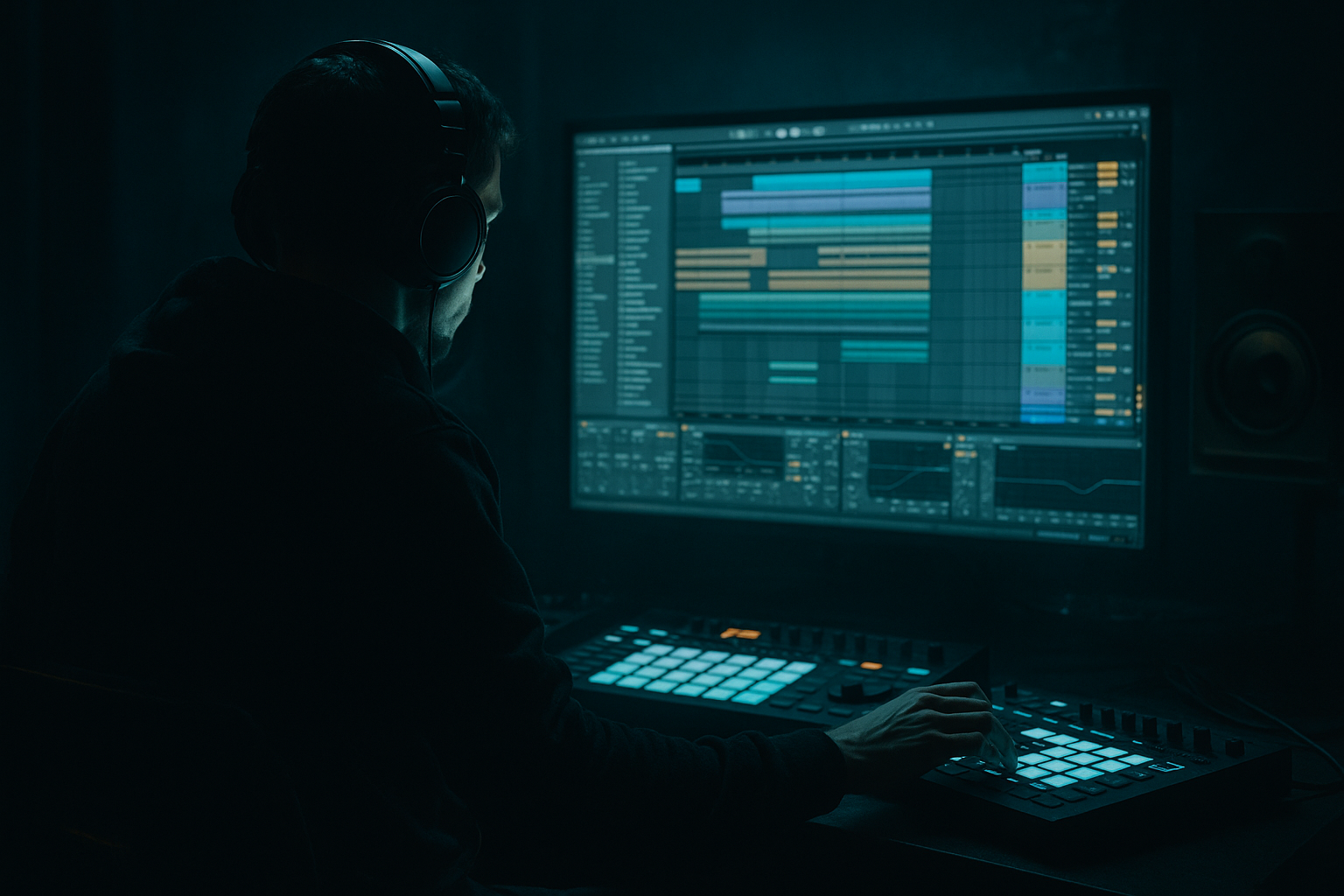
Main tutorial
Drive a Ghost Note Using Stock Devices Only in Ableton Live 12
Jungle / oldskool DnB resampling tutorial for advanced producers 🥁🔥
1. Lesson overview
In jungle and oldskool DnB, ghost notes are those tiny, almost-hidden drum hits that add movement, shuffle, pressure, and swing. On their own they can feel too quiet to matter — but when you drive them with saturation, transient shaping, compression, resampling, and controlled clipping, they become part of the groove’s engine.
In this lesson, you’ll use only stock Ableton Live 12 devices to take a weak ghost note and turn it into something that feels weighty, dirty, and rhythmic, without losing the “ghost” character.
This is specifically useful for:
- adding bounce to a breakbeat chop
- reinforcing snare-side ghost hits
- creating texture behind main drum accents
- making a tiny percussion element feel like it belongs in a rolling jungle pattern
- building energy in an arrangement without cluttering the mix
- a ghost note source taken from a break, rim, snare tick, or low-volume percussion hit
- a processing chain that adds drive, body, and edge using stock devices
- a resampled audio layer that sounds more aggressive and controllable than the original
- a layered ghost note that can sit under a break or snare in a jungle loop
- optional arrangement automation to make the ghost note evolve across a 16- or 32-bar section
- a ghosted snare from a breakbeat
- a low-level rim shot
- a closed hat with a brushed tail
- a tiny break slice from Amen, Think, Hot Pants, Funky Drummer, etc.
- a snare flam fragment
- a percussion hit with room tone
- a short transient
- some midrange content
- a little decay or room
- enough detail to survive resampling
- Amp Envelope
- Drive: `5–20%`
- Crunch: `5–25%`
- Damp: slightly below center if the top end is harsh
- Boom: usually off or very subtle for ghost notes
- Transients: slightly positive if you want more stick
- Dry/Wet: `20–60%`
- Type: `Analog Clip` or `Soft Sine`
- Drive: `2–8 dB`
- Soft Clip: `On`
- Output: trim to match level
- Ratio: `2:1` to `4:1`
- Attack: `1–10 ms`
- Release: `50–150 ms`
- Threshold: set for `2–6 dB` of gain reduction
- Attack: `0.3 ms` or `1 ms`
- Release: `Auto` or `0.1–0.3 s`
- Soft Clip: `On`
- Aim for light gain reduction, not squashing
- High-pass around `80–150 Hz` if it’s muddy
- Small boost around `180–300 Hz` if it needs chest
- Cut harshness around `2.5–5 kHz` if saturation got spitty
- Add a touch around `700 Hz–1.5 kHz` if you want more knock or stick
- Width: `0–80%` depending on the role
- For a snappy central ghost layer, keep it mono
- Use Gain to level-match before resampling
- print the tone of the chain
- commit to a sound
- create a new audio layer with a more solid transient
- process the result again without stacking too many devices live
- denser
- more tactile
- slightly louder in perceived weight
- still short and groovy
- Erosion
- EQ Eight
- Redux
- Compressor
- Drum Buss
- very light Drive
- tiny Crunch
- maybe a touch of Transients
- Put the ghost note just before the main snare, or slightly after it
- Try placing it on the “a” of the beat for swing
- Use it as a pickup into a kick/snare hit
- Alternate velocity or volume across repetitions
- under a chopped Amen snare
- between kick and snare for forward motion
- as a low-volume answer to the main snare
- on offbeats to create a rolling tension
- in fills at the end of 8- or 16-bar phrases
- bars `1–8` of a phrase to establish groove
- bar `8` or `16` as a fill response
- the breakdown return to reintroduce motion subtly
- the second drop for extra drive
- Drum Buss Drive
- Saturator Drive
- Filter cutoff in Auto Filter
- Compressor threshold
- Utility gain
- Dry/Wet of the whole chain
- Bars `1–8`: mild saturation, subtle ghost
- Bars `9–16`: increase drive by 1–2 dB
- Fill bar: add more crunch or push the note slightly louder
- Breakdown: reduce density with a filter or lower utility gain
- Saturator
- Drum Buss
- Overdrive
- Dynamic Tube
- Erosion for grime
- move Saturator Drive
- modulate Filter cutoff
- change decay slightly
- vary velocity
- add Redux
- add Compressor
- maybe Drum Buss
- blend quietly under the cleaner version
- mirror the kick pattern
- answer the snare
- reinforce syncopation in the 16th grid
- create call-and-response with hats and rides
- audible in the groove
- not distracting when soloed
- clearly adding momentum to the drum pattern
- usable in a dark jungle / rolling DnB mix
- start with a small percussive source
- shape the envelope and level
- use Drum Buss, Saturator, and Compression to add body and grit
- clean and focus with EQ Eight and Utility
- resample the result to commit the tone
- add a second light processing pass if needed
- place it in the groove where it supports the breakbeat
- automate for movement and arrangement energy
- a device-by-device Ableton rack preset recipe
- a MIDI + audio workflow version
- or a specific Amen break example with exact bar placement
We’ll work in a way that’s very practical for DnB / jungle / dark rolling bass music: process, resample, then reprocess the resampled layer so you can get movement and grit while keeping the original transient intact.
---
2. What you will build
By the end, you’ll have:
Typical final chain
You’ll likely end up with something like:
Ghost note sample / chopped break hit
→ Drum Buss
→ Saturator
→ Compressor or Glue Compressor
→ EQ Eight
→ Utility
→ Resample to audio
→ optional second stage: Erosion / Overdrive / Redux / Clip
This is a classic oldskool approach: process for character, print to audio, then sculpt the result.
---
3. Step-by-step walkthrough
Step 1: Choose the right ghost note source
You need a sound that already has some personality. Great sources for oldskool DnB include:
#### What to look for
Pick a hit that has:
Avoid super-clean one-shots with no texture unless you plan to heavily process them. Jungle ghost notes usually work best when they already sound like they came from a record.
---
Step 2: Put the ghost note in a Simpler or audio track
You can do this either way:
#### Option A: Simpler
1. Drop the sample into Simpler.
2. Set Mode to Classic or One-Shot depending on how you want it triggered.
3. Tune the sample if needed.
4. Use the Start and End controls to isolate the useful part of the transient.
#### Option B: Audio track
1. Place the sample on an audio track.
2. Tighten the clip boundaries.
3. Enable Warp only if needed — for a ghost note, often you want the natural transient untouched.
For jungle work, I often prefer audio track + resampling because it preserves the raw attack more cleanly.
---
Step 3: Shape the ghost note before driving it
Before distortion, get the envelope right.
#### If using Simpler:
- Attack: `0.00 ms`
- Decay: `80–180 ms`
- Sustain: `0%`
- Release: `20–60 ms`
This keeps it tight and percussive.
#### If using audio clip:
Use Clip Gain or Utility to control level before processing.
A useful trick is to pull the sample down a bit first so the chain can be driven more musically.
---
Step 4: Build the drive chain
Now let’s make it hit harder while preserving ghost-note subtlety.
Suggested stock device chain
1. Drum Buss
Start here if you want instant DnB thickness.
Settings to try:
#### Why it works
Drum Buss gives that modern-but-still-rough drum edge. In jungle, it can make a tiny ghost hit feel like it came from a break tracked through tape and a dirty console.
---
2. Saturator
Use this to add controlled harmonic weight.
Settings to try:
#### Practical tip
If the ghost note starts losing definition, back off the drive and instead increase the input level slightly before saturation. The sweet spot is usually where the midrange gets denser, not fuzzy.
---
3. Compressor or Glue Compressor
This is where you “glue” the note and bring up the body.
#### Compressor settings
#### Glue Compressor settings
#### Why it matters
A ghost note can disappear in the groove if it’s too spiky and short. Compression helps pull the body forward, so the hit reads on small speakers and in a busy break pattern.
---
4. EQ Eight
Now shape the tone so it sits like a proper jungle accent.
Useful moves:
#### Tip
If the ghost note is acting like a snare layer, don’t overdo the low end. Let the kick and main snare own the sub and weight.
---
5. Utility
Use Utility to manage stereo and overall level.
Settings to try:
For jungle, ghost notes often work best dead center. If they’re wide, they can feel blurry inside a breakbeat.
---
Step 5: Resample the processed ghost note
This is the important part for the lesson topic.
#### Why resample?
Resampling lets you:
How to resample in Ableton Live 12
1. Create a new Audio Track.
2. Set Audio From to Resampling.
3. Arm the track.
4. Trigger your ghost note pattern from the original track.
5. Record the output.
Now you have a printed version of the driven ghost note.
#### Practical resampling goal
You want the resampled clip to feel:
If the resampled note is too long, trim it. If it feels too flat, go back and increase the pre-resample transient or saturation slightly.
---
Step 6: Process the resampled audio layer
This is where it becomes properly oldskool.
After printing, add a second light chain. Keep it minimal:
Option A: Erosion + EQ Eight
- Mode: `Noise`
- Amount: very subtle
- Frequency: target mid/high texture
- cut any fizz
- boost the useful knock zone
This gives a dusty, worn character reminiscent of sampled breaks.
Option B: Redux + Compressor
- Bit reduction very lightly
- Downsample gently, not destroyingly
- Slight glue after reduction
This can give you that grubby sampler-era grit without making the ghost note obnoxious.
Option C: Drum Buss only
If the resampled hit already sounds great, just use:
Often less is more after resampling.
---
Step 7: Layer it under the break
Now place your new ghost note in context.
#### In a jungle groove, try this:
Good DnB placement ideas
#### Arrangement idea
Use the ghost note more aggressively in:
---
Step 8: Automate drive, filter, or dry/wet for movement
A static ghost note can work, but in DnB, motion is king.
#### Useful automation targets:
Example automation approach
This keeps the ghost note evolving instead of sounding copy-pasted.
---
4. Common mistakes
1. Overdriving before resampling
Too much drive can flatten the transient and turn the ghost note into noise.
Fix: use moderate pre-drive, then print, then add a second layer of subtle post-resample character.
---
2. Making the note too loud
A ghost note is supposed to support the groove, not become the lead.
Fix: level-match in context with the break. If you notice the groove feels smaller when soloed, it may be too hot in the mix.
---
3. Losing the transient
Saturation and compression can smear the attack.
Fix: use slightly slower compression attack, or bring the transient back with Drum Buss or by trimming the sample start.
---
4. Too much low end
Ghost notes are often midrange tools. Low-end buildup creates mud quickly in DnB.
Fix: high-pass gently and keep sub ownership to the kick and bass.
---
5. Forgetting the groove context
A processed ghost note might sound huge soloed but clash with the break.
Fix: audition it in the full drum loop, not in solo only.
---
5. Pro tips for darker/heavier DnB
Tip 1: Push harmonics, not just volume
For dark DnB, weight often comes from harmonic density, not raw gain.
Try:
Use them subtly in series, not all maxed out.
---
Tip 2: Resample through movement
Instead of one static processing pass, automate the source before resampling:
That creates a resampled hit with life inside the waveform.
---
Tip 3: Make it mono and central
Most jungle ghost notes work best in mono.
If you want width, add it lightly on a send or parallel layer, not the main ghost hit.
---
Tip 4: Use parallel crush carefully
Duplicate the ghost note and crush one copy harder:
This gives you the aggressive floor of a modern DnB drum layer while preserving the detail on top.
---
Tip 5: Tie it to the break rhythm
Oldskool jungle feels alive because everything interacts with the break.
Try ghost notes that:
---
6. Mini practice exercise
Goal
Create one ghost note layer that adds drive to a 2-bar jungle drum loop using only stock Ableton devices and resampling.
Exercise steps
1. Load a breakbeat loop or program a simple kick/snare pattern.
2. Extract or choose one tiny ghost note from the loop.
3. Process it with:
- Drum Buss
- Saturator
- Compressor
- EQ Eight
- Utility
4. Resample it onto a new audio track.
5. Re-process the resampled clip with either:
- Erosion + EQ Eight, or
- Redux + Compressor
6. Place the result under the original break.
7. Create two variations:
- one subtle for the main groove
- one dirtier version for a fill or phrase ending
8. Automate one parameter over 8 bars.
Challenge target
By the end, the ghost note should be:
---
7. Recap
You’ve now got a reliable Ableton Live 12 workflow for driving a ghost note with stock devices only:
That’s the jungle mindset: turn tiny details into rhythmic pressure 🥁⚡
If you want, I can also turn this into:

