Main tutorial
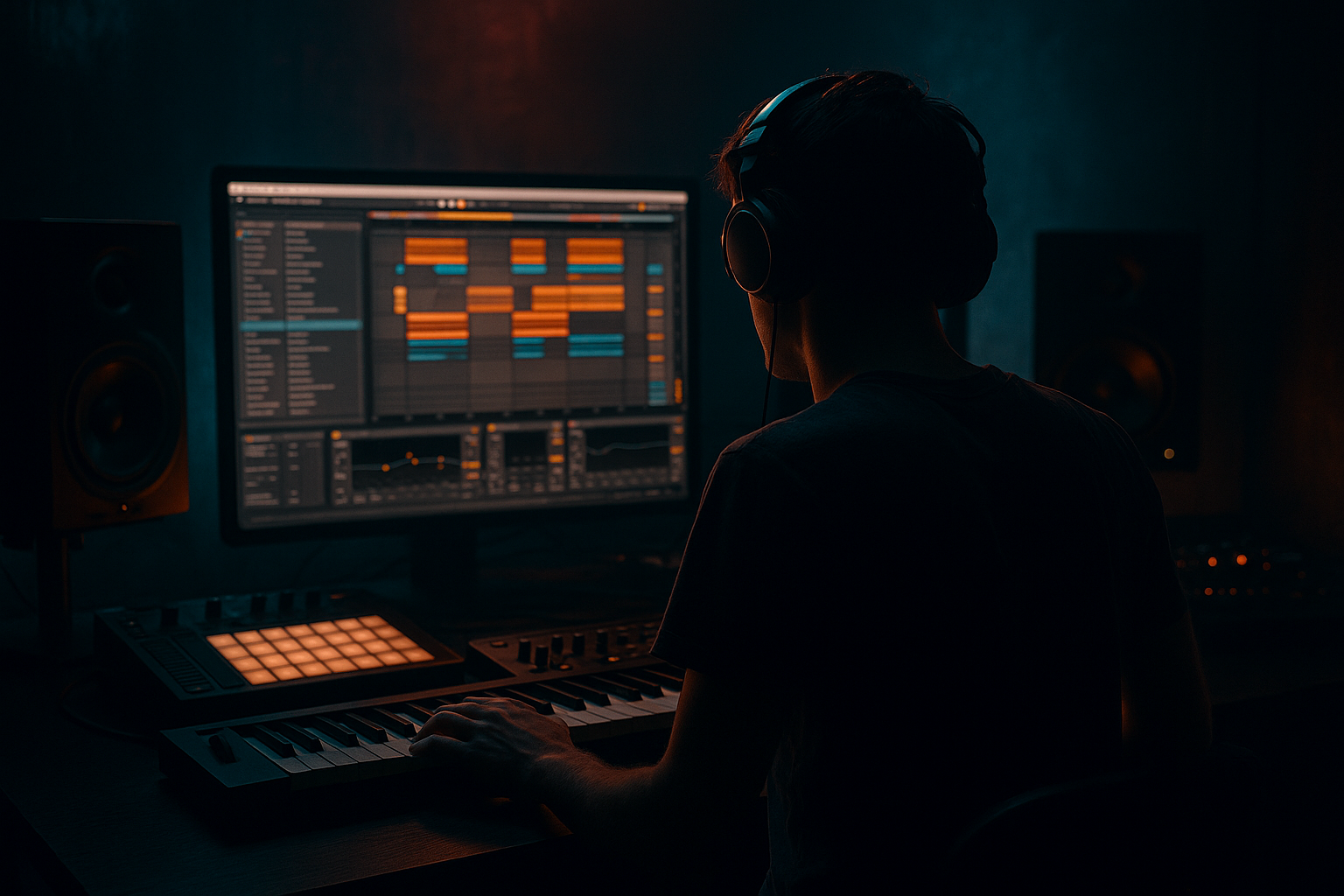
DJ Intro Compose Framework with Breakbeat Surgery in Ableton Live 12
1. Lesson overview
In drum and bass, the DJ intro is not just “the first 16 or 32 bars.” It’s the mix bridge: the section that lets another track come in cleanly while still sounding like your tune has identity. For advanced production, the best DJ intros do two things at once:
1. Give DJs room to mix
2. Introduce your sonic character immediately
In this lesson, we’ll build a DJ intro framework in Ableton Live 12 using breakbeat surgery and resampling. The focus is on making a clean, mix-friendly intro that still has gritty jungle energy, intelligent groove, and enough tension to lead into the drop.
This is especially useful for:
- DJ-friendly DnB arrangements
- Jungle / rollers / darkside intros
- Breakbeat-led intros before a full-drop bassline
- Resampling your own surgical edits into new, playable phrases 🎛️
- Simpler
- Slice to New MIDI Track
- Drum Rack
- Auto Filter
- EQ Eight
- Glue Compressor
- Saturator
- Drum Buss
- Hybrid Reverb
- Beat Repeat
- Delay
- Utility
- Resampling
- Clip Envelopes
- A clean opening section with kick/snare or atmospheric break fragments
- A surgically edited breakbeat loop with fills and variation
- A resampled texture layer for grit, ghost hits, and movement
- A mix-out friendly frequency profile so a DJ can blend the next tune
- A pre-drop tension ramp that transitions naturally into the drop
- Bars 1–8: Atmosphere + sparse break fragments + filtered low-end suggestion
- Bars 9–16: Full break loop appears, but still restrained
- Bars 17–24: More syncopation, fills, reverse hits, risers, tension
- Bars 25–32: Pre-drop emphasis, snare roll or impact prep, then drop entry
- Amen-style breaks
- Think break
- Worm / Funky Drummer style break layers
- Old jungle break recordings
- Your own programmed break with ghost notes and variations
- For tight percussive breaks: Beats mode
- Transient loop/slice preservation: try Complex Pro only if needed
- Set transient envelope so the kick and snare edges stay punchy
- Clean transient peaks
- Natural swing
- Separate kick/snare body
- Enough top-end hats for slicing
- 174 BPM for modern rolling DnB
- 170 BPM for darkstep / halftime-leaning intro logic
- 160–168 BPM if you’re building a more broken jungle feel
- Reorder hits
- Repeat ghost notes
- Remove clutter
- Program fills
- Recombine break fragments into a DJ intro groove
- Kick slices
- Snare slices
- Ghost hits
- Hat ticks
- Rim / top crack / noise fragments
- Fills / turnaround hits
- Rename pads if needed
- Color-code kick/snare/hat groups
- Route similar slices to chains or subgroups if you want separate processing
- Clean mix intro
- Heavy version
- Fill/variation version
- Start with atmosphere, filtered noise, or vinyl texture
- Add isolated break hits:
- Keep low-end restrained
- Bring in a short break loop
- Use 1-bar or 2-bar patterns with subtle variation
- Add a sidechain-tuned sub pulse or low percussion if needed
- Start hinting at the future bass movement
- Insert chopped fills
- Re-order slices for syncopation
- Add reverse break fragments
- Automate filter opening
- Add a second percussive layer or rim-click layer
- Increase drum density
- Introduce snare roll or accelerating fills
- Pull down the low end just before the drop if the mix needs space
- Add a final impact or short brake-hit before drop entry
- Bar 1: isolated snare ghost + hat
- Bar 2: kick + shuffled top slice
- Bar 3: break fragment with a missing kick
- Bar 4: turnaround fill
- Bar 5–8: repeat with subtle changes
- Don’t copy-paste the exact same 1-bar loop for 8 bars
- Remove a kick on bar 2 or 4 to create breathing space
- Re-sequence slices from different moments of the original break
- Use note velocities to simulate a real drummer:
- Hard quantize for anchor hits
- Slight swing or humanization for top-end fragments
- Quantize kick/snare anchors to 1/16
- Leave some hi-hat or ghost elements slightly loose
- If using Groove Pool, try classic MPC-style swing lightly, not heavily
- Prints your groove and processing
- Lets you chop the edited pattern again
- Makes variation faster
- Creates “one-off” rhythmic textures impossible to play from the original slices alone
- Slice it again
- Reverse a few hits
- Time-stretch a section
- Use it as a layer beneath the original Drum Rack
- Process with Beat Repeat, Redux, or Grain Delay for more character
- Use it as a subtle background groove
- Chop just the top-end transients and blend underneath
- Reverse a snare tail into the start of a phrase
- Automate a high-pass filter to bring in rhythmic air
- Apply a short room reverb to make it feel like a “space” before the drop
- EQ Eight
- Auto Filter
- Transient shaping via Drum Buss
- Utility
- Beat Repeat
- Echo
- Redux
- Hybrid Reverb
- EQ Eight
- Avoid full-range bass dominance too early
- Keep the first 8–16 bars relatively uncluttered
- Leave gaps where a DJ can phrase-match
- Use automation to gradually reveal energy
- Bar 1: atmosphere only or filtered percussion
- Bar 5: introduce snare anchor
- Bar 9: break loop starts
- Bar 17: open the hats and top end
- Bar 25: tension rise, not full drop energy
- Bar 31/32: pre-drop hit or stop
- Auto Filter cutoff
- Reverb dry/wet
- Delay feedback
- Utility gain
- Drum Buss drive
- Saturator drive
- Consider filtering the sub out until just before the drop
- Let the kick exist, but avoid full sub-bass pressure unless intentional
- Use EQ Eight or Auto Filter to thin the intro section
- If your bass is present early, make it less harmonically dense
- mono
- short
- filtered
- sparse
- Snare rolls
- Reverse cymbals
- Reversed break slices
- Short tape-stop style moments
- Drum fills made from the original break
- One-bar silence or drop-out before the drop
- Reverb with automation for tails
- Echo for rhythmic repeats into the drop
- Beat Repeat with a short grid for glitch fills
- Auto Filter for sweep tension
- Delay on isolated hits
- Fade envelopes on clips for quick reverse-like gestures
- a new texture
- a more coherent layer
- a source for re-slicing
- vinyl crackle
- machine rumble
- low mechanical atmospheres
- distant reverb tails
- Saturator
- Drum Buss
- Redux
- Overdrive
- broken breakbeat phrasing
- half-time phrase accents
- aggressive off-grid ghost notes
- clean mix intro
- heavier “album version” intro
- start with a solid breakbeat
- slice it surgically in Ableton Live 12
- program a phrase-based intro skeleton
- shape it with stock devices
- resample it into a new rhythmic asset
- re-slice and automate for tension and variation
- keep the low end controlled so DJs can mix cleanly 🎚️
We’ll use Ableton stock tools like:
---
2. What you will build
By the end, you’ll have a 32-bar DJ intro framework for drum and bass that includes:
Core structure
A strong advanced DnB intro often looks like this:
You can scale it to 16 bars if you want a tighter intro, but 32 bars is great for club-ready mixing.
---
3. Step-by-step walkthrough
Step 1: Choose or create your source breakbeat
You need a source break that has enough transient detail to cut up into usable fragments.
Good choices:
If using audio
Drag the break into an audio track and set the clip warp mode carefully:
If using a loop from a sample pack
Look for:
---
Step 2: Warp and align the break to your project grid
Set your project tempo in the DnB range, for example:
Warp procedure
1. Double-click the break clip
2. Enable Warp
3. Place the first downbeat precisely
4. Check the bar alignment
5. If needed, reduce warp markers to avoid over-stretching transients
Practical tip
If the break has natural swing you want to preserve, don’t over-quantize it into robotic stiffness. Let the groove breathe slightly. The intro should feel human and DJ-friendly, not locked like a rigid loop demo.
---
Step 3: Slice the break to a Drum Rack
This is where the surgery begins 🔪🥁
How to do it
1. Right-click the break audio clip
2. Choose Slice to New MIDI Track
3. In the slicing menu:
- Slicing preset: `Built-in → Drum Rack`
- Slice by: `Transient` is usually best
- Create one slice per: transient
- If needed, choose a custom slicing sensitivity to avoid tiny unwanted slices
Ableton will generate a Drum Rack with individual slices.
Why this matters
Now you can:
---
Step 4: Organize the slices into roles
Advanced break surgery becomes much easier when you think in roles, not just hits.
Group your slices conceptually:
Practical workflow
Inside Drum Rack:
Best practice
Duplicate your Drum Rack track and make one version for:
This gives you arrangement flexibility later.
---
Step 5: Build the DJ intro skeleton
Now create the actual intro rhythm.
Suggested 32-bar roadmap
#### Bars 1–8: Minimal opening
- snare ghost
- hat tick
- one kick every 2 bars or a sparse kick pattern
#### Bars 9–16: Groove appears
#### Bars 17–24: Surgery and variation
#### Bars 25–32: Pre-drop tension
---
Step 6: Program the core break pattern in MIDI
Open the Drum Rack MIDI lane and place slices deliberately.
Example intro idea
A strong DnB intro might use:
Advanced programming tips
- ghost notes around 20–45
- normal hats around 50–80
- accented snares around 95–127
Quantization
Use a mix of:
A good starting point:
---
Step 7: Shape the break with stock Ableton devices
Now we turn raw slices into a polished intro tool.
Recommended device chain on the Drum Rack track
#### Option A: Clean but punchy
1. EQ Eight
- High-pass the break layer around 30–40 Hz if needed
- Cut muddy low mids around 200–400 Hz if the break is boxy
2. Glue Compressor
- Ratio: 2:1
- Attack: 10–30 ms
- Release: Auto
- Aim for 1–3 dB gain reduction
3. Saturator
- Soft Clip on
- Drive: 1–4 dB
- Use subtly for density
4. Utility
- Mono below if needed, or reduce width for intro control
#### Option B: Dirtier jungle surgery
1. Drum Buss
- Drive: light to moderate
- Crunch: small amount for edge
- Boom: careful if the intro needs DJ headroom
2. Saturator
- Analog Clip or soft clip
3. EQ Eight
- Shape harshness around 6–10 kHz
4. Auto Filter
- Use automated low-pass to gradually open the intro
Important
Keep the intro mix more restrained than the drop. The DJ needs headroom. Your intro can be vibey, but it should not already sound “finished” in the same way the drop does.
---
Step 8: Add resampled texture layers
This is where the lesson moves into resampling.
Instead of just using the break slices directly, bounce them into new audio and re-edit the result. This gives you a more cohesive and aggressive intro texture.
Resampling method
1. Create a new audio track
2. Set its input to Resampling
3. Arm the track
4. Play your chopped break pattern
5. Record 4–8 bars of the intro groove
Now you have a single audio file containing your edited rhythm.
Why resample?
After resampling
Take that recorded audio and:
---
Step 9: Create a layered intro from the resampled audio
Now treat the resample as a new instrument.
Ideas for the resampled layer
Useful chains for resampled audio
#### Tighter layer
#### More experimental layer
Keep this layer quieter than the main break. Think of it as ear candy and glue, not the main event.
---
Step 10: Build the DJ mix-friendly arrangement
A DJ intro must let another track mix in without chaos.
Arrangement rules
Practical arrangement tactics
Automation ideas
Use automation on:
This creates movement without overcrowding the intro.
---
Step 11: Make it DJ-friendly in the low end
Your intro should often be more mixable than your drop.
Low-end strategy
If the intro includes bass hints
Keep it:
That way the DJ can blend another tune without the low end becoming a mess.
---
Step 12: Add tension with fills and phrase transitions
This is where advanced arrangement starts to feel like record-level writing.
Strong transition tools
Ableton devices that help
A classic trick: resample a 2-bar fill, then slice that fill and use the final 1/2 bar as a pickup into the drop.
---
4. Common mistakes
1. Making the intro too full too early
If everything is big from bar 1, the DJ has nowhere to mix. Leave space.
2. Over-quantizing breakbeat surgery
DnB needs precision, but if every slice is snapped perfectly, the groove loses life.
3. Using too much low end in the intro
The intro should usually suggest bass, not overwhelm with it.
4. Resampling without intention
Don’t resample just to resample. Print a groove because you want:
5. Too much reverb on drum slices
Long reverb can destroy mix clarity. Keep it tight or automate it selectively.
6. Ignoring phrase structure
DJ intros need predictable phrasing. Make sure your 8-, 16-, and 32-bar logic is clean.
7. No variation
Even an intro should evolve. Change a hit, mute a slice, or alter a fill every 4 or 8 bars.
---
5. Pro tips for darker/heavier DnB
Tip 1: Use negative space as pressure
Dark DnB hits harder when the drums stop for a moment. Silence before a snare or fill can be brutal in the best way.
Tip 2: Layer a filtered noise bed
Add:
Then high-pass and automate them so they feel alive, not muddy.
Tip 3: Distort the resample, not the original
Keep your original break editable. Push the resampled layer harder with:
That way you preserve flexibility while still getting grit.
Tip 4: Make the snare the anchor
In darker rolling DnB, the snare is often the main structural reference. Build the intro around its timing and energy.
Tip 5: Use filtered bass hints
A low rumble or filtered Reese fragment can foreshadow the drop without stealing the intro’s mix space.
Tip 6: Experiment with half-step and broken phrasing
You can make an intro feel menacing by combining:
That contrast is very jungle/DnB-friendly.
---
6. Mini practice exercise
Goal
Build a 16-bar DJ intro using one breakbeat and one resample layer.
Exercise steps
1. Pick one break loop at 174 BPM
2. Slice it to Drum Rack using Transient
3. Program a 4-bar motif with:
- sparse opening
- one fill at the end of bar 4
4. Resample that 4-bar phrase to a new audio track
5. Slice the resample into 4–8 new fragments
6. Rebuild a second layer beneath the first
7. Automate:
- Auto Filter cutoff
- Saturator drive
- Utility gain
8. Create a phrase lift at bars 13–16
9. Bounce the whole intro and listen for:
- mix clarity
- energy rise
- DJ usability
Challenge version
Make the intro work in two modes:
Use the same source break, but different resample processing.
---
7. Recap
A strong DJ intro in drum and bass is a structured mix tool with attitude. The process is:
If you remember one thing:
the best DnB intros don’t just fill space — they create a controlled runway into impact.
Use breakbeat surgery to make the rhythm speak, and use resampling to turn edits into a signature intro language.

