Main tutorial
1. Lesson Overview
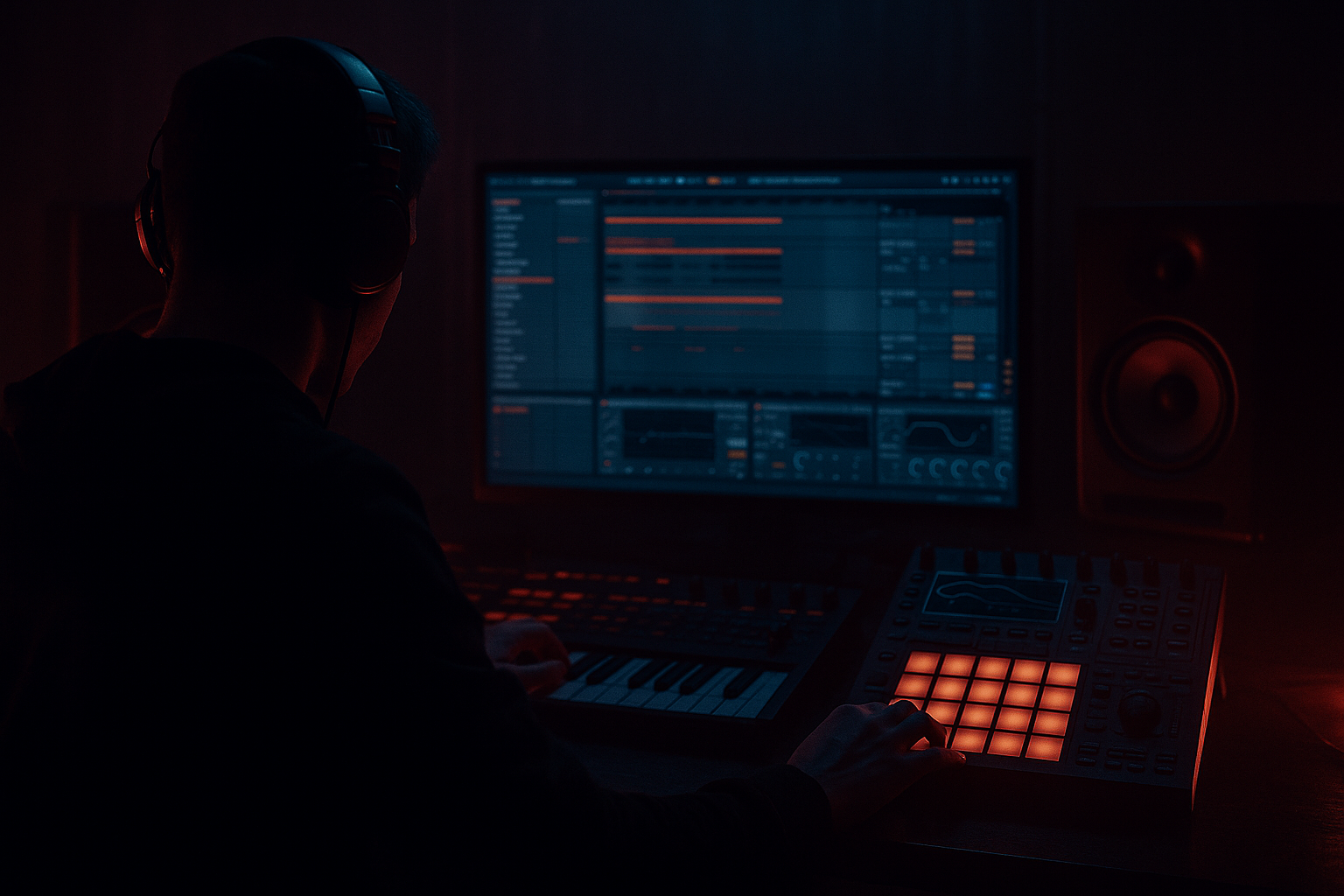
This intermediate Sound Design lesson teaches you how to create a Dimension edit: tune a filtered breakdown from scratch in Ableton Live 12 for rave-laced tension. You’ll build a musically tuned, resonant filtered breakdown section that sits in context with Drum & Bass energy, using only Ableton Live 12 stock devices (Wavetable/Operator/Simpler, Auto Filter, EQ Eight, Compressor/Glue, Saturator, Hybrid Reverb, Grain Delay, Utility, LFO). The focus is on tuning the filter movement to musical content (so filter peaks and sweeps harmonize with your key/chords), creating rhythmic tension, and keeping the mix tight for high-impact DJ/rave transitions.
2. What You Will Build
- An 8–16 bar filtered breakdown template (MIDI + audio) suitable for Drum & Bass.
- A layered pad/chord source with a clean sub/bass separation.
- A tuned low‑pass filter sweep and resonant peaks that are locked musically to the track’s key and chord changes.
- Complementary effects (reverb/delay, saturation, sidechain/gating) to create rave-laced tension without cluttering the low end.
- Automation and modulation maps so the breakdown is easy to tweak and performance-ready.
- Leaving resonance too high across the whole breakdown — causes nasal ringing and mask the bass. Automate resonance to rise only during peaks of tension.
- Tuning by numbers only (Hz) without an aural check — the ear is the final arbiter. Use a sine reference to confirm.
- Not keeping the sub clean: if your pad has energy below ~120 Hz, it will fight the bass/drop. Always HPF atmospheric layers.
- Over-automating many parameters simultaneously — keep primary modulations on cutoff, resonance, dry/wet sends, and one LFO/rhythm source.
- Relying only on synced LFO rates for musical relation — use the keyed manual tuning technique to align filter peaks to chord roots/partials.
- Use a simple sine Operator reference on a MIDI track playing the root + chord tones: when you sweep the filter you’ll hear beating when you’ve found harmonic alignment. It’s fast and reliable.
- For very precise musical filter tuning, create short automation snapshots: hit play, find sweet spot, right‑click the Cutoff knob and choose “Show Automation” and use Command-click (or Ctrl) to capture exact value into the arrangement.
- Use Auto Filter’s LFO as a subtle vibrato on the cutoff while the main movement is done with automation — keeps things lively but predictable.
- If you need the filter peak to act like a pitched element, automate Resonance up and simultaneously add a narrow boost in EQ Eight at the same frequency — this creates a quasi-tonal “whistle” that can be MIDI-locked by ear.
- To emulate the Dimension edit vibe, automate pre-delay of the reverb (short pre-delay -> longer) and increase Grain Delay feedback subtly for the last bar before drop: it gives that “rave tail” without extra spectral mud.
- Save this entire chain as an Effect Rack preset with Macro controls (Cutoff, Resonance, LFO Amount, Reverb Send, Drive) for quick recall.
- Tempo = 174 BPM.
- Use Wavetable + Simpler layered pads; HPF both at 120 Hz.
- Create a key reference sine on Operator that plays the chord notes for all 8 bars.
- For bars 1–8, capture four distinct Auto Filter cutoff positions (one per 2 bars) that harmonize with the chord changes. Automate cutoffs with smooth exponential curves between them.
- Add an LFO mapped to cutoff synced to 1/8 at a low amount.
- Add Hybrid Reverb send automation that rises from 0% to 35% by bar 7.
- Export a 24-bit audio loop and compare it in context with your drum loop and sub bass — adjust HPF and resonance to keep clarity.
- Use a clear sine key reference to find harmonic points.
- Build layered pads, keep low end clean with HPF, and group them.
- Tune Auto Filter cutoff and resonance to musical sweet spots for each chord change, using EQ Eight to locate frequencies.
- Combine automated cutoff snapshots with subtle synced LFO, sidechain, and wet/dry send automation for tension.
- Polish with saturation, reverb/delay returns, and careful mix-stage EQ.
3. Step-by-Step Walkthrough
Note: the phrase "Dimension edit: tune a filtered breakdown from scratch in Ableton Live 12 for rave-laced tension" is the central goal — follow these steps to achieve it.
A — Project setup and key reference
1. Set your project tempo (160–175 BPM typical for modern DnB; I’ll use 174 BPM as an example). Create a return track for Reverb (Hybrid Reverb) and a return for Delay (Ping Pong or Grain Delay).
2. Decide the key of your track. Create a simple MIDI track called KEY_REF using Operator (or Wavetable) and put a single sustained MIDI note of the root (and optionally the chord notes) for the full length of the breakdown. This is your tuning reference — keep it audible while you tune the filter later. Set Operator to a pure sine or triangle for clear harmonics (easy ear-locking).
B — Build the pad/chord sound
3. Create a new MIDI track PAD_1 with Wavetable (or Simpler with a multi-saw sample). Program a 4–8 bar chord progression that matches your track key. Keep voicing sparse: root + 3rd + 5th (or add a suspended 4th for tension).
4. Stack a second layer PAD_2 (Simpler with sampled texture or Wavetable with different unison) an octave above or with different timbre for width. Keep low frequencies below 120 Hz removed on these pad channels using EQ Eight (high-pass at ~120 Hz) — we’ll keep sub clean.
C — Route and group for filtering
5. Group PAD_1 + PAD_2 into a group called BREAKDOWN_PAD. After the group device chain, insert:
- Utility (center phase and gain staging)
- Auto Filter (Low Pass, 24 dB/oct recommended)
- EQ Eight (for fine harmonic boosts)
- Saturator (soft drive)
- Compressor (Glue for subtle glue)
6. Set Auto Filter initial settings:
- Type: Low Pass 24dB
- Cutoff: start around 1.2–1.5 kHz (you’ll tune this)
- Resonance: 3–5 (watch for ringing)
- Drive: 0–3 dB (optional)
- LFO OFF for now
D — Tune the filter to musical content (the key technique)
7. Solo KEY_REF and BREAKDOWN_PAD together. Play them both. The goal is to “lock” Auto Filter’s cutoff so its resonant emphasis sits on harmonic partials of the reference note/chords.
8. Manually sweep the Auto Filter cutoff while listening. When you get a noticeable beating or reinforcement between the reference sine and the filter peak, stop. That’s a musically sympathetic point.
9. To make precise choices:
- Use EQ Eight after Auto Filter set to a narrow Bell (Q ~ 4–6) and sweep frequency: boost a few dB to find harmonic peaks. Note the frequency shown in Hz.
- With that frequency in hand, set the Auto Filter cutoff near it (slightly lower for sweep motion) and increase Resonance to taste so the filter peak emphasizes that harmonic.
10. Repeat this process at each chord change. Place breakpoints in Arrangement view automation for the Auto Filter Cutoff (or map Cutoff to a Rack Macro and automate the Macro). For an 8-bar breakdown with chord changes at bars 1, 3, 5, 7: capture the cutoff sweet spot for each chord and draw a smooth curve between them (use exponential curves to create strong tension build).
E — Create rhythmic/rave-laced movement
11. Add rhythmic motion to the tuned cutoff:
- Insert Live 12’s LFO device (audio-rate LFO available natively) after Auto Filter or map to Auto Filter’s Cutoff. Set LFO to sync to 1/8 or 1/16 and a triangle or saw wave. Set amount low (e.g., ±80–150 Hz) to add musical wobble without losing tuning.
- For more pronounced stutters, automate the Auto Filter Cutoff with sharply stepped values (use Draw Mode), or use a Utility device and automate Gain for gating.
12. Use sidechain compression to duck the pad slightly against the drums/bass for groove. Place a Compressor after Saturator and enable Sidechain, using the Kick/Drum bus as input. Adjust attack/release to taste (fast attack, release synced to 1/16–1/8 for bounce).
F — Add tension-building FX and tails
13. Send some of the pad to Reverb return: Hybrid Reverb with pre-delay (10–40 ms) and long decay (2–4 s) gives the rave tail. Automate the send amount to increase across the breakdown.
14. Use Grain Delay on a duplicate send for broken granular shimmer timed to the grid — set dry/wet low and sync to 1/8 or 1/16 triplets. This adds dimension without clouding low end.
15. Automate the group’s Saturator drive and the Auto Filter resonance subtly during the last two bars to push toward the drop.
G — Final tonal/mix polish
16. After you’ve tuned automation points, turn off the KEY_REF or lower it. Solo with drums and bass and confirm the filter peaks don’t clash with the bass/sub. If you hear low-end clash, reduce pad low content further (HPF at 140–180 Hz) or notch conflicting frequencies with EQ Eight.
17. Add a dedicated parallel bus: Duplicate the pad group (or use a return) and heavily saturate and high-pass it to create a bright, resonant “shimmer” that you can automate in at the climactic moment.
18. Bounce/export or pull into arrangement as your tuned filtered breakdown.
4. Common Mistakes
5. Pro Tips
6. Mini Practice Exercise
Create an 8-bar tuned filtered breakdown in G minor (or your track key) using the following constraints:
7. Recap
This lesson showed you how to create a Dimension edit: tune a filtered breakdown from scratch in Ableton Live 12 for rave-laced tension. The key steps:
Follow the practice exercise and save your Effect Rack so you can reuse this tuned filtered breakdown approach across tracks.

