DNB COLLEGE

Drum & Bass Ableton Live 12 Tutorials

LESSON DETAIL

Digital DJ intro in Ableton Live 12 for breakbeat science (Advanced · Vocals · tutorial)

An AI-generated advanced Ableton lesson focused on Digital DJ intro in Ableton Live 12 for breakbeat science in the Vocals area of drum and bass production.

Back to lessons
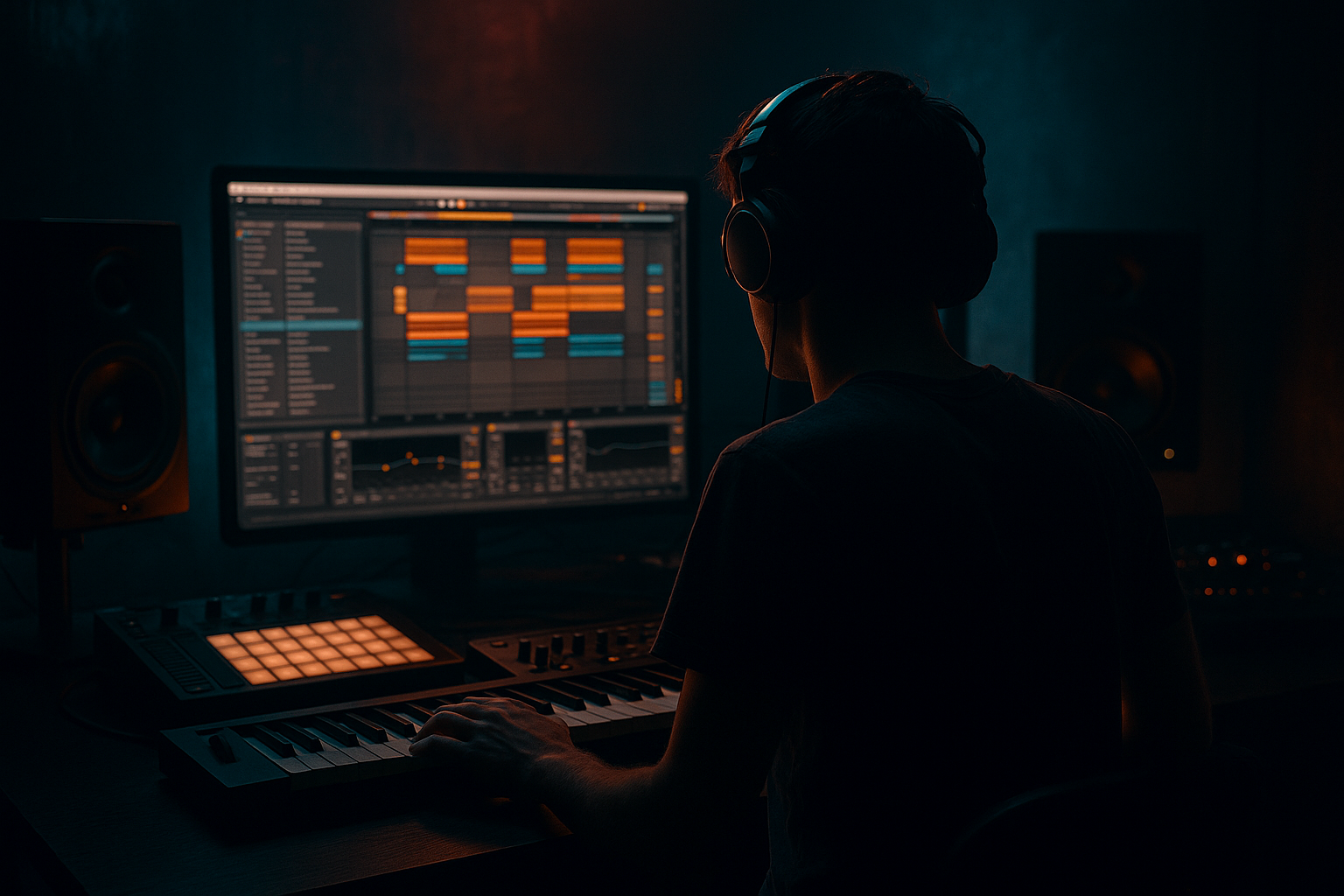
Digital DJ intro in Ableton Live 12 for breakbeat science (Advanced · Vocals · tutorial) cover image

Narrated lesson audio

The voice track includes the tutorial plus extra teacher commentary.

Open audio file

Main tutorial

1. Lesson Overview

This advanced lesson walks you through creating a polished, club-ready Digital DJ intro in Ableton Live 12 for breakbeat science — a short, characterful voice-led opening that DJs and promos use to set tempo, attitude and texture over breakbeat rhythms. We'll focus on vocal processing for that “digital DJ” aesthetic: clean voice capture, rhythmic chopping/stutters, vocoderized texture for a futuristic label-id, and mix-ready blending so the intro sits with punchy breakbeat drums. All workflows use Ableton Live 12 stock devices.

2. What You Will Build

  • A 16–32 bar intro (tempo-synced to your session) containing:
  • - A clear, compressed and de-essed lead voice line (spoken/staccato line).

    - Glitch/stutter and gated chop variations sync’ed to breakbeat groove.

    - A vocoder layer (chords) that gives a digital DJ texture.

    - Delay/reverb and modulation that keep intelligibility but add space.

    - Render-ready stereo stem (dry+processed) that fits over a breakbeat loop.

    3. Step-by-Step Walkthrough

    Note: Use a Breakbeat session set to your target BPM (160–176 typical for D&B). Name tracks for clarity: VO_Dry, VO_Processed, VOC_Carrier (Wavetable), GATE/CHOP, FX_Send, Drums.

    A. Prepare the vocal

    1. Record/Import the spoken DJ line into VO_Dry as an audio clip. Normalize and trim silence so phrases start on beat 1.

    2. Warp to the grid if you need timing tightening; use Beats mode with transient preservation for spoken word.

    3. Duplicate VO_Dry to VO_Processed. Keep the original VO_Dry muted or as a parallel reference.

    B. Clean-up and intelligibility

    1. Insert EQ Eight on VO_Processed. High-pass at ~100 Hz to remove proximity boom. Use a gentle low-mid cut (~200–400 Hz) if the voice sounds boxy.

    2. Add Live’s De-Esser (Compressor sidechain technique or Multiband Dynamics) — if you prefer stock-only: use Compressor with sidechain triggered by a high-band send (use Utility + EQ to route) or use Multiband Dynamics to tame sibilance band (~4–8 kHz).

    3. Add Compressor (Glue or Compressor): fast attack (~1–10 ms), medium release, 3–6 dB gain reduction — this tightens the vocal for a confident DJ read.

    C. Create rhythmic chops/stutters (Digital DJ feel)

    1. Duplicate VO_Processed to GATE/CHOP track. Insert Gate (Live’s Gate) and set Threshold so only strong syllables pass.

    2. Use Beat Repeat on GATE/CHOP for stutter patterns: set Interval to 1/16 or 1/32 synced to grid, Grid to 1/16 (or smaller for glitch), Chance to taste, and set Pitch to 0 for no detune. Automate Repeat chance and Gate threshold across the intro for variation.

    3. For tight micro-chops, convert small vocal slices to new clips and use clip start/loop points to create rhythmic repeats. Use clip transpose and nudge to taste.

    D. Build the carrier for the vocoder

    1. Create VOC_Carrier track and load Wavetable (stock synth).

    2. Program a simple pad/chord progression: use a saw + square mix, low-pass filter with slow envelope to avoid harshness. Keep voices high enough in harmonic content — use 3–6 unison voices with slight detune for width but low detune amount to avoid pitch smear.

    3. Place an Auto Filter or EQ Eight pre-Vocoder on the carrier and high-pass below ~100 Hz to keep carrier clean. Keep carrier level healthy but not clipping.

    E. Set up Ableton Vocoder (modulator and carrier routing)

    1. Place the Vocoder device on the VOC_Carrier track (the track hosting Wavetable). This makes the device act on the carrier and allows the sidechain to be the modulator.

    2. Open the Vocoder’s sidechain pop-up (click the small arrow or Sidechain section in the device). In the “Audio From” (sidechain) chooser, select the VO_Processed track — this assigns your processed vocal as the modulator signal.

    3. Configure the Vocoder:

    - Bands: increase to 40–80 for intelligibility (more bands = clearer consonant detail). For a more “digital” grainy texture, reduce bands (10–20).

    - Attack/Release: set Attack short (~1–10 ms) to capture consonant transients; Release medium to long depending on pad length (20–200 ms) to avoid choppy tails.

    - Dry/Wet: start at 50% and later blend by parallel routing (see blending).

    - Carrier Shape: if the Vocoder offers carrier oscillator choices, try saw/square for harmonically rich carriers; if not, shape the Wavetable accordingly.

    4. Optional: enable Pitch Tracking or Formant controls if present to make the vocoded voice follow vocal pitch more tightly. If Live 12’s Vocoder includes a Formant Shift, use subtle shifts (±2 semitones) to avoid intelligibility loss.

    F. Shape intelligibility of the vocoded voice

    1. Pre-filter the modulator (VO_Processed) with EQ Eight: emphasize 1–4 kHz (presence) with a narrow boost (1–3 dB) before it hits the Vocoder. This helps bands detect consonants.

    2. On the VOC_Carrier track, add EQ Eight after Vocoder to carve space: cut 2–4 kHz slightly if the vocoder muddies the lead, boost 5–8 kHz carefully for sibilance clarity.

    3. Use Sidechain Compressor on the VOC_Carrier track with the kick/snare or VO_Processed as trigger for rhythmic pumping if required; keep the vocab intelligible by making the compressor medium ratio and short release.

    G. Blend the effected voice in context

    1. Use a Send/Return approach: create an FX_Send return for reverb (Hybrid Reverb) and Delay (Echo). Send both VO_Processed and VOC_Carrier to the returns at different send levels (Vocoder often gets less reverb than dry VO so consonants remain intelligible).

    2. Create parallel chains: keep VO_Processed dry in the center and place VOC_Carrier slightly wider via Utility (Width ~80–100%) and a stereo delay (ping-pong) on an FX return for width without losing mono intelligibility.

    3. Use Utility gain staging: set the vocoder return slightly lower (-3 to -6 dB) and automate up on climactic bars.

    4. Final glue: add Master Bus compression (Glue Compressor) lightly and a touch of Saturator (Soft Drive) on the vocal bus to help cut through breakbeat drums.

    H. Finishing touches (digital DJ flavor)

    1. Use Redux sparingly on small duplicates for bitcrushed digital texture; automate on/off for build-ups.

    2. Automate a “vocal scan” effect: automate Bands or Dry/Wet of Vocoder from low to high for an opening scan; pair with a rising filter sweep on Wavetable.

    3. Add micro-delay/gated reverb tails by duplicating a short vocal hit into a reverb-heavy chain and gating the reverb with Gate synced to tempo.

    4. Render stems: create two exports — a VO stem (dry+processed, but not the full mix reverb) and an FX stem (sweeps, vocoder-heavy bed) so DJs can mix the intro cleanly.

    4. Common Mistakes

  • Over-vocoding: using too few bands or extreme wet setting so the words become unintelligible. Fix: increase bands and blend dry in parallel.
  • Carrier is too busy: overly detuned, high-unison carriers smear consonants. Fix: lower unison amount, reduce chorus, simplify carrier patch.
  • No pre-emphasis on vocal: skipping the mid/high boost on the modulator reduces consonant detection, vocoder sounds mushy. Fix: EQ the vocal before the Vocoder sidechain.
  • Too much global reverb on the vocoded track: intelligibility lost and the intro sits behind the drums. Fix: use short predelay, lower wet, or send less to reverb on vocoder.
  • Not tempo-syncing chop/repeat devices: stutters out of groove. Fix: set Beat Repeat, Echo and clip loop sizes to triplets or straight divisions that match your breakbeat pattern.
  • Over-compressing the carrier so it squashes dynamics needed for modulation. Fix: use gentle compression or sidechain only.
  • 5. Pro Tips

  • Use transient emphasis on consonants: duplicate vocal, apply a fast-attack transient designer (or Compressor with fast attack) and feed that copy into Vocoder for stronger intelligibility on consonants.
  • Create “stereo intelligibility” by keeping the dry vocal center and the vocoder slightly panned or width-adjusted: humans localize speech centrally, so keep core content mono.
  • Automate low-pass on the carrier under drop-ins: cut carrier lows just before the drums to make the intro punch through.
  • Use a rhythmic LFO on Wavetable filter cutoff synced to 1/8 or 1/16 to make the vocoder breath rhythmically with the breakbeat.
  • Print different versions (full wet, 50/50, dry-heavy) so DJs/promoters can choose according to their mixing style.
  • For a “radio/announcement” tone, run a subtle Analog-modeled Saturator before EQ to add harmonic weight without losing clarity.
  • 6. Mini Practice Exercise

    Goal: Make a 16-bar “Digital DJ intro in Ableton Live 12 for breakbeat science” that DJs can drop into a set.

  • Start with a 16 bar scene at 170 BPM. Import a spoken line (4–6 words).
  • Process: EQ, De-ess, Glue Compress.
  • Create a 4-bar looped vocoder bed: Wavetable pad → Vocoder (sidechain from vocal) → set Bands = 60, Attack = 5 ms, Release = 60 ms.
  • Make two 1-bar variations using Beat Repeat and clip chopping (one with 1/16 stutter and one with pitched repeats).
  • Add an Echo return synced to 1/8 dotted; send the vocoder at -6 dB and the dry vocal at -2 dB.
  • Export the intro stem and listen over a simple breakbeat loop; tweak band count and send levels until vocal reads clearly over the drums.

7. Recap

We built a Digital DJ intro in Ableton Live 12 for breakbeat science by preparing a tight spoken vocal, creating rhythmic chops, and designing a vocoder texture using a Wavetable carrier routed into Ableton’s Vocoder (modulator = processed vocal). Key advanced moves: pre-EQ the modulator for consonant clarity, choose carrier waveforms and unison carefully, set Vocoder bands/attack/release to balance intelligibility vs character, and blend via parallel routing and tempo-synced FX. Apply the pro tips and the mini exercise to lock this intro into your breakbeat mixes quickly and professionally.


Ask GPT about this lesson

Chat with the lesson tutor, get follow-up help, or use quick actions.

Bigup 👽 Ask me anything about this lesson and I’ll answer in context.

Narration script

Show spoken script
Welcome. In this advanced Ableton Live 12 lesson we’ll build a polished, club-ready Digital DJ intro for breakbeat science — a short, characterful voice-led opening that DJs and promos use to set tempo, attitude and texture over breakbeat rhythms. We’ll focus on vocal processing for a “digital DJ” aesthetic using only Live 12’s stock devices: clean voice capture, rhythmic chops and stutters, a vocoder texture for a futuristic label ID, and mix-ready blending so the intro sits with punchy breakbeat drums.

What you’ll build: a 16 to 32 bar intro, tempo-synced to your session, featuring a clear compressed and de‑essed lead voice line, glitch and gated chop variations synced to the groove, a vocoder layer built from a Wavetable carrier, and delay, reverb and modulation that keep intelligibility while adding space. You’ll finish with render-ready stereo stems — a dry+processed vocal stem and an FX stem that fits over a breakbeat loop.

Set up your Breakbeat session at your target BPM — 160 to 176 is typical for drum and bass. Name your tracks for clarity: VO_Dry, VO_Processed, VOC_Carrier, GATE_CHOP, FX_Send, and Drums. This makes routing and automation predictable as you work.

First, prepare the vocal. Record or import a short spoken DJ line into VO_Dry. Normalize and trim silence so your phrases start on beat one. If timing needs tightening, warp to the grid in Beats mode while preserving transients for spoken word. Duplicate VO_Dry to create VO_Processed; keep the dry reference muted or available as parallel material.

Next, clean up the processed vocal for intelligibility. Insert EQ Eight on VO_Processed and high‑pass around 100 hertz to remove proximity boom. If the voice is boxy, apply a gentle low‑mid cut around 200 to 400 hertz. Treat sibilance with Live’s De‑Esser approach: if you have a De‑Esser device, use it; if you want a stock workaround, use Compressor with a sidechain routed to a high-band send or use Multiband Dynamics to tame the 4 to 8 kilohertz band. Follow with a Glue Compressor or Compressor set to a fast-ish attack — between one and ten milliseconds — medium release, and around three to six decibels of gain reduction. That tightens the vocal into a confident DJ read.

Now build the rhythmic chops and stutters for the digital DJ feel. Duplicate VO_Processed to a GATE_CHOP track. Insert Live’s Gate and set the threshold so only strong syllables pass. Add Beat Repeat on the GATE_CHOP track for stutter patterns: set Interval to 1/16 or 1/32, Grid to 1/16 or smaller for glitch, Chance to taste, and Pitch to zero unless you want detune. Automate Repeat chance and Gate threshold across the intro for variation. For very tight micro‑chops, convert short vocal slices into new clips and use clip start and loop points to create precise rhythmic repeats; transpose and nudge clips to taste.

Next we need a carrier for the vocoder. Create a VOC_Carrier track and load Wavetable. Program a simple pad or chord progression using a saw and square mix, and tame it with a low‑pass filter and a slow envelope so it doesn’t get harsh. Use three to six unison voices with slight detune for width, but keep detune low to avoid pitch smear. Place Auto Filter or EQ Eight before the Vocoder on the carrier, and high‑pass below about 100 hertz to keep the carrier clean. Keep the carrier level healthy, but not clipping.

Place Ableton’s Vocoder on the VOC_Carrier track so the device treats the carrier and accepts a sidechain modulator. In the Vocoder’s sidechain, choose VO_Processed as the Audio From source. For settings, raise Bands to something between forty and eighty for good intelligibility; for a more robotic grain, choose lower band counts between ten and twenty. Set Attack short — around one to ten milliseconds — to capture consonant transients, and Release between twenty and two hundred milliseconds depending on the pad length to avoid choppy tails. Start Dry/Wet at fifty percent and plan to blend with parallel routing. If Live offers carrier oscillator choices or formant controls, experiment subtly — small formant shifts of a couple semitones can add character without destroying intelligibility.

To keep the vocoded voice clear, pre‑filter the modulator. On VO_Processed, use EQ Eight to emphasize presence between one and four kilohertz with a narrow one to three dB boost so the Vocoder’s bands detect consonants more reliably. After the Vocoder, on the VOC_Carrier track, use EQ Eight to carve space — cut two to four kilohertz slightly if the vocoder muddies the lead, and boost five to eight kilohertz carefully for sibilant clarity. If you want rhythmic pumping, add Sidechain Compression on the carrier triggered by kick or snare, but keep ratios moderate and release short so you don’t chop consonants.

Blend the effected voice in context using Sends and Returns. Create an FX_Send return for Hybrid Reverb and an Echo return. Send VO_Processed and VOC_Carrier to the returns at different levels — usually the vocoder gets less reverb than the dry vocal to preserve consonant clarity. Keep VO_Processed centered and mono, and place the VOC_Carrier slightly wider using Utility or a stereo delay on an FX return. Use Utility gain staging to set vocoder returns lower — around minus three to minus six dB — and automate up during climactic bars. For final glue, add light bus compression on your vocal bus and a touch of Saturator in Soft Drive mode to help the voice cut through breakbeat drums.

Add finishing touches for the digital DJ flavor. Use Redux sparingly on short duplicates for bitcrushed texture and automate it on and off for transitions. Automate Vocoder bands or Dry/Wet to create a “vocal scan” that evolves from clean to digital; pair that with a rising filter sweep on the Wavetable. For gated reverb tails and micro‑delays, duplicate short vocal hits into a reverb-heavy chain and gate the reverb with Gate synced to tempo. When you’re ready, render two exports: a VO stem with dry and processed elements but minimal global reverb, and an FX stem that contains sweeps and vocoder-heavy beds so DJs can mix the intro cleanly.

Be mindful of common mistakes. Over‑vocoding with too few bands or extreme wet settings makes words unintelligible — fix this by increasing bands and blending dry in parallel. If the carrier is too busy from excessive unison or detune, reduce unison and simplify the patch. Don’t skip pre‑emphasis on the vocal; boosting presence before the Vocoder is crucial to avoid mushy results. Avoid drowning the vocoder in global reverb — use short predelay and lower wet levels. And always tempo‑sync chop and repeat devices so stutters stay in groove.

A few pro tips: emphasize consonants by duplicating the vocal, applying a fast transient focus or heavy compression to that duplicate, and feeding it into the Vocoder to strengthen band triggers. Keep the dry vocal centered and mono for localization; make the vocoder slightly wider. Automate a low‑pass on the carrier under drop‑ins to let drums pop through. Use a rhythmic LFO on Wavetable cutoff synced to eighth or sixteenth notes to make the vocoder breathe with the breakbeat. Print different mixes — full wet, 50/50, and dry-heavy — so DJs can choose what works for their set.

Mini practice exercise: make a 16‑bar intro at 170 BPM. Import a 4–6 word spoken line. Process it — EQ, de‑ess, glue compress. Create a 4‑bar looped vocoder bed with Wavetable and Vocoder sidechained to the vocal, set Bands to 60, Attack to five milliseconds and Release to sixty milliseconds. Make two 1‑bar variations: one with a 1/16 stutter using Beat Repeat and one with pitched repeats via clip chopping. Add an Echo return synced to dotted eighth, send the vocoder at minus six dB and the dry vocal at minus two. Export the stem and listen over a simple breakbeat; tweak bands and sends until the vocal reads clearly.

Recap: we prepared a tight spoken vocal, created rhythmic chops, and designed a vocoder texture using Wavetable as carrier with the processed vocal as modulator. Key advanced moves are pre‑EQing the modulator for consonant clarity, choosing carrier waveforms and unison carefully, finding Vocoder band, attack and release settings that balance intelligibility with character, and blending via parallel routing and tempo‑synced FX.

A few final coaching notes: treat the intro as a DJ tool first — clarity, tempo locking and dynamic contrast matter more than lush pads. Think in layers: dry read in the center, processed chops for rhythm, vocoder bed for texture, and FX stems for air and risers. Build Audio Effect Racks with macros for de‑essing, compression, presence and dry/wet so you can morph the vocal fast. For CPU savings, resample finished vocoder sounds and work with audio. Always check mono compatibility, keep low end summed and high‑pass carriers under about 100 hertz, and label your stems with BPM, key and bar length when delivering to DJs.

That’s the roadmap. Follow these steps, apply the pro tips and practice exercise, and you’ll be able to produce a professional Digital DJ intro in Ableton Live 12 that sits cleanly with breakbeat drums and gives DJs the tools they need to drop it into their sets.

mickeybeam

Go to drumbasscd.com for +100 drum and bass YouTube channels all in one place - tune in!

Generating PDF preview…