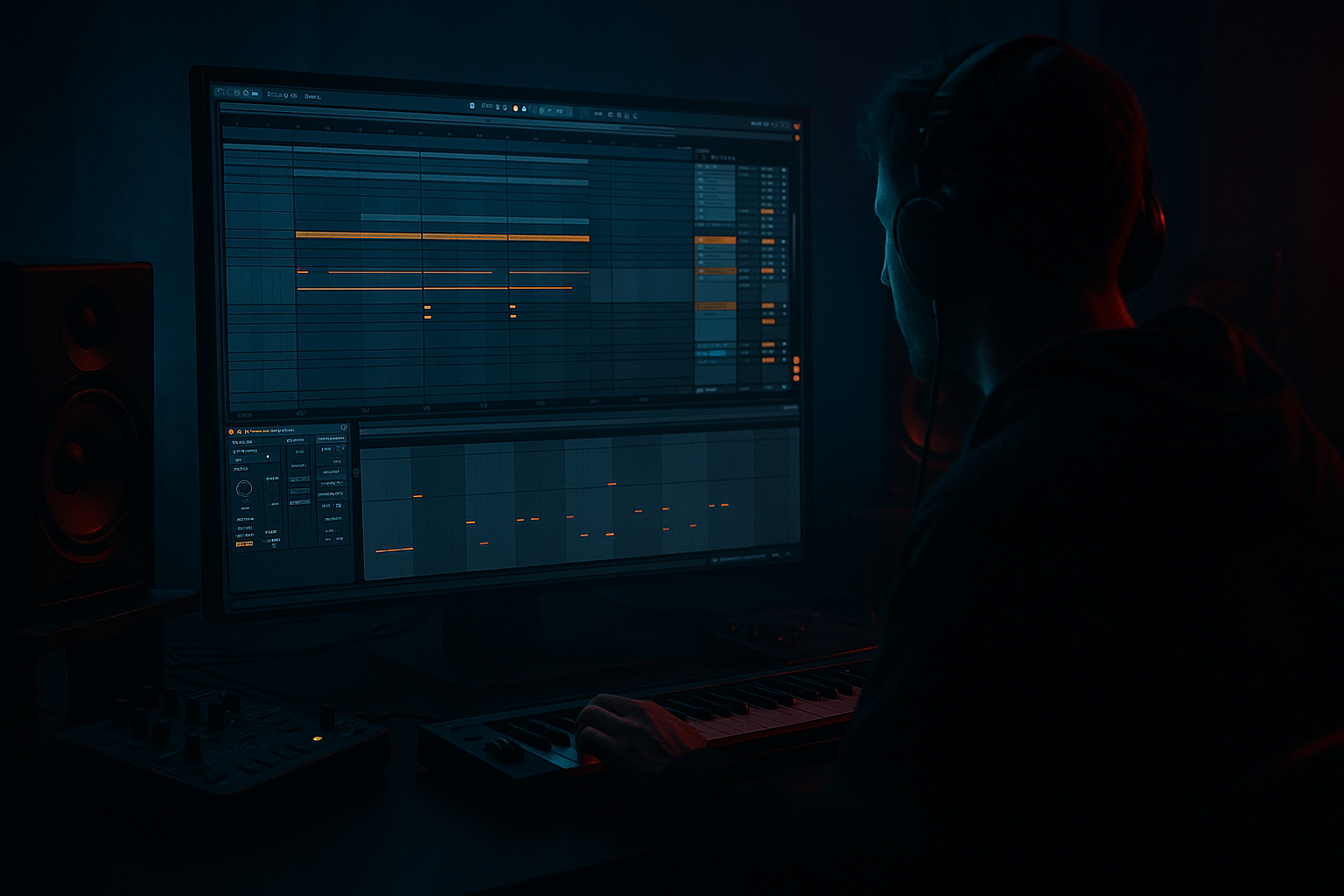
Main tutorial
Lesson Overview
This lesson is about building a darkside edit of a jungle 808 tail in Ableton Live 12, then controlling that tail with automation so it behaves like a proper DnB weapon instead of a random long sub boom. The goal is to make the 808 feel huge, creepy, and alive, but still locked to the drums, readable in the mix, and usable in an arrangement.
In a real DnB track, this kind of sound usually lives in one of three places:
- as a drop accent after a snare or break chop,
- as a transition note leading into a phrase change,
- or as a call-and-response bass event between hits.
- a clean, punchy front end
- a long tail that evolves over 1 to 2 bars
- a sub foundation that stays mono and stable
- a gritty upper character that rises or shifts over time
- enough polish to sit in a rough mix without falling apart
- Separate weight from menace. Let the sub provide the weight and let automation create the menace. If one layer tries to do everything, the result gets muddy fast.
- Use low-mid discipline aggressively. The dangerous area is often 180–350 Hz. Too much there makes the tail boxy and obscures the snare body.
- Design the first 150 ms carefully. That initial transient tells the room whether the sound is a kick-adjacent weapon or a sloppy rumble. Keep it firm.
- Automate less than you think. In darker DnB, small movements read as sophisticated. A tiny filter rise plus a touch of drive often feels heavier than a huge sweep.
- Build contrast between phrases. If every tail opens the same way, the ear stops noticing it. Alternate between a locked, dry tail and a longer, more diseased one.
- Use the tail as a negative-space tool. Sometimes the heaviest move is letting the 808 bloom into silence before the next snare. That gap makes the next hit feel larger.
- Check it on a club-style loop. Test the tail against a real drum pattern, not a soloized sound design audition. DnB weight only matters when the groove survives the full loop.
- Keep the second half of the arrangement more dangerous. In a second drop, reuse the same 808 but automate slightly more grind or a longer tail. That evolution gives the listener a payoff without needing a new sound.
- Use only Ableton stock devices
- Keep the sub element mono
- Use no more than three automation lanes
- Make two versions only: one shorter, one longer
- An 808 tail that lands after a drum hit and evolves over time
- A second printed version with either a pitch fall or a brighter tail opening
- Both versions placed in an 8-bar loop
- Does the tail still hit cleanly when the drums are playing?
- Can you hear the note identity through the automation?
- In mono, does the low end stay firm and centered?
- Does one version feel better as a lead-in and the other as a hit?
It matters musically because a jungle 808 tail can carry weight and dread without needing constant note density. It matters technically because the low end has to stay controlled while the tail morphs in a way that feels intentional, not smeared. In darker DnB, this is especially useful for rollers, dark jungle, halftime edits, and heavy atmospheric breaks where you want the bass to threaten the room without wrecking the kick/snare relationship.
By the end, you should be able to hear a tail that starts with a solid sub/body hit, then changes colour over time through automation: filtering, saturation, decay shape, and maybe pitch or noise movement. The result should feel like a single sound with a storyline, not just a long note. A successful version will hit hard, sustain with controlled menace, and still leave enough space for the drums to speak.
What You Will Build
You will build a dark, modulated jungle 808 tail inside Ableton Live 12 that works as a drop accent or phrase connector. The finished sound should have:
Sonically, think: sub-heavy, slightly overdriven, with a shifting tail that feels like it’s bending into the next bar. Rhythmically, it should be able to answer a snare chop or land after a break fill with weight. In the track, it should act like a statement bass event rather than constant bassline motion. If you do it right, it will sound deliberate, menacing, and DJ-friendly — something that can survive a club system while still adding motion and tension.
Step-by-Step Walkthrough
1. Start with a clean mono 808 source
Drop an 808-style sample or synthesized 808 into a new audio or instrument track. If you’re using a sample, choose one with a clear transient and a long tail. If the source is too clicky or too short, it will fight the purpose of the lesson.
If you’re building from stock devices, a good starting point is:
- Operator for a sine-based low end
- then Saturator for harmonics
For the initial note, program something around 1 bar long so you can hear the tail in full. Keep it simple: one or two notes first, not a busy bassline.
Why this matters: in DnB, the tail only works if the foundation is stable. A weak front end makes the automation feel like it’s fixing a bad sound instead of shaping a good one.
What to listen for: the note should feel solid in the center, with no stereo wobble and no ugly click at the start.
2. Shape the tail length before adding movement
If you’re using Simpler, switch to a mode that lets you control the sample length cleanly and adjust the Fade so the end doesn’t click. If the source is in a sampler or clip, make sure the tail is actually long enough to automate. The point is to create a tail with enough duration to sculpt.
A useful starting range:
- Decay / tail length: around 600 ms to 2 seconds, depending on tempo and role
- If it’s a drop accent, shorter is usually better
- If it’s a transition tail, longer can work
In Live, you can also keep it tight by cutting the note length in the MIDI clip while letting the sample ring naturally. That gives you more control over the phrasing.
Why this works in DnB: drum and bass arrangement often depends on short, decisive rhythmic events. A tail that is too long can smear across the snare grid, especially around 174 BPM.
3. Build the dark tone with a simple stock-device chain
Use one of these two stock chains depending on the flavour you want:
Chain A: Cleaner, more focused dark tail
- EQ Eight: low cut only if needed above the sub, not on the sub itself
- Saturator: drive lightly to add harmonics
- Auto Filter: low-pass or band-pass for motion
- Compressor: mild control if the tail jumps too much
Chain B: Nastier, more damaged jungle character
- Saturator
- Overdrive or Distortion if you want more bite
- EQ Eight
- Auto Filter
Concrete starting points:
- Saturator Drive: around 2 to 6 dB
- EQ Eight: reduce mud around 180–350 Hz if it clouds the kick/snare
- Auto Filter cutoff: start around 120–400 Hz for a darker tail, then automate upward if you want the texture to reveal itself
- Filter resonance: keep moderate; too much resonance can whistle and cheapen the sound
Decision point:
- Choose Chain A if you want the 808 to feel like a deep, premium sub event
- Choose Chain B if you want it to feel more scuffed, haunted, and underground
Both are valid. The key is to commit to one character before automating.
4. Set up the modulation path with automation lanes
This lesson is about automation, so keep the movement inside the clip and arrangement rather than relying on constant static processing. In Live 12, draw automation for the key parameters you want the tail to evolve through.
Start with these three:
- Auto Filter cutoff
- Saturator Drive or Dry/Wet
- Clip gain or track volume
A practical automation shape for a darkside tail:
- Start relatively dark and solid
- Open the filter slightly during the first half of the tail
- Add a little more drive as the note decays
- Pull the level down near the end so it doesn’t cloud the next drum hit
Suggested ranges:
- Cutoff movement: from roughly 150 Hz up to 800 Hz, depending on how audible you want the texture
- Drive automation: only 1–3 dB of change is often enough
- Volume trim: -1 to -4 dB over the tail to preserve headroom
What to listen for: the tail should feel like it’s opening up, not like it’s suddenly getting brighter for no reason. If the automation is too aggressive, the note will lose weight and turn into a random growl.
5. Add pitch or note movement only if the arrangement needs it
This is the first big decision point. You have two valid flavours:
A. Static pitch tail
- Keep the note pitch fixed
- Use tone automation only
- Best for a cleaner, more sub-focused roller
B. Falling or bending pitch tail
- Automate a subtle pitch drop
- Great for a dark jungle hit, impact, or transition
- Keep it small: a short drop of 1 to 3 semitones is usually enough
If using Simpler or Operator, keep the pitch move subtle. Too much pitch drama and the tail becomes a novelty effect rather than a usable bass tool.
Why this matters in DnB: pitch movement can create menace and motion, but if the low end slides too far, it becomes hard for the kick and snare to anchor the groove.
What to listen for: the note should still feel like the same identity throughout the tail. If it starts sounding like a different sound entirely, the movement is too extreme.
6. Check the tail against drums and break energy
Stop here if the 808 works in solo but starts trampling the snare or kick in context. This is where a lot of good sound design dies.
Loop it with:
- a snare on 2 and 4
- a jungle break chop
- a kick pattern around it
Listen for two things:
- Does the tail leave space for the snare crack?
- Does the sub stay readable when the break is busy?
If the tail masks the kick/snare:
- shorten the tail
- reduce low-mid energy around 200–400 Hz
- automate a slight volume dip just before the next drum hit
- or use EQ Eight to notch the offending area
If the tail feels too polite:
- add a touch more Saturator drive
- let the first 100–200 ms stay louder
- or extend the tail slightly, but only if the groove still breathes
This is the DnB reality check: the idea must work inside the drum grid, not just as a sound design loop.
7. Use automation to create a phrase, not just a sound
A jungle 808 tail becomes much more useful when it behaves like part of an 8-bar idea. Try this arrangement shape:
- Bars 1–2: short dark 808 answer after a break chop
- Bars 3–4: same idea, but with slightly more filter opening
- Bars 5–6: introduce a more obvious tail or pitch bend
- Bars 7–8: strip it back or mute it so the drop breathes
This creates progression without overcomplicating the bassline. You can also reserve the longest tail for the last hit before a phrase change, which makes the next section feel bigger.
A strong DnB use case:
- hit the 808 on the last half of bar 4
- let the tail swell into bar 5
- then return with the drums full-force
That kind of phrasing makes the tail feel like a transition device with attitude, not just another note.
8. Commit the best version to audio when the automation is right
Once the tail feels right, commit it to audio if you’re starting to stack more processing or variations. This is especially useful in DnB because the tail often becomes part of a bigger edit, and audio gives you precision.
Print it if:
- you want to reverse it
- you want to chop the tail into a fill
- you want to layer it with a reverb hit or stop-start edit
- you want to control the exact tail length visually
After printing, you can warp or cut the tail so it lands exactly where the arrangement needs it. This is a workflow win: faster decisions, less endless tweaking, more actual track movement.
Efficiency tip: once you have a version that works, duplicate the clip and create one short, one medium, and one long version. That gives you immediate arrangement options without rebuilding the sound each time.
9. Polish the mix so the effect stays heavy in mono
Because this is a low-end device, keep the low end centered and disciplined. If you add stereo effects, do it only to the upper texture, not the sub.
Practical approach:
- keep the sub element mono
- if you use Reverb or Echo, apply it subtly to a higher layer or a duplicated audio track, not the pure sub
- check the low end in mono to make sure the tail doesn’t hollow out
If you want a wider dark haze, separate the sound into two roles:
- Sub layer: mono, clean, direct
- Texture layer: filtered, distorted, possibly widened lightly
This is one of the biggest reasons the technique works: the sub remains trustworthy while the top of the tail can move and smear a little for atmosphere.
What to listen for: in mono, the tail should still feel anchored. If it disappears or gets weak, the width or phase content is too much on the core low end.
10. Decide whether the tail should lead or hit
The final creative choice is functional. Ask: is this 808 tail supposed to lead into the next event or slam on the event itself?
- If it should lead, let the automation rise slightly as it approaches the next drum hit.
- If it should hit, keep the front edge strong and let the tail decay faster.
This choice changes how the listener feels the groove:
- leading tails create tension and suspense
- hitting tails create impact and authority
For darker DnB, both are valid, but don’t make every tail do both jobs at once. That’s when the arrangement loses clarity.
Common Mistakes
1. Making the tail too long
- Why it hurts: it smears the groove and competes with the snare/break.
- Fix: shorten the decay or clip length, then automate only the character, not endless sustain.
2. Automating too much brightness too fast
- Why it hurts: the sound stops feeling subterranean and starts sounding like a random sweep.
- Fix: use a slower cutoff move and keep the first part of the tail dark.
3. Putting stereo width on the sub itself
- Why it hurts: low end becomes unstable and weak in mono.
- Fix: keep the main sub mono; if needed, widen only a filtered texture layer above the low end.
4. Overdriving the 808 until the note loses pitch
- Why it hurts: the bass turns into flat noise and loses its DnB authority.
- Fix: reduce Drive, or use a gentler EQ/saturation chain and keep the fundamental clear.
5. Ignoring the kick/snare relationship
- Why it hurts: the tail can sound huge solo and still wreck the drop.
- Fix: audition it with the full drum pattern and trim the tail where it masks the next hit.
6. Using pitch bends that are too dramatic
- Why it hurts: the sound becomes gimmicky and loses track utility.
- Fix: keep bends subtle, usually within 1–3 semitones for most dark DnB use.
7. Not committing to audio when the tail is working
- Why it hurts: you keep tweaking instead of arranging.
- Fix: print the best version and chop/duplicate it into usable phrases.
Pro Tips for Darker / Heavier DnB
Mini Practice Exercise
Goal: Build one usable darkside jungle 808 tail and make it work in an 8-bar drum loop.
Time box: 15 minutes
Constraints:
Deliverable:
Quick self-check:
Recap
A strong jungle 808 tail in DnB is not just a long bass note — it’s a controlled automation event. Build the foundation first, keep the sub stable, then shape the tail with filter, saturation, and volume movement. Check it against the drums early, keep the low end mono, and commit to audio once the idea is working. The best result should feel dark, heavy, and purposeful, with enough evolution to carry tension but enough discipline to stay club-ready.

