Main tutorial
Lesson Overview
Darkside breakbeat drive is the art of making drums feel like they’re constantly pulling the track forward without turning into a messy jungle chop or a sterile neuro loop. In Drum & Bass, this sits right at the tension point between a rolling half-time drop and an aggressive break-led push: think jungle DNA, modern dark rollers, and that clipped, restless energy you hear in deeper techstep, halftime crossover, and darker neuro-influenced cuts.
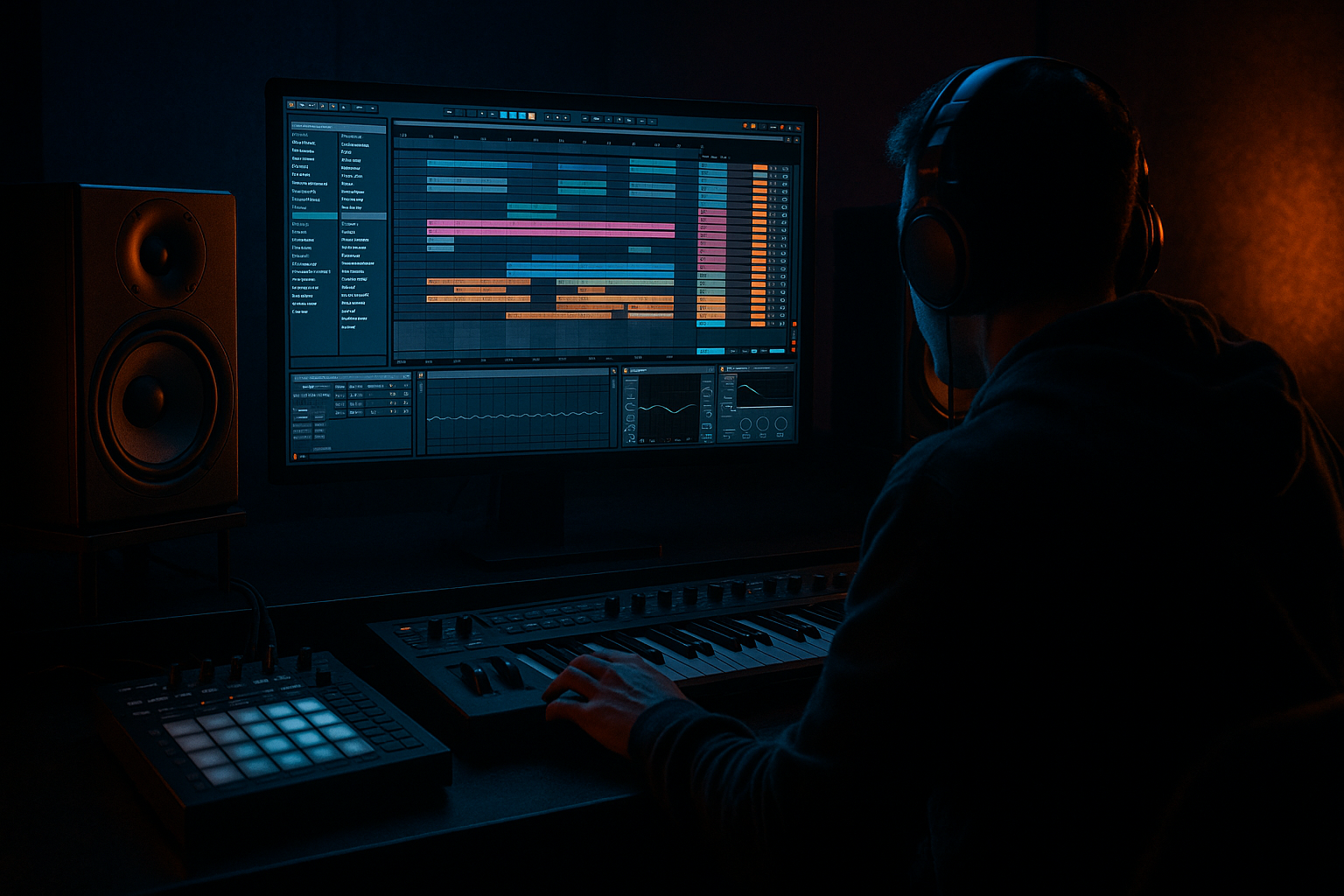
The goal of this lesson is to build a breakbeat-driven drum engine inside Ableton Live 12 that feels alive, forward-moving, and mix-ready. You’ll learn how to cut and reshape a break, layer it with tight one-shots, add ghost-note motion, and shape the groove so it locks with sub and reese bass without fighting them. This matters because in DnB, the drum groove is often the emotional engine of the track: it dictates whether a tune feels snarling, urgent, spacious, or flat. A strong darkside break pattern can carry an entire 16-bar drop with only subtle variations, which is exactly the kind of pressure and control you want in advanced DnB production.
What You Will Build
You’ll build a dark, forward-driving DnB drum groove in Ableton Live 12 with:
- A chopped breakbeat foundation with controlled swing and edited ghost notes
- Tight layered kick and snare reinforcement for impact
- A drum bus that glues the break while preserving transient snap
- Subtle tension layers like hats, rim clicks, and reversed textures
- A drop-ready 8-bar drum phrase that evolves every 2 bars
- A clean low-end relationship with bass, ready for rollers, darkstep, or neuro-leaning arrangements
- Over-quantizing the break
- Too much low-end in the kick layer
- Compressing the drum bus too hard
- Ghost notes are too loud
- No phrase variation
- Snares lack authority
- Break and bass are fighting in the same pocket
- Use Saturator with Soft Clip on drum groups to thicken transients without obvious distortion.
- Try Drum Buss on break groups with modest Drive and Transients to bring out bite and urgency.
- Keep the sub truly clean: mono, simple, and rhythmically disciplined. The darker the drum groove, the more important that low-end control becomes.
- Build tension by slightly filtering the break during breakdown bars, then opening the highs into the drop.
- Use one reversed percussion hit or snare swell before a new 8-bar section to create that “pressure release” feel.
- For a more neuro-leaning edge, automate subtle Auto Filter movement on a percussion bus rather than on the whole drum group.
- If your loop feels too loop-like, resample 4 bars to audio, then slice the print and re-edit the best moments. Resampling often reveals groove choices you’d miss in MIDI view.
- Keep the kick/snare core simple and let the break carry the personality. In dark rollers, restraint often sounds heavier than constant density.
- If the top end gets harsh, use a narrow EQ cut around 6–9 kHz on the break or hats instead of dulling the whole drum bus.
- Reference a well-mixed dark DnB tune and compare:
- Darkside breakbeat drive is about forward motion, tension, and controlled groove.
- Build around a strong break, then reinforce with kick and snare layers.
- Use ghost notes, micro-edits, and phrase variation to keep the loop alive.
- Process drums lightly: punch, glue, and grit without flattening the movement.
- Keep bass and drums in a clear call-and-response relationship.
- In DnB, the drums don’t just support the track — they power the entire drop.
The result should feel like a modern darkside DnB drum bed: not too busy, not too plain, with enough grit and movement to survive repeated drop repetition without losing energy.
Step-by-Step Walkthrough
1. Start with a reference-minded drum lane and choose the right break source
In a new Live set, create a dedicated drum group with separate tracks for:
- Break loop
- Kick layer
- Snare layer
- Hats/percs
- Drum FX / fills
For the break, use a classic amen-style, think, or any clean dusty break you’ve chopped yourself. If you’re building from stock material, start with a break that already has strong ghost-note movement and a clear snare backbeat. In the Browser, audition Drum Hits and break-style loops, then warp only as needed.
In advanced DnB, your source matters because the break’s transient shape and internal swing decide how much you need to process later. A break with good ghost notes can carry more of the groove naturally, while a flatter loop needs more editing and transient enhancement.
Why this works in DnB: the break acts like a humanized rhythm bed underneath the programmed kick/snare. That contrast between machine precision and break shuffle is a huge part of darkside drive.
2. Warp and slice the break for control, not perfection
Drag the break into Audio. Set Warp Mode to Complex Pro if the break has tonal body and you want to preserve character, or Beats if you want punch and clearer transient control. For pure drum movement, Beats is often the better choice.
Then:
- Turn Warp on
- Set transient envelope to emphasize attacks if the break is too soft
- If using Beats, try preserve around 1/16 or 1/8 for a punchier, more chopped feel
- Nudge the warp markers only enough to lock the groove; don’t quantize the break into lifeless grid lock
If the break drifts, use Slice to New MIDI Track and let Live create a Drum Rack from the hits. Set slicing by transients, then manually re-sequence the pieces. This gives you advanced control over which ghost notes survive and where the shuffle lands.
A strong move here is to keep two versions:
- One more natural break loop
- One sliced/editable break rack for fills and rephrases
That gives you flexibility in arrangement without constantly re-editting audio.
3. Build the core drum pattern around the snare illusion
In DnB, especially darkside, the snare often feels like it’s anchoring the track at 2 and 4, even when the break is doing most of the motion. Create a MIDI pattern or audio arrangement where the main snare hits are reinforced with a tight one-shot layered underneath the break.
Use Drum Rack or simpler one-shots with:
- A punchy snare around 180–220 Hz for body
- A sharper layer around 2–5 kHz for crack
Try these starting settings:
- Snare layer 1: short decay, slight transient emphasis
- Snare layer 2: slightly lower velocity, high-pass around 150 Hz
- Velocity range: keep main snares at 110–127, ghost accents around 35–70
Use Drum Buss on the snare group with:
- Drive: 5–15%
- Boom: usually off or very low in dark rollers
- Crunch: low to medium for edge
- Transients: +10 to +25 for snap
If the break already includes snare hits, don’t replace them fully. Instead, layer the one-shot to increase impact and consistency. That blend keeps the break human while making it club-stable.
4. Cut ghost notes and micro-edits to create forward motion
This is where the darkside feel really starts. Open the chopped break or use the audio clips and manually shape the spaces between kick and snare. Focus on:
- Tiny hat fragments after the snare
- Short kick pickups before the backbeat
- Low-velocity ghost snare taps
- Unusually placed break slices that answer the main hits
In Live 12, use Clip View to nudge note timing and velocity. For Drum Racks, keep ghost notes slightly late or early by a few milliseconds to preserve groove. If everything sits exactly on grid, the break loses that rolling, anxious pressure.
Good starting concepts:
- Place a ghost snare at the end of bar 1 beat 4
- Add a quiet hat slice just before the main snare on the next bar
- Pull one kick slightly late by 5–10 ms to make the groove lean back, then counter it with a hat pickup
Use velocity to shape feel more than volume automation. A ghost note at low velocity with a brighter timbre often feels more convincing than a louder, flattened one.
For a darker drum language, avoid overpacking the bar. Leave negative space so the bass can breathe. That empty pocket before a snare hit is often where the drop feels hardest.
5. Layer and process the kick for sub-safe punch
Darkside DnB kicks should hit clearly without bulking the sub region too much. Use a layered kick approach:
- Low-mid thump layer
- Short click layer if needed for translation
- Optional filtered break kick for glue
Route all kick layers to a Kick Group. On the group, use EQ Eight and Drum Buss:
- High-pass gently around 25–35 Hz if necessary
- Small cut if there’s mud around 180–300 Hz
- Drum Buss Transients: +5 to +20
- Drive: subtle, just enough to firm the body
If the kick is fighting the sub bass, use Compressor on the bass or sidechain the bass group to the kick using the kick as the input. In advanced DnB, the kick doesn’t always need aggressive pumping; often a very short, precise duck of 1–3 dB is enough.
For a heavier darkside approach, consider using Saturator on the kick group with:
- Soft Clip on
- Drive around 2–6 dB
- Output trimmed to match level
This helps the kick read on smaller systems without swallowing headroom.
6. Shape the break with transient control and bus glue
Put the break group through a subtle processing chain:
- EQ Eight: clean unwanted low rumble below 25–30 Hz
- Drum Buss: add controlled density
- Glue Compressor: light bus glue, not heavy squash
- Optional Saturator before or after Glue for harmonic bite
Example Glue Compressor settings:
- Ratio: 2:1
- Attack: 10–30 ms
- Release: Auto or around 0.3–0.6 s
- Gain reduction: aim for 1–2 dB, maybe 3 dB at most
This keeps the break coherent while preserving movement. If you compress too hard, the ghost notes flatten and the groove turns rigid. In dark rollers, that usually kills the “chase” feeling.
If certain break hits poke out too harshly, use Auto Filter or EQ Eight automation on the break group to tame brightness in specific sections. A slight high shelf dip during dense bass moments can keep the mix from getting shredded.
7. Add top-end motion without losing the underground weight
Now add hats, ride fragments, and percussive textures to create that dark forward pressure. In DnB, this top-end motion is often what makes a loop feel faster than the actual BPM.
Add one or two of these:
- Tight offbeat hats
- Metallic rim or foley ticks
- Very short ride bursts at phrase ends
- Reversed cymbal into bar transitions
Use Simpler or Drum Rack for quick hit control. For hats:
- High-pass above 300–600 Hz
- Short decay, often under 200 ms
- Pan slightly for width if needed, but keep key transients near center
A subtle Auto Pan on a percussive texture can add movement:
- Rate: 1/2 or 1 Bar
- Amount: very low, around 10–20%
- Phase: 0° if you want mono-compatible motion feel
Keep these elements lighter than the main break. Their job is to push the groove, not distract from it.
8. Design fills, switches, and 2-bar variations
Darkside DnB thrives on controlled evolution. Don’t run a static 8-bar loop. Build a phrase that changes every 2 bars:
- Bar 1–2: full groove
- Bar 3–4: remove one kick or mute a ghost note
- Bar 5–6: add a fill slice or reverse hit
- Bar 7–8: increase tension with extra hat stabs or a snare pickup
Use Audio Effects Racks or Return tracks for fill treatment:
- Short delay throws on fill hits using Delay
- Reverb tail on a single crash or snare using Reverb, then automate the send
- Reverse one-shot into the next downbeat for lift
Arrangement context example: in a 174 BPM dark roller, you might open the drop with 4 bars of sparse break + sub, then bring the full kick/snare layer in on bar 5, then strip again for bars 9–12 before a second phrase variation. That keeps DJs and listeners locked because the groove breathes in clear sections.
9. Lock the drums to the bass with space, not dominance
Once the drum engine is working, check it against the bass. For darkside DnB, the drum and bass relationship is usually built on contrast:
- Bass fills the gaps
- Drums claim the transient moments
- Sub remains mono and controlled
Use Utility on the bass group to keep low end mono. If you have a reese or moving mid-bass, keep stereo width above the low band and avoid wide information under about 120 Hz.
If the bass is too busy in the same rhythmic slot as the break, edit the bass phrasing. A strong darkside drum groove is often made more powerful by bass notes that answer the snare, not collide with it.
Try this phrasing idea:
- Main bass stab after the snare
- Longer bass note in the gap before the next kick
- Silence or filtered tail at the top of the bar for air
That call-and-response is classic DnB arrangement logic: drums speak, bass replies.
Common Mistakes
- Fix: leave tiny timing imperfections and manually nudge select hits instead of flattening the loop.
- Fix: high-pass kick top layers and keep the sub region reserved for bass/sub only.
- Fix: aim for light glue. If the groove loses bounce, back off the compressor and use saturation instead.
- Fix: lower velocity first, then adjust EQ if needed. Ghosts should imply motion, not clutter the groove.
- Fix: change at least one drum element every 2 or 4 bars. Dark DnB needs evolution to stay dangerous.
- Fix: layer a transient-rich snare with body underneath, and use Drum Buss or gentle saturation for density.
- Fix: edit bass note placement so it answers the break instead of masking it, and use sidechain only as much as necessary.
Pro Tips for Darker / Heavier DnB
- snare level
- kick weight
- break brightness
- how much space exists before each backbeat
Mini Practice Exercise
Spend 15 minutes building a 4-bar darkside break engine.
1. Choose one break and warp or slice it.
2. Add a snare layer and a kick layer.
3. Program or edit at least 4 ghost notes.
4. Add one hat or percussion texture for motion.
5. Process the drum group lightly with EQ Eight, Drum Buss, and Glue Compressor.
6. Create one 2-bar variation by removing or shifting just one element.
7. Loop it against a simple sub or reese bass and check if the drums still feel strong when the bass enters.
Goal: by the end, your loop should already feel like a real drop foundation, not just a drum loop.

