Main tutorial
1. Lesson Overview
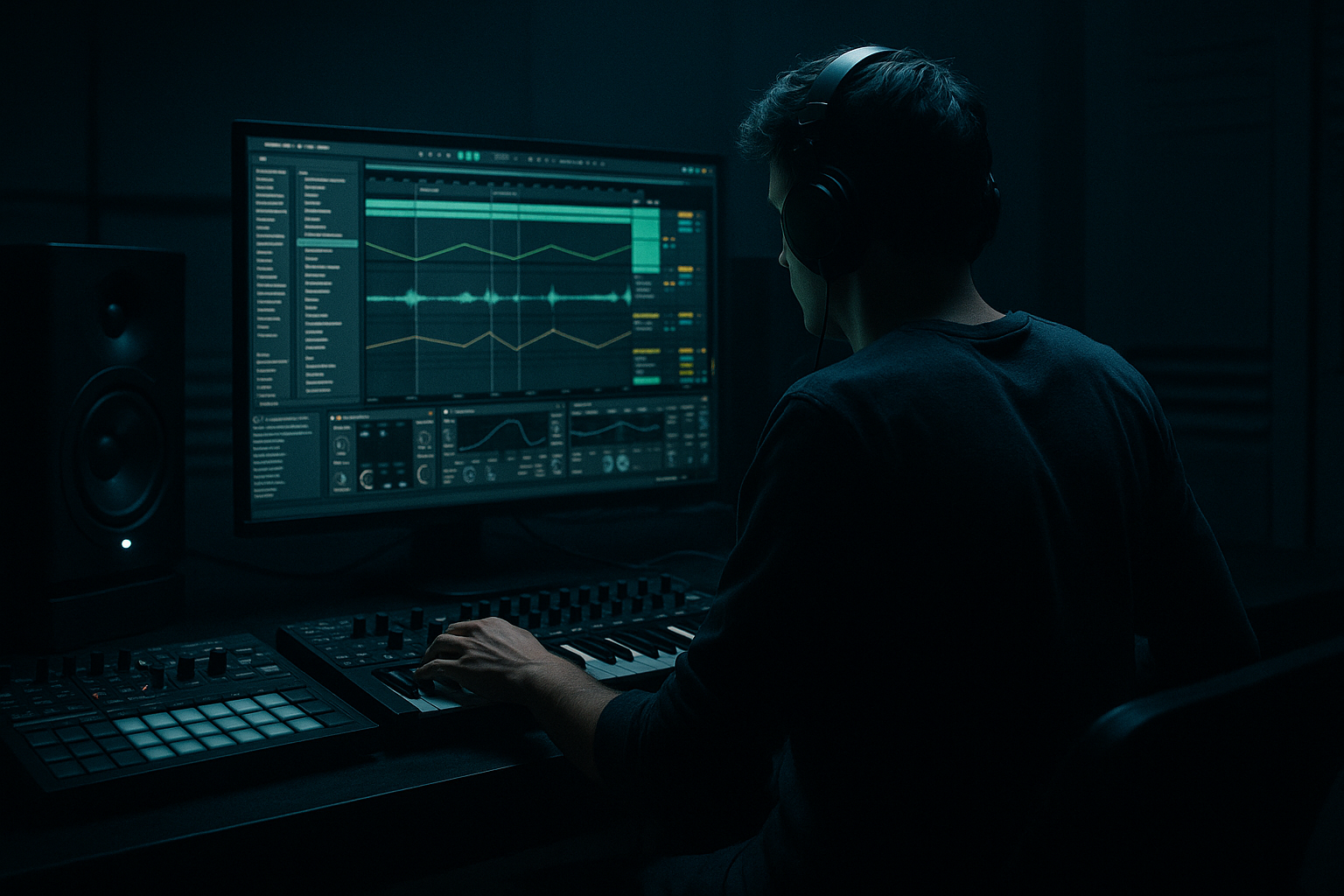
This advanced Resampling lesson shows you how to control a jungle bass wobble with crisp transients and dusty mids in Ableton Live 12. You'll build a wobbling bass patch using stock devices, record (resample) it to audio, and process that audio with parallel chains so the transients read as snap while the midrange stays gritty and present — all using native Ableton devices and resampling workflows. By the end you’ll be able to print a processed bass audio file that sits tight with drums and carries the analog-style dust and mid-harmonic character of classic jungle.
2. What You Will Build
- A Wavetable-based bass patch with two modulations for organic wobble (sync’d LFO + unsync’d jitter).
- A resampled audio loop of that bass.
- An Audio Effect Rack with two parallel chains:
- A final printed resample (audio file) ready for arrangement.
- Over-saturating and losing sub: pushing Saturator or Redux too hard will crush subby content. Always high-pass the transient chain and leave sub on the Dust/Body chain.
- Making the transient chain too loud: if transient chain dominates, bass sounds thin. Start with transients well below body (-8 to -12 dB) and increase slowly.
- Gate too aggressive: gates that chop off natural tails can make wobble sound robotic. Tune hold/release to preserve musical length.
- Resampling with Warp enabled incorrectly: warped audio can smear transients. When you want a clean print, disable Warp or choose proper warp settings.
- Ignoring phase/mono compatibility: stereo widening can introduce cancellations in mono. Keep sub mono (Utility Width = 0% on lowband or use Racks).
- Too much bit reduction or erosion: small amounts create character; large amounts make bass unsafe in a club mix.
- Use Oversampling in Saturator to avoid aliasing when adding harmonics.
- Keep your sub mono: place a Utility after the Rack and use EQ/Multiband Dynamics to ensure <120 Hz is mono.
- Automate the wobble rate and depth via Rack Macros before resampling: you can print multiple variants for arrangement (tight wobble for breaks, wider wobble for drops).
- Use small stereo movement on higher harmonics only: split out a high-band chain, widen it a touch with Utility (width 110–140%) to make bass fuller live without compromising mono sub.
- For extra analog dust, run a short bus through Erosion + a tiny amount of Redux in parallel and blend with the dry signal — resample both to keep options.
- Freeze & Flatten a group as an alternative to resampling if you want to commit CPU-heavy device chains and print them quickly.
- When resampling multiple variants, name files with macros state and tempo (e.g., “Bass_wobble_tightDust_174bpm.wav”).
- You’ve learned how to control a jungle bass wobble with crisp transients and dusty mids in Ableton Live 12 using stock devices and a resampling workflow.
- Key points: build the wobble in Wavetable with two mod sources (tempo LFO + jitter), resample to audio to commit timing and modulation, and then process via parallel chains in an Audio Effect Rack — one chain to extract/boost crisp transient snap, one chain to fatten and add dust to mids.
- Always protect the sub (keep it mono and un-saturated), use subtle saturation/erosion for character, and print multiple resampled variants for arrangement flexibility.
- "Crisp Transients" chain that isolates and enhances transient attack.
- "Dusty Mids" chain that fattens, saturates and dirties the midrange without blurring the transient.
Devices used (stock Ableton Live 12): Wavetable, Auto Filter, Utility, Audio Track Resampling, EQ Eight, Saturator, Erosion, Redux, Compressor, Multiband Dynamics, Gate, Glue Compressor (optional), Audio Effect Rack, Utility, and Live’s clip-warping/resampling workflow.
3. Step-by-Step Walkthrough
Make sure your project sample-rate is set (44.1 or 48 kHz) and monitoring/latency are nominal. Save a new version before you start.
A. Create the wobbling bass sound (synth stage)
1. Create a MIDI track and load Wavetable.
2. Oscillators:
- Osc 1: Select a basic wavetable with strong low harmonics (e.g., “Analog” -> “Saw” or a “Fat” table). Set octave to -1 or -2 (depending on sub).
- Osc 2: Add a second oscillator an octave or a fifth above for harmonic content; set level low (around -6 to -12 dB) to taste.
3. Filter:
- Route both oscillators to the filter. Choose a 24dB low-pass (MG or Classic).
- Set cutoff around 120–400 Hz as starting point (depends on note).
- Set filter drive to taste for extra harmonics (small amounts).
4. Two LFOs for wobble:
- LFO 1: Sync to project tempo; set to 1/16 or 1/8 (triplet options work well for classic jungle feel). Map LFO 1 to filter cutoff amount (moderate depth) so you get the primary wobble rhythm.
- LFO 2: Unsync’d or very slow random/jitter waveform (sample & hold or noise) with small amplitude mapped to wavetable position or pitch detune (very subtle, <10 cents) to introduce organic instability.
- Set LFO 2 to retrigger behavior or free-run depending on whether you want repeatable or evolving wobble.
5. Envelope shaping:
- Amp envelope: Short attack (0–8 ms) to keep transients punchy, sustain medium to full depending on groove. Add a small decay (30–120 ms) if you want tails.
- Filter envelope: Slight positive amount to boost initial attack if needed (adds pluck).
6. Macros:
- Map LFO 1 rate and LFO 1 amount to Macro 1 (Wobble Rate/Depth).
- Map filter cutoff to Macro 2 (Presence).
- Map Osc 2 level or saturation to Macro 3 (Harmonics/Dust).
B. Prepare and resample the loop (Resampling stage)
1. Create a 1–4 bar MIDI pattern playing bass line that fits your DnB/jungle rhythm (use off-grid timing/groove if desired).
2. Create a new audio track. In its Input Type choose “Resampling.” Arm the track for recording.
- Note: This captures the master output (you can isolate the synth track by muting other tracks or using a Group track).
3. Set record length to match your loop (e.g., 4 bars). Hit Arrangement record and record the performance. Stop and consolidate the clip (Cmd/Ctrl-J).
4. Double-click the clip: disable Warp for a raw print or use Beats/Complex if you plan tempo-changing; for maximum fidelity when printing, disable warp and keep original timing.
C. Split the resampled audio into two parallel processing chains (Audio Effect Rack)
1. Create a new audio track and drop the resampled clip into it (or work on the resampled clip’s track).
2. Insert an Audio Effect Rack. Create two chains and label them:
- Chain A: "Crisp Transients"
- Chain B: "Dusty Mids"
3. Macro mapping: create macros for “Transient gain”, “Dust amount”, and “Overall output” and map them to the respective chain volumes or device parameters for quick balancing.
D. Chain A — Crisp Transients (isolate and accentuate attack)
1. Put a Gate at the top:
- Threshold: set so the gate opens only for the initial attack peaks (test while playing loop). Floor at -30 to -50 dB, attack 0–1 ms, hold 8–30 ms, release 30–80 ms.
- The goal: allow the attack through while reducing sustaining body in this chain, creating a transient-focused layer.
2. After Gate add an EQ Eight:
- High-pass under 200 Hz (this chain will not carry deep sub; we want snap only).
- Add a gentle bell boost at 1.5–4 kHz +3 to +6 dB (this is where the “snap” of bass lives).
3. Add Saturator:
- Drive moderate (1–3 dB gain), choose “Analog Clip” or “Soft Sine” curve, enable Oversampling 2x or 4x.
- This brings harmonic content that reads as transient crispness.
4. Glue Compressor (optional):
- Fast attack ~1–3 ms, fast release ~30–60 ms, ratio 4:1, make-up gain to taste — use subtle gain reduction (1–3 dB) to glue the processed transients.
5. Chain output gain: keep this chain considerably lower than Dust chain; it is meant as transient accent, not full body.
E. Chain B — Dusty Mids (fat, mid-harmonic dirt)
1. EQ Eight first:
- High-pass below sub (20–40 Hz) so sub is preserved.
- Boost mids between 200–800 Hz by 1–5 dB (bell shape, Q 0.7–1.2) to make the mid-present “growl”.
- Cut around 1.2–2 kHz slightly if needed to avoid honk.
2. Multiband Dynamics:
- Split bands: Low (below ~120 Hz); Mid (120–1000 Hz); High (above 1 kHz).
- Compress mids lightly (threshold to achieve ~2–5 dB reduction) with slowish attack (10–30 ms) and medium release — this fattens the mid body without stealing transients.
- Leave low band mostly untouched except for minimal shaping to retain sub.
3. Saturator:
- Put a second Saturator here with a warm curve (e.g., “Warm” preset) and moderate drive (2–6 dB). Enable Oversampling.
- Use the “Dry/Wet” to dial the dirt.
4. Erosion (subtle):
- Mode: “Noise” (not “dither”).
- Amount: very low (5–15%) — this layers high-frequency mechanical noise which reads as dust.
- Frequency: choose Mid or High depending on character.
5. Redux (optional, small amount):
- Sample Rate Reduction: small (e.g., down to 22–32 kHz) and Bit Reduction minimal (1–3 bits) — just enough to add coarse texture.
6. Final EQ:
- Tighten midband if necessary to keep clarity; avoid boosting too much to prevent mud.
7. Chain output gain: main body volume.
F. Balancing and further dynamics
1. In the Audio Effect Rack, set Chain A level to taste (start -12 dB relative to Chain B) and use Macro “Transient gain” to raise/lower.
2. Use a Utility after the Rack with +/- gain macro mapped for final output, and a Stereo Width control if you want a narrower sub (keep sub mono: use Utility > Width for chain B low band).
3. Optional final processing:
- Subtle Glue Compressor across the entire Rack: slow attack (10 ms) to preserve crisp attack, low ratio 2:1, small makeup gain.
- Limiter only if you need to tame peaks.
G. Print the processed bass (final resample)
1. Create a new audio track and set its input to “Resampling” (or route via BUS and select the BUS as input).
2. Solo the bass track/group to record just the processed bass.
3. Record a looped pass of 4–8 bars. Consolidate and name it “Bass_wobble_processed”.
4. If you need stems at multiple degrees of dirt, repeat resampling with different Macro states (e.g., “clean”, “dusty”, “extreme”).
H. Optional advanced tweak: transient sidechain for sharper snap
1. Duplicate the resampled audio to create a transient-trigger track.
2. On the transient-trigger track: apply a very fast high-pass (2–3 kHz) to isolate attack content, then a limiter/compressor to make a strong trigger pulse.
3. On the main processed bass, add a Compressor with sidechain set to that transient-trigger track. Set compressor with medium ratio (4:1), very fast attack (0.1–1 ms) and medium release. Invert the compressor’s action by using makeup gain differences to sculpt how sustain sits under the transient — this is an advanced technique and requires fine-tuning for phase/coherence.
4. Common Mistakes
5. Pro Tips
6. Mini Practice Exercise
Goal: Create a 2-bar jungle bass wobble, resample it, and print a “snap + dust” version.
Steps (20–30 minutes):
1. Build a 2-bar loop in Wavetable: low oscillator octave -2, filter cutoff ~200 Hz, LFO 1 sync’d (1/16) to cutoff, LFO 2 free-run subtle to wavetable pos.
2. Map LFO 1 depth to Macro 1 and filter cutoff to Macro 2.
3. Record a resample of 2 bars (Arrangement > Resampling).
4. Create Audio Effect Rack with two chains (Crisp Transients & Dusty Mids) following the walkthrough (Gate -> EQ -> Saturator on transient chain; EQ -> Multiband -> Saturator -> Erosion on dust chain).
5. Map transient chain level to Macro 1 and dust amount to Macro 2.
6. Record the final processed loop to a new audio track. Compare processed vs. original and tweak Macro 1 & 2 to taste.
7. Recap
Work through the Mini Practice Exercise to lock these techniques into your production flow. Adjust attack/release, EQ points, and saturation amounts to match your mix — the balance between transient snap and dusty mids is taste-dependent and highly contextual with drums.

