Main tutorial
Lesson Overview
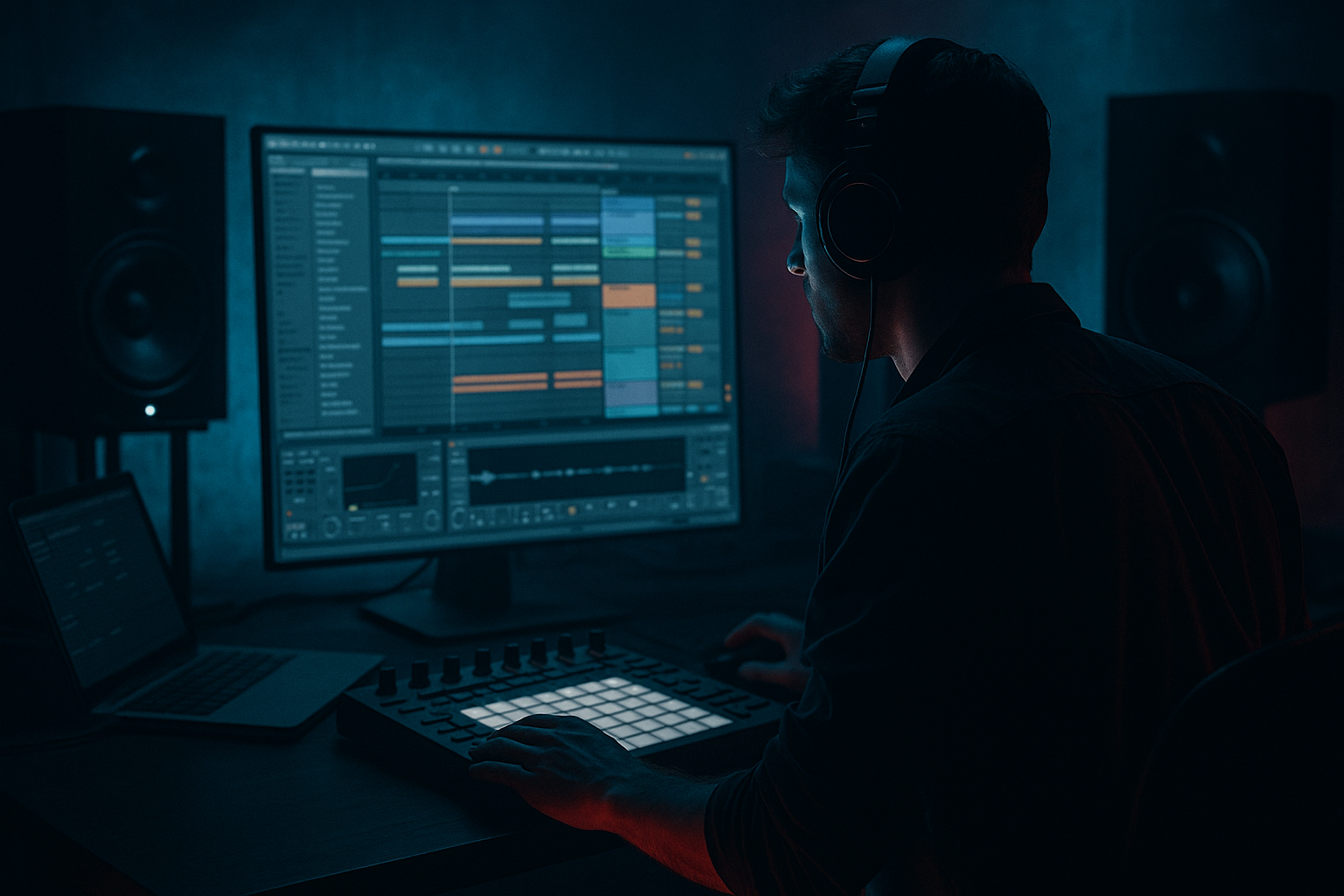
This lesson is about building a Concrete Echo arrangement in Ableton Live 12: a dark, urban DnB tune centered around a subsine workflow blueprint and jungle swing. The goal is to create a track that feels heavy, gritty, and forward-driving, but still musical and DJ-friendly.
In a real DnB session, this approach fits right between sound design and arrangement: you’re not just making a bass patch, you’re designing a bass system that can survive a full tune—intro, drop, switch-up, breakdown, second drop, and outro. The “Concrete Echo” vibe means tight sub pressure, echoing industrial textures, chopped break energy, and a bassline that answers itself in phrases instead of just looping.
Why this matters in DnB: the best tracks usually don’t rely on one massive sound. They rely on contrast—sub vs. mid, dry vs. echo, break vs. space, straight drive vs. swung jungle feel. If you can shape your arrangement around those contrasts, your tune instantly sounds more finished and more believable in a club system.
You’ll use Ableton stock devices like Operator, Wavetable, Drift, Saturator, Drum Buss, Echo, Auto Filter, EQ Eight, Utility, Glue Compressor, Arpeggiator, Shaper, and Resampling to build a proper arrangement blueprint that feels like a real production workflow, not a loop demo.
What You Will Build
By the end, you’ll have a 16- to 32-bar drop structure built around:
- a mono sub sine foundation
- a moving mid-bass layer with reese-like pressure
- jungle-swing drum programming using chopped breaks and ghost hits
- echo-driven transitions and tension tools
- a call-and-response bass arrangement that avoids masking the drums
- a DJ-friendly intro and outro with clean mix section behavior
- bars 1–8: stripped intro with atmospherics, filtered break fragments, and sub hints
- bars 9–16: first drop with simple bass phrasing and break-led swing
- bars 17–24: switch-up with more syncopation, echo throws, and drum fill energy
- bars 25–32: heavier second drop with added harmonic weight or rhythmic variation
- Making the sub too wide
- Letting the bass play through every drum hit
- Over-grooving the entire project
- Using too much Echo on the drop
- EQing away arrangement problems
- No contrast between sections
- Piling sub and mid on the same frequency lane
- Use parallel distortion on the mid bass only. Duplicate the track or use a return, then saturate it harder than the main layer. Blend it in quietly for grit without wrecking the core tone.
- Add a very subtle pitch envelope to the bass stab or reese layer for a more aggressive attack. Keep it short so it doesn’t sound like EDM wobble.
- In Auto Filter, automate small resonance boosts at the ends of phrases to create “metallic echo” tension. Keep resonance modest, around 10–25%.
- For heavier drops, use a single-bar silence or drum cut before the switch. The re-entry feels much bigger than adding more layers.
- Resample your bass and break combo to audio once the idea works. Then chop the resampled audio for extra phrasing control and a more underground, less pristine feel.
- Use EQ Eight to carve a narrow pocket around the snare fundamental if the bass and break are fighting. Don’t chase loudness before separation.
- If the tune needs more menace, automate the mid bass filter to open only on the last half of the phrase. That delayed reveal keeps the energy coiled.
- Build your DnB tune around a clean mono sub and a separate moving mid bass.
- Use jungle swing through selective groove, break edits, and ghost notes.
- Treat Echo as an arrangement tool for tension and transitions.
- Keep the first drop disciplined, then evolve density and rhythm in the second half.
- In darker DnB, space, contrast, and phrasing hit harder than constant full energy.
Musically, the result should feel like this:
This is not just a sound design exercise. It’s a whole arrangement blueprint you can reuse for rollers, jungle-inflected DnB, darkstep, or neuro-leaning tunes.
Step-by-Step Walkthrough
1. Set up the session like a real DnB sketch, not a loop playground
Start at 174 BPM. If you want a slightly darker, heavier feel, 172–174 BPM is the sweet spot; if you want more classic urgency, stay around 174.
Create these core tracks:
- Kick
- Snare
- Break Loop
- Hat Perc
- Sub
- Mid Bass
- Echo FX
- Atmosphere
- Return A: Echo
- Return B: Reverb
Put your sub and mid bass on separate tracks from the start. That separation is essential for clean DnB low-end control.
Arrangement workflow move: build in 8-bar blocks. In DnB, decisions happen faster when you think in phrases instead of bars. Mark your arrangement with locators for:
- Intro
- Build
- Drop 1
- Switch
- Drop 2
- Outro
Use a reference track if you have one, but keep your view focused on the timeline so you’re making arrangement choices, not just sound tweaks.
2. Design the subsine foundation first
On the Sub track, load Operator and use a pure sine wave. Keep it simple. The subsine is your anchor.
Suggested settings:
- Oscillator A: sine
- Polyphony: mono
- Glide: off for tight rollers, or 20–40 ms if you want slightly more legato movement
- Volume envelope: fast attack, short release, no click
Write a bassline that follows a strong DnB rhythm:
- root notes on the kick/snare grid
- leave gaps for drum phrases
- avoid overfilling the bar
A strong starter pattern is a two-note or three-note motif repeated with small variation. For example, in a dark minor key, let the sub hit on the downbeat, then answer after the snare. That creates the “sub echo” feeling without actually piling on effects yet.
Use Utility after Operator and keep the bass mono. Set width to 0% on the sub track. This keeps the low end locked and club-safe.
Why this works in DnB: the sub is the part most likely to disappear if you let stereo processing, over-compression, or too many harmonics interfere. A clean sine foundation gives you headroom and lets the drums punch harder.
3. Build the jungle swing drums with break edits, not just straight programming
Load a chopped break on the Break Loop track. Use Simpler or just audio clips sliced to warp markers. Pick a classic jungle-style break fragment and slice it into useful hits.
Focus on:
- ghost notes
- offbeat hats
- short snare tail edits
- kick pickups into the main snare
In Ableton Live 12, use Groove Pool to push swing carefully. For jungle-flavored movement, try a groove around:
- 55–60% timing
- 10–20% velocity
- 5–15% random
Don’t apply too much groove to the whole drum bus. Instead, apply it selectively to the break or percussion layers, while keeping the main snare/snare layer more locked. That gives you a push-pull feel: rigid core, swinging edges.
Add a separate snare layer if needed:
- one clean snare for impact
- one break snare for texture
Shape the break with EQ Eight:
- high-pass around 120–180 Hz
- reduce boxiness around 300–500 Hz if needed
- tame harsh crack around 3–6 kHz if the break bites too hard
This is where the “Concrete Echo” character starts to appear: sharp but worn, mechanical but human.
4. Create the mid bass as a moving reese/pressure layer above the sub
On Mid Bass, choose Wavetable or Drift for a layered, animated bass tone. Keep the sub separate—this layer should carry motion, not true low-end weight.
A practical starting point:
- use a saw-based wavetable or detuned oscillator pair
- low-pass filter around 120–250 Hz to keep out sub competition
- add subtle unison/spread only in the mid layer
- automate filter movement across 8-bar phrases
Good stock chain:
- Wavetable
- Saturator
- Auto Filter
- EQ Eight
- Utility
Suggested settings:
- Saturator Drive: 2–6 dB
- Auto Filter cutoff sweep: roughly 200 Hz to 1.5 kHz depending on the section
- Utility width: keep the bass mono below the crossover region; if you need width, add it only to the top harmonics
Write the mid bass as call-and-response with the sub. For example:
- bar 1: sub hits alone
- bar 2: mid bass answers on the offbeat
- bar 3: both together
- bar 4: gap before the next phrase
That phrasing creates arrangement movement without needing a huge number of notes. In DnB, space is part of the groove.
5. Use echo as an arrangement device, not just a delay effect
Load Echo on a return track and send selected bass stabs, break hits, or FX to it. The key is to treat echo as a transition tool and a rhythmic ghost, not a wash that smears the drop.
Good Echo starting points:
- Delay time: synced 1/8 or 1/8 dotted
- Feedback: 20–45%
- Filter: roll off low end aggressively
- Dry/Wet on return: 100%
Automate send amounts at phrase ends:
- end of 4th bar: send a bass stab or snare hit into echo
- end of 8th bar: throw a break fill into echo
- before drop: echo tail helps the last empty bar feel tense
Use Auto Filter before or after Echo if you want a more obvious “closing tunnel” effect. Example:
- automate a low-pass filter down from 12 kHz to 2–4 kHz during a transition
- then snap it open at the drop
This is one of the easiest ways to make the arrangement feel intentional. The echo throw tells the listener, “something is about to happen.”
6. Shape the drop around bass/drum conversation, not constant full force
For the first drop, keep the arrangement disciplined. Don’t start with every layer active. A solid DnB first drop often works best if it introduces the core idea in a restrained way.
A strong first-drop structure:
- bars 1–2: kick, snare, sub motif
- bars 3–4: add break texture and hat movement
- bars 5–6: introduce mid bass answer phrase
- bars 7–8: fill, echo throw, or drum switch
Keep the kick and snare clear. If the bass is too busy, use Envelope shaping or simpler note lengths rather than over-EQing your way out.
On the drum bus, use Glue Compressor gently:
- Attack: 10–30 ms
- Release: Auto or 0.1–0.3 s
- Gain reduction: just 1–3 dB
That preserves transient punch while gluing the break and programmed drums together.
If your groove feels static, cut the bassline for half a bar before the snare returns. In DnB, micro-silence often hits harder than another fill.
7. Add jungle swing with ghost notes, pickup edits, and velocity contrast
This is where the “jungle” in Concrete Echo becomes more than a reference. Create motion by editing the break and percussion with intent.
Techniques:
- duplicate a break slice, lower the velocity, and place it just before the snare
- add tiny kick pickups into the groove
- offset hat hits by a few milliseconds for looseness
- vary velocities across repeated 1-bar patterns
If you’re using MIDI for drums, program 16th-note hats and then remove some hits so the groove breathes. If you’re using audio loops, slice to MIDI and manually place ghost hits.
Use Drum Buss on the drum group lightly:
- Drive: 5–15%
- Transients: small boost if needed
- Boom: usually low or off for tight DnB unless you’re designing a specific chest-hit layer
The goal is not to make the drums louder with processing. The goal is to make the groove feel more alive and more physical.
8. Develop the second half with a switch-up that changes density, not identity
By the time you reach the second drop, your track should evolve, but not fall apart. In dark DnB, a switch-up usually means one of these:
- a new bass rhythm
- a harsher drum edit
- a higher-pitched response phrase
- a breakdown of the break into smaller fragments
Try one of these changes:
- duplicate the mid bass and automate a more aggressive filter opening
- invert the phrase so the response becomes the call
- add a short fill every 4 bars
- remove the kick for one beat before the snare to create tension
Use Automation Clips in Arrangement View for:
- filter cutoff
- resonance
- Echo send
- Saturator drive
- Utility gain on FX layers
Example musical context: if the first drop is a “rolling concrete tunnel,” the second drop can become “the tunnel collapsing and echoing back.” Same sound palette, but more unstable rhythm and more tension.
Common Mistakes
Fix: keep the sub mono with Utility and avoid stereo effects below the crossover.
Fix: leave holes. DnB needs space for the snare and break detail.
Fix: apply swing to the break and percussion selectively, not the whole arrangement.
Fix: keep delay throws for phrase endings and transitions; use dry bass in the main groove.
Fix: if the bass masks the drums, rewrite the phrase or shorten note lengths before reaching for more plugins.
Fix: make the intro, first drop, and second drop differ in density, filtering, or bass rhythm.
Fix: let the sub own the bottom and let the mid bass live above it.
Pro Tips for Darker / Heavier DnB
Mini Practice Exercise
Set a timer for 15 minutes and build a mini Concrete Echo section in Ableton Live.
1. Set tempo to 174 BPM.
2. Make a 4-bar subline in Operator using a sine wave only.
3. Write a one-bar jungle break loop with at least 3 ghost notes.
4. Add a mid bass layer in Wavetable with light saturation.
5. Create an Echo return and automate one throw at bar 4.
6. Arrange the 4 bars into:
- Bar 1: sub + kick/snare
- Bar 2: add break texture
- Bar 3: add mid bass
- Bar 4: remove one element and use an echo throw
7. Duplicate the idea to 8 bars and make one switch-up using filter automation or a drum fill.
Goal: by the end, your section should already sound like the beginning of a proper DnB drop, not just a loop.

