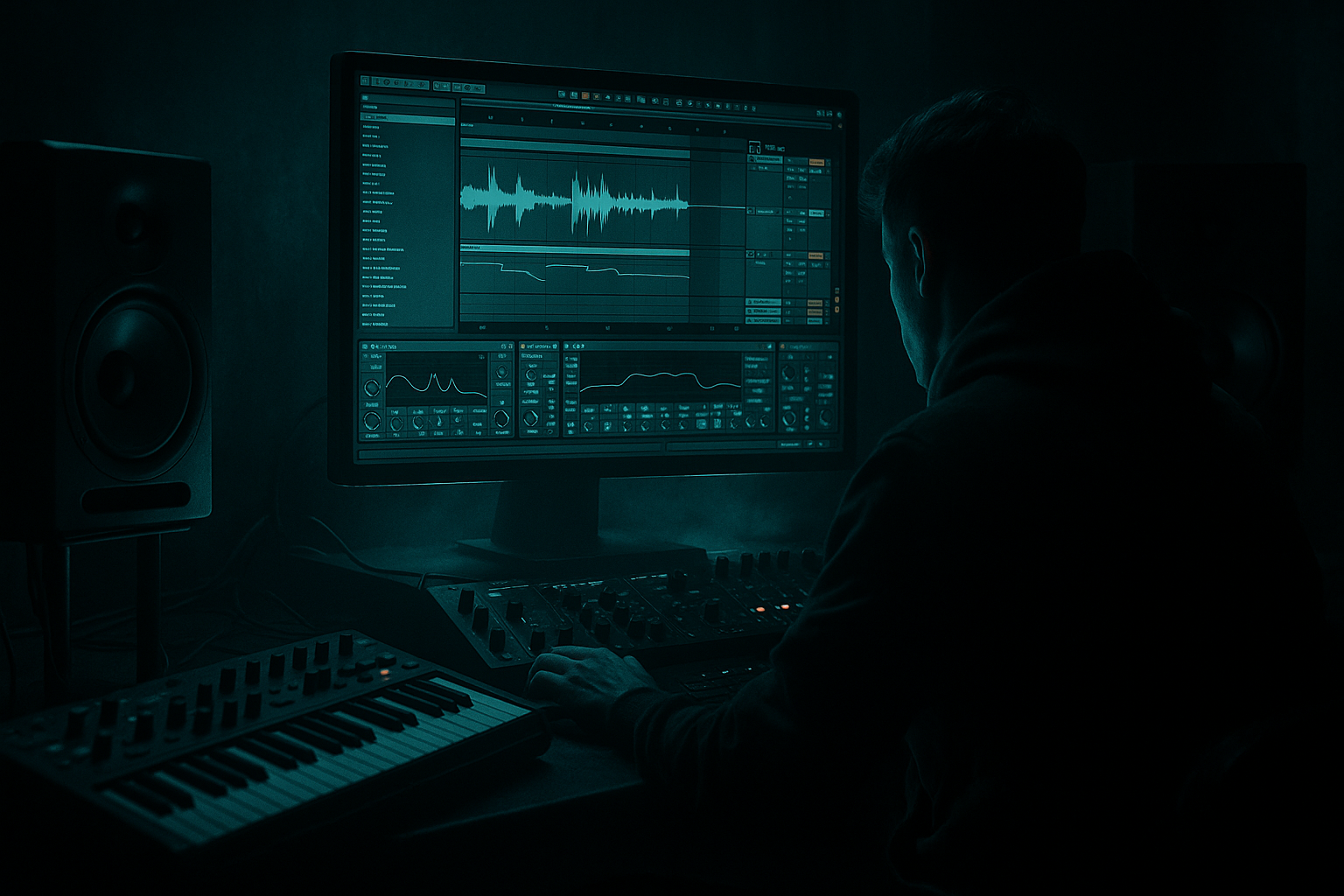
Main tutorial
Compose a Jungle Air Horn Hit Using Session View to Arrangement View in Ableton Live 12
1. Lesson overview
In this lesson, you’ll build a classic jungle / drum and bass air horn hit in Ableton Live 12, then turn that idea from a Session View loop into a fully arranged moment in Arrangement View. 🎺
We’re not just placing a sample on the grid. We’re creating a hit that feels big, rude, and musically integrated with the rest of the tune — the kind of horn stab that slices through rewinds, drops, and transition bars in jungle, jump-up, rollers, and darker DnB.
You’ll learn how to:
- design a horn sound with stock Ableton devices
- make the hit feel wide, aggressive, and punchy
- trigger and perform it in Session View
- record it into Arrangement View
- shape its role in a DnB arrangement so it lands with maximum impact
- a drop intro sting
- a transition hit
- a call-and-response accent
- a rewind-style punctuator
- a rude energy layer over drums and bass
- a detuned synth/chant-style source
- EQ shaping to keep it loud without mud
- saturation for grit
- reverb and delay for space
- macro control over tone and size
- a recorded Arrangement View performance that fits into a DnB drop or breakdown
- Oscillator 1: Saw
- Oscillator 2: Saw or Square
- Detune: light to medium
- Unison: 2–4 voices
- Filter: Low-pass or band-pass depending on brightness
- Filter envelope: short attack, medium decay
- Amp envelope:
- use a fast pitch envelope if available in your sound design approach
- or automate a quick pitch drop:
- Drive: 2–8 dB
- Soft Clip: On
- Output: trim to maintain level
- High-pass around 120–180 Hz if the horn is muddy
- Cut any harsh boxiness around 300–600 Hz
- If the sound needs more bite, boost slightly around 1.5–4 kHz
- If it’s too fizzy, tame 7–10 kHz
- Drum Buss:
- Roar:
- Size: medium or small-medium
- Decay: 0.8–1.8 s
- Pre-delay: 15–35 ms
- Low-cut in the reverb: 200 Hz+
- High-cut if needed to keep it from becoming glassy
- Start mono or narrow for the core hit
- Then widen in the arrangement if needed
- Keep the low-mids controlled
- Root note for a strong, rude hit
- Root + octave for a more strained shout
- A quick two-note phrase, like:
- Single hit on the downbeat of a 4-bar phrase
- Two-stab answer:
- Pickup horn just before the drop
- Off-grid syncopation against the snare for a more chaotic jungle feel
- around 1/16 to 1/8
- let the release and reverb do the work
- Clip length: 1 bar or 2 bars
- Launch quantization: 1 Bar for reliable arrangement capture
- Legato: off unless you’re intentionally sliding notes
- Groove: optionally apply a subtle swing from a Drum Rack groove pool, but be careful not to over-swing the horn itself
- Scene 1: breakdown atmos
- Scene 2: drum fill
- Scene 3: horn hit + bass drop
- Scene 4: main groove
- filter cutoff opening on the attack
- reverb amount increasing on the tail
- width widening after the transient
- saturation increasing on a repeated horn phrase
- pitch movement for tension
- Bar 1: slightly darker, tighter horn
- Bar 2: brighter, wider horn with more reverb
- Trigger the horn on the last beat before the drop
- Launch it with a drum fill
- Bring it in on the second phrase of a breakdown
- Use it once every 8 or 16 bars to keep it special
- record quantization if you want it tight
- or perform slightly loose, then edit later for groove
- clip launches
- mute/unmute decisions
- parameter tweaks
- filter moves
- spontaneous timing choices
- Snap the horn exactly onto the phrase start if needed
- Make sure it lands with the snare or just before it, depending on intent
- Adjust note length so it doesn’t smear into the bass entry
- Intro sting: horn before the drums fully enter
- Pre-drop call: horn in the final 1–2 bars of the buildup
- Drop punctuation: horn on bar 1, beat 1, then again on bar 3
- Switch-up marker: horn right before a bass variation or break edit
- Rewind moment: horn followed by a stop or break cut
- automate reverb down during the main hit, then up on the tail
- automate filter opening on repeated hits
- automate Utility width for a bigger second occurrence
- automate delay feedback for a single echo slap at phrase ends
- add a Compressor with sidechain from the kick/snare
- or use Volume automation to tuck it around the drum impact
- snare crack around 1–3 kHz
- reese upper mids around 200 Hz–1 kHz
- sub below 100 Hz
- high-pass the horn more aggressively
- carve a small notch where the snare lives
- reduce reverb low-mid buildup
- use square waves, detuned saws, or wavetable layers
- lower the filter cutoff
- add subtle FM or oscillator drift
- a noise burst
- a short vocal shout
- a metallic hit from Drum Synths or sampled percussion
- keep the transient clean-ish
- distort the sustain or reverb return more heavily
- keep the first transient relatively narrow
- widen the release and delay return after the hit
- main horn hit on beat 1
- delayed echo on beat 2 or the offbeat
- Bars 1–2: drums + bass only
- Bar 3: horn hit on beat 1
- Bar 4: horn answer on the “and” of 4
- Bars 5–6: repeat horn with brighter filter and more width
- Bar 7: final horn hit with longer reverb tail
- Bar 8: mute the horn and let the drums/bass reclaim the space
- Use Session View to test the idea first
- Record the performance into Arrangement View
- Automate at least two parameters
- Make the second horn more intense than the first
- design a jungle air horn hit using stock Ableton Live 12 devices
- shape it with saturation, EQ, reverb, and width control
- launch it in Session View
- record that performance into Arrangement View
- place it musically inside a DnB arrangement
- avoid the common mistakes that make horn hits weak or messy
- a rack chain preset recipe
- a MIDI clip example
- or a full 16-bar arrangement map for this horn hit in a DnB track.
This is an advanced workflow lesson, so we’ll focus on precision, control, and arrangement decisions rather than basic navigation.
---
2. What you will build
You will create a short horn phrase that can work as:
Final result
A Session View clip that triggers a sharp jungle air horn with:
---
3. Step-by-step walkthrough
Step 1: Set the project up for DnB
Before you build the horn, get the session ready.
1. Set the tempo to 170–175 BPM.
- For a classic jungle feel, try 172 BPM.
2. Set global quantization to:
- 1 Bar for controlled launches
- or 1/4 if you want more live, aggressive horn punches
3. Make sure your drum/bass foundation is already sketched:
- kick/snare break
- sub bass or reese
- maybe a pad or atmos layer
Why this matters: the horn should be designed to cut through the existing groove, not exist in isolation.
---
Step 2: Create the horn instrument rack
We’ll build the horn from stock devices so you can shape it to taste.
#### Option A: Aggressive synth horn using Wavetable
Create a new MIDI track and load:
1. Wavetable
2. Saturator
3. EQ Eight
4. Drum Buss or Roar (if you want extra attitude)
5. Hybrid Reverb
6. Utility
#### Wavetable settings
Use a simple, rude tone that can imitate a horn-ish blast:
- Attack: 0–5 ms
- Decay: 300–700 ms
- Sustain: 0–20%
- Release: 80–150 ms
The goal is a short, barking sustain, not a flute.
#### Add pitch character
To make it feel more “air horn” and less generic synth stab:
- start around +12 semitones
- fall quickly to root over 30–80 ms
That tiny pitch fall gives the hit a more vocal, shouted quality.
---
Step 3: Shape the tone with processing
#### Saturator
Use Saturator for edge and body:
This adds harmonic aggression so the horn feels present on smaller speakers.
#### EQ Eight
Use EQ Eight to keep the hit useful in a DnB mix:
The horn should sit above the bass and drums, not fight them.
#### Drum Buss or Roar
If the horn needs more weight:
- Drive: light to medium
- Crunch: subtle
- Boom: usually off for this kind of hit unless you want a huge rave-style impact
- Use a mild saturation curve
- Keep it controlled, not destroyed
- Great for giving the horn a brutal, modern edge
#### Hybrid Reverb
For jungle vibe, don’t drown the sound — give it space with attitude:
You want the horn to feel like it’s blasting through a room, not floating in a cathedral.
#### Utility
Use Utility to manage width:
A classic trick: make the initial transient more centered, then automate wider ambience after the attack.
---
Step 4: Save the sound as a rack
Once the chain feels good:
1. Select the devices
2. Group them into an Instrument Rack
3. Map key controls to macros:
- Macro 1: Filter cutoff
- Macro 2: Saturation drive
- Macro 3: Reverb send/amount
- Macro 4: Width
- Macro 5: Pitch bend amount or envelope depth
- Macro 6: Decay time
This gives you performance control in Session View, which is perfect for live-style DnB arranging.
---
Step 5: Program the MIDI hit
Now build the actual air horn pattern.
#### Basic note choice
Start with one note on the key of the track.
Try:
- root
- fifth
- octave up for the classic rave tension
#### Example phrase ideas
- hit on bar 1
- reply on bar 3
#### MIDI tip
Keep the note lengths short:
If the sound is too polite, shorten the MIDI and increase the transient aggression with saturation or a faster envelope.
---
Step 6: Build the Session View clip
In Session View, create a MIDI clip with the horn phrase.
#### Clip settings
#### Scene usage
Place the clip in a scene that represents a drop intro, switch-up, or build transition.
For example:
This is where Session View shines: you can audition the horn against different sections of the tune before committing.
---
Step 7: Add automation in Session View
A great horn hit changes over time. Don’t leave it static.
Use clip envelopes or track automation to shape:
#### Practical automation idea
For a 2-bar clip:
That creates progression without needing a different patch.
---
Step 8: Perform the hit in Session View
Now you’re ready to play it like an instrument.
#### Performance ideas
For DnB, restraint matters. The horn is most effective when it feels like a statement, not wallpaper.
#### Capture your timing
Use:
A classic jungle vibe often benefits from slightly human, urgent timing, especially if the horn responds to a breakbeat fill.
---
Step 9: Record Session View into Arrangement View
Now we move from idea to song structure.
#### Recording workflow
1. Hit Arrangement Record
2. Trigger the horn clip in Session View at the right moment
3. Let Live capture the performance into Arrangement View
4. Stop recording once the horn section is complete
This gives you a real arrangement pass instead of manually drawing every clip onto the timeline.
#### Why this is powerful
You can record:
That’s ideal for DnB, where energy changes fast and arrangement motion matters.
---
Step 10: Edit the horn in Arrangement View
Once recorded, go to Arrangement View and refine the placement.
#### Tighten the hit
#### Layer arrangement with impact
Try these structural options:
#### Automation in Arrangement View
Now create more detailed movement:
---
Step 11: Make it sit with drums and bass
This is where many horns either win or die.
#### Sidechain or ducking
If the horn masks the kick/snare or bass:
For jungle and DnB, the hit should feel like it’s punching through the groove, not flattening it.
#### Frequency space
Check the horn against:
If needed:
---
4. Common mistakes
1. Making the horn too long
A jungle air horn should be short and decisive. Long sustains often blur the phrase and weaken impact.
2. Overloading the low end
If the horn has too much body below 150 Hz, it will clash with your sub and kick. High-pass it if necessary.
3. Too much reverb
Big reverb can sound huge in solo but destroys the arrangement. Keep the tail controlled so the drums stay forward.
4. No contrast between hit and tail
If the whole sound is equally loud and wide, it feels flat. Make the attack centered and the tail more spacious.
5. Forgetting arrangement context
A horn that sounds great alone may feel cheesy in the wrong spot. Place it where it supports a transition, drop, or response phrase.
6. Using the same velocity every time
If you repeat the horn, vary velocity or processing slightly so it feels performed, not copied.
---
5. Pro tips for darker/heavier DnB
Use darker harmonic sources
For a heavier vibe:
This makes the horn less “festival rave” and more warehouse menace. 😈
Add a hidden layer
Layer the horn with:
Blend quietly underneath to make the attack more aggressive.
Distort the tail, not just the attack
Instead of overdriving the whole horn:
That preserves punch while adding grime.
Automate stereo widening late
For a heavier mix:
This keeps the center clear for kick, snare, and bass.
Use delay like a response
A short ping-pong delay or Simple Delay can create a rude call-and-response:
Set delay time carefully so it grooves with the tempo, not against it.
Resample for control
If the patch gets complex:
1. resample the horn into audio
2. chop the best transient
3. process the audio clip with fades, reverse tails, or transient shaping
In DnB, resampling is often faster and punchier than endlessly tweaking MIDI.
---
6. Mini practice exercise
Exercise: 8-bar jungle horn arrangement
Build an 8-bar section using this structure:
#### Goals
#### Challenge version
Try making three different versions:
1. classic jungle rave
2. dark warehouse roller
3. modern neuro-influenced DnB
Compare how much reverb, distortion, and width each one needs.
---
7. Recap
You now know how to:
The key takeaway: in drum and bass, the air horn works best when it feels like a performance gesture, not just a sound effect. Build it to be tight, rude, and purposeful — then use Session View to play it like part of the arrangement. 🎛️🔥
If you want, I can also give you:

