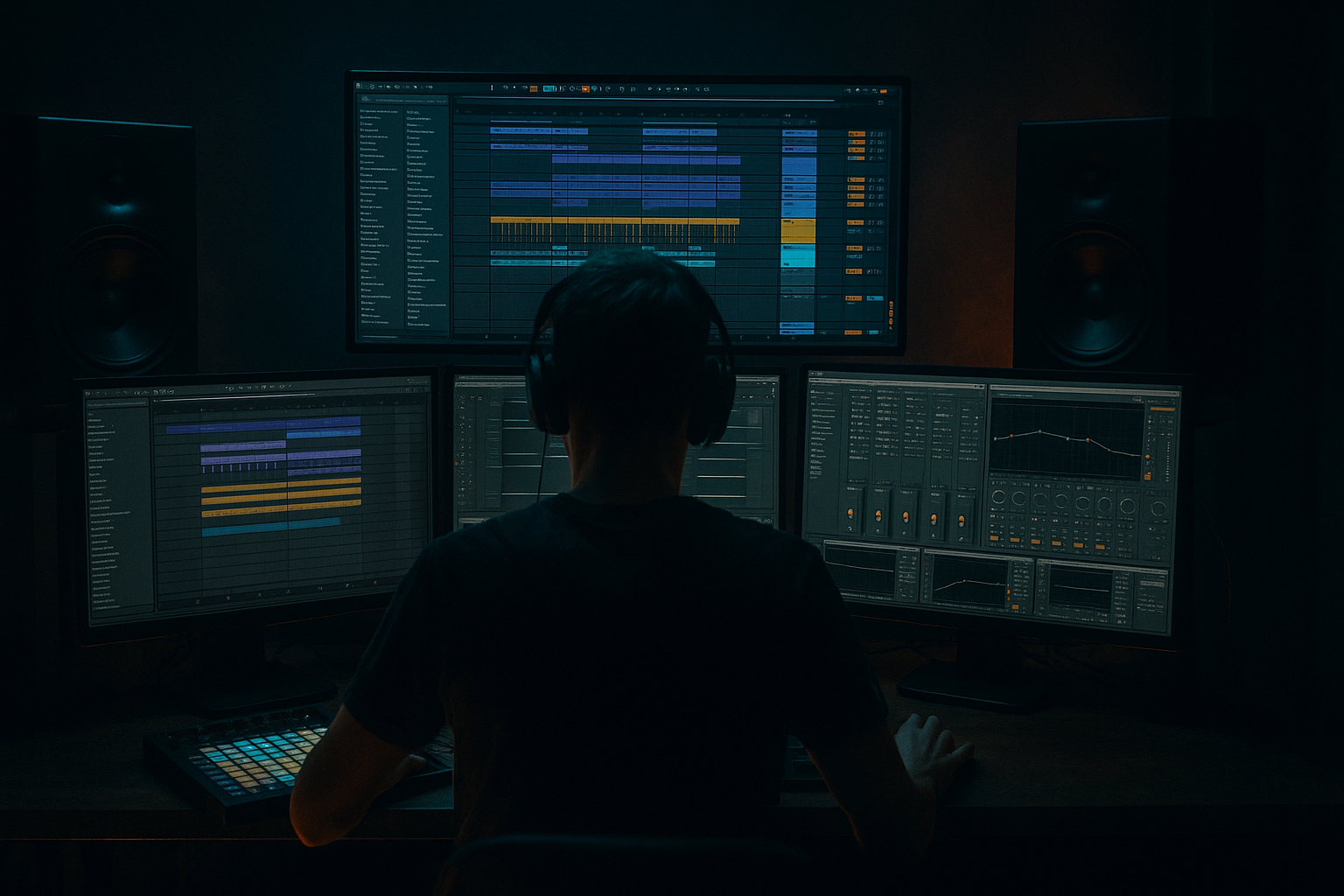
Main tutorial
```markdown
Color an Oldskool DnB/Jungle Arp with Chopped‑Vinyl Character in Ableton Live 12 🎛️💿
1) Lesson overview
In oldskool jungle and early DnB, arps often feel like they’ve been sampled off wax, re‑pitched, re-triggered, and abused through timing + filtering until they sit inside a rolling break and sub.
In this workflow lesson you’ll take a clean synth arp and turn it into a chopped-vinyl, time-warped, resampled “slice instrument” using Ableton Live 12 stock devices and a few deliberate arrangement moves.
You’ll focus on:
- Resampling and slicing (the “sample brain” approach)
- Vinyl-like pitch drift + wobble (without sounding like a plugin preset)
- Crunch + bandwidth shaping (jungle-style)
- Micro-chop arrangement tricks that feel played not looped
- It came from a 90s record (band-limited + worn transients)
- It’s been chopped into a sampler (re-triggers, stutters, reverse hits)
- It’s rhythmically locked to a rolling DnB grid but with human, “deck” movement
- One resampled audio loop
- A sliced Simpler/Drum Rack instrument for live re-chopping
- A performance/automation lane that makes it evolve across 16 bars
- Wavetable: Basic Shapes (saw/pulse blend)
- Filter: LP24, drive ~10–20%
- Amp Env: short-ish (A 5–15 ms, D 200–400 ms, S 0–20%, R 80–150 ms)
- Style: Up or Up/Down
- Rate: 1/16 (start here)
- Gate: 35–55%
- Steps: 1–2 oct (jungle arps love octave motion)
- Warp: On
- Try Complex Pro (good starting point for tonal material)
- Alternatively try Texture for grain character:
- Turn on Clip Gain Envelope and draw tiny 0.5–2 dB dips on offbeats to create “needle drag” dynamics.
- For pitch drift:
- Slice by: Transient (or 1/16 if transients aren’t clear)
- Create: Simpler
- Slicing preset: choose something neutral (no FX)
- Trigger mode: Try Gate for performance, Trigger for one-shots
- Voices: 1–3 (lower = tighter; higher = more overlap)
- Add Filter in Simpler:
- Use call/response: dense 1/16 stutters in bar 1, more space in bar 2.
- Add re-trigger bursts:
- Use reverse accents:
- Apply a Groove Pool swing (subtle):
- Macro 1: `CUTOFF` (Auto Filter)
- Macro 2: `DRIVE` (Roar amount / mix)
- Macro 3: `WOBBLE` (map to small LFO amount if using Auto Filter LFO)
- Macro 4: `SPIN` (map to Delay send amount or feedback)
- Macro 5: `TIGHT` (map to Simpler Release + Gate/Trigger feel)
- Highpass it more (Auto Filter cutoff higher + less resonance)
- Fewer chops; let it “hint” the hook
- Keep delay low
- Open filter down a touch (darker + heavier)
- Introduce 1/32 re-triggers before snares
- Add one reverse-ish swell (a slice + delay automation)
- Pitch trick: duplicate clip, transpose a few slices up +7 semitones (fifth) as fills
- Or swap to a different slice bank (slice from a different 8-bar print)
- Automate Roar drive up slightly
- Increase chop density
- Then hard mute the arp for 1 beat before a drop (classic tension move)
- Sidechain it to kick/snare with Compressor:
- Control harshness:
- Over-warping: extreme warp artifacts can make it sound like modern glitch, not jungle. Keep drift subtle.
- Too wide, too bright: oldskool flavor is often mid-focused and band-limited. Width is a spice, not the meal.
- Chops with no musical phrasing: random slicing doesn’t equal jungle. Think fills, call/response, tension/release.
- Fighting the sub: if the arp has low mids (150–400) unchecked, your whole roll turns to soup.
- All “character,” no hook: the best chopped-vinyl parts still have a strong motif you can hum.
- Resample at least twice:
- Make the arp “answer” the bass: leave intentional holes where the reese/sub does a push note.
- Use Roar as a parallel dirt bus:
- Dirty timing, clean grid:
- Jungle “telephone band” moment:
- Start with a strong clean arp (synth + Arpeggiator).
- Pre-color with EQ, Saturator, Redux, and filtering.
- Resample to audio so you can treat it like a record.
- Add “vinyl life” using warp modes + clip pitch/gain envelopes.
- Slice to Simpler and program jungle-style chops (stutters, fills, space).
- Build a performance rack (Roar, Auto Filter, delay) and automate across 16 bars.
- Mix it into DnB properly: HP, sidechain, and controlled brightness.
---
2) What you will build
A 16-bar jungle/DnB arp hook that sounds like:
Deliverables:
---
3) Step-by-step walkthrough
Step 0 — Set the DnB context (so the arp makes sense)
1. Tempo: 170–175 BPM.
2. Drop in a basic drum foundation:
- Any Amen/Think break loop, or a tight DnB drum rack.
- Keep it simple: you just need something rolling to judge groove against.
3. Add a sub bass (Operator or Wavetable) playing root notes to anchor the arp.
> Why: chopped-vinyl arps only feel “right” when they’re fighting for space with break transients + sub.
---
Step 1 — Create a clean arp source (fast, controllable)
You can start from any synth. Stock route:
MIDI Track → Wavetable (or Operator)
Add MIDI Arpeggiator (before synth):
Then add MIDI Scale (optional) to keep it tonal while you get wild.
Write a 1-bar or 2-bar MIDI chord and let the arp do the work.
✅ Goal: a clean arp that is musically strong before you destroy it.
---
Step 2 — Pre-color it like a sampled record (before resampling)
This is about printing character into the audio.
Device chain (still on the synth MIDI track):
1. EQ Eight
- Highpass: 24 dB @ 120–200 Hz (make room for sub)
- Gentle dip: 2–4 kHz if it’s too modern/bright
- Optional lowpass: 12–18 kHz (subtle “age”)
2. Saturator
- Mode: Analog Clip
- Drive: 2–6 dB
- Soft Clip: On
- Output: trim to match
3. Redux (use lightly)
- Downsample: 1.2–2.5
- Bit Reduction: 0 or 1–2 (tiny amount)
- Dry/Wet: 10–25%
4. Auto Filter
- Filter: LP (12 or 24 dB)
- Env: very subtle, or none
- Set cutoff so it feels band-limited, not dull (often 6–12 kHz range depending on source)
🎯 You’re trying to make it print like a sample, not like a synth with “lo-fi plugin.”
---
Step 3 — Resample to audio (commit and gain the “sample mentality”)
1. Create a new Audio Track called `ARP PRINT`.
2. Set its input to Resampling.
3. Arm `ARP PRINT`, record 8 bars of arp playing.
4. Consolidate (Cmd/Ctrl+J) to one clip.
Now you have a single audio “record” of your arp.
---
Step 4 — Add vinyl-like motion using warp + clip controls 💿
Open the recorded audio clip and:
#### Warp settings
- Formants: 0–30
- Envelope: 70–120 (adjust to taste)
- Grain Size: 20–60
- Flux: 10–25
#### Clip modulation (the secret sauce)
- Use Clip Transpose Envelope (yes, subtle!)
- Draw slow drift: ±5 to ±15 cents over 4–8 bars
- Add a few quick mini “falls” (like -10 cents over a 1/16) right before key hits.
This creates that deck instability without using heavy chorus.
---
Step 5 — Slice it like it’s a break: Simpler in Slice mode
Right-click the printed clip → Slice to New MIDI Track.
Settings:
Now you’ve got a playable chopped arp instrument.
#### Tighten the chop response (important)
On Simpler (Slice mode):
- LP12/LP24 with slight drive
- Map cutoff to Macro later
---
Step 6 — Build a Jungle chop pattern (MIDI programming that feels sampled)
Create a new 2-bar MIDI clip on the sliced track.
Practical pattern ideas (DnB/jungle language):
- Pick one slice and repeat it 3–5 hits at 1/32 right before a snare.
- Duplicate a slice audio in Simpler? Easy method:
- Go back to the audio clip, create a reversed copy, slice again, or
- Put the arp slice track through Grain Delay (tiny time + feedback) for pseudo-reverse swells.
Groove:
- Start with something like MPC-ish swing at 10–20%
- Don’t over-swing at 174 BPM; jungle energy needs precision + attitude.
---
Step 7 — “Chopped vinyl” FX rack (stock-only, performance friendly) 🎚️
Create an Audio Effect Rack on the sliced arp track.
Chain order (recommended):
1. EQ Eight (Pre)
- HP @ 150–250 Hz
- Small notch @ 300–500 Hz if boxy
2. Roar (great for jungle texture)
- Mode: try Tape or Overdrive
- Drive: 5–20% (watch level)
- Tone/Filter: tilt darker
- Mix: 30–60% depending on aggression
3. Auto Filter (movement)
- LP24
- Cutoff: map to Macro `CUTOFF`
- Resonance: 0.8–1.5 (don’t whistle)
4. Chorus-Ensemble (micro width, optional)
- Keep it minimal: Rate low, Amount low
- Or skip and do width later
5. Delay (or Echo)
- Use Ping Pong lightly for space
- Sync: 1/8 or 3/16
- Feedback: 15–30%
- Filter: keep delays darker (LP around 3–6 kHz)
6. Utility
- Width: 70–110% (keep mono compatibility)
- Mono Bass: On (not necessary here but safe habit)
Macro suggestions:
---
Step 8 — Arrangement: make it evolve like a real jungle record (16 bars)
A strong jungle arp isn’t static—it’s introduced, teased, then abused.
Bars 1–4 (tease):
Bars 5–8 (hook lands):
Bars 9–12 (variation):
Bars 13–16 (peak / pre-drop energy):
---
Step 9 — Glue it into the mix (so it sits with breaks + sub)
- Sidechain input: your drum bus
- Ratio: 2:1–4:1
- Attack: 1–10 ms
- Release: 60–140 ms
- Aim: 1–4 dB GR on snare hits
- Multiband Dynamics lightly or just EQ
- A dynamic dip around 3–6 kHz if it fights break snares (use EQ Eight with automation, or Live’s dynamic EQ functions if you’re using them)
---
4) Common mistakes
---
5) Pro tips for darker/heavier DnB 🖤
Print → slice → perform chops → print again. The second print is where it starts sounding “found,” not “made.”
Duplicate chain inside a rack, distort one chain heavily, lowpass it, blend at 10–30%.
Keep MIDI notes mostly on-grid, but use tiny clip gain/pitch dips and micro-stutters for movement.
For 1 bar before a drop, automate Auto Filter to a bandpass ~600 Hz–3 kHz, then slam back full.
---
6) Mini practice exercise (15–25 minutes)
1. Build a 2-bar arp loop (MIDI) and print 8 bars to audio.
2. Warp it using Complex Pro, add ±10 cent pitch drift over 8 bars.
3. Slice to Simpler and write a 2-bar chop pattern with:
- One 1/32 stutter fill
- One “reverse-ish” swell (using delay automation or a reversed print)
4. Arrange 16 bars:
- Bars 1–4: filtered tease
- 5–8: hook
- 9–12: variation
- 13–16: peak + 1-beat mute
5. Bounce a quick reference and A/B:
- Does it still sound like a melodic idea when quiet?
- Does it dance with the break when loud?
---
7) Recap ✅
If you want, tell me what style you’re aiming for (early Reinforced/Moving Shadow jungle, techstep, modern rollers with jungle sauce, etc.) and what your arp source is (Wavetable/Serum/sample), and I’ll tailor a rack + chop pattern that fits that exact lane.
```

