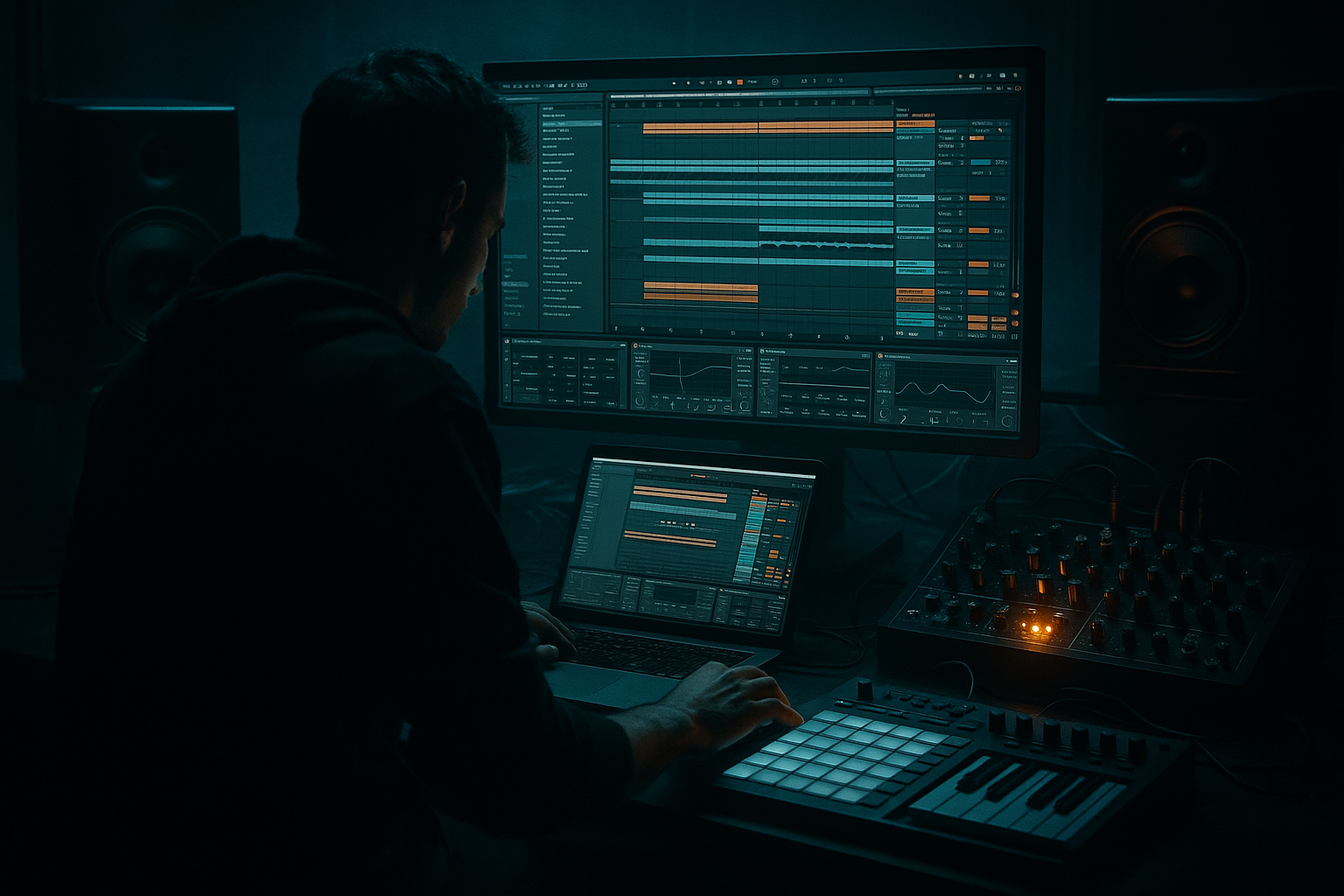
Main tutorial
Clean an Amen-style subsine for rewind-worthy drops in Ableton Live 12
1. Lesson overview
In modern drum and bass / jungle, the Amen is often used as a top-layer character element, while the subsine is the low-end anchor that makes the drop feel huge, clean, and rewindable 🔥
This lesson shows you how to build a tight, mono-safe, punchy subsine that sits under an Amen chop without muddying the kick, snare, or bass movement. We’ll focus on:
- Cleaning the sub so it doesn’t blur the break
- Making the bass hit hard on club systems
- Using Ableton Live 12 stock devices
- Keeping the drop heavy but controlled
- Building arrangement tension for a proper rewind moment
- A sub that follows the root notes of the bassline
- Clean separation from the Amen kick/snare
- Punch through saturation without losing low-end weight
- A mix bus setup that keeps everything stable in Live 12
- Foundation only: simple sustained root notes
- Rhythmic support: follows drum syncopation
- Call-and-response: answers the snare or vocal chop
- Drop impact driver: short, aggressive notes before the rewind
- simple note choices
- clear rhythmic placement
- occasional movement for tension
- Load your Amen chop on an audio track.
- Program or import the sub on a separate MIDI track.
- Keep the sub written in the same key as the drop.
- Use root notes, fifths, and occasional octave jumps only if the arrangement needs energy.
- Oscillator A: Sine
- Oscillator B/C/D: Off
- Filter: Off or fully open
- Voicing: Mono
- Glide/Portamento: 20–60 ms if you want subtle legato movement
- Pitch envelope: off for now
- Very clean sine generation
- Precise MIDI control
- Stable low end
- Easy mono behavior
- Place notes on strong drum accents
- Leave space for the snare
- Let the kick and sub complement, not fight
- Use short note lengths for tighter grooves
- Sub note on beat 1
- Short pickup before beat 2
- Longer note after beat 2
- Rest around the snare transient if needed
- Repeat with variation every 2 or 4 bars
- Use 1/16 grid or 1/32 for pickups
- Add velocity consistency
- Keep note overlaps controlled if using glide
- Avoid too many octave jumps unless you want a drop accent
- Drive: 1–4 dB
- Soft Clip: On
- Output: compensate so level stays controlled
- Curve: default or subtle curve shaping
- Use Analog Clip mode carefully
- Keep the drive low
- Don’t destroy the sine’s fundamental
- Attack: 0 ms
- Decay: short to medium depending on note style
- Sustain: full or slightly reduced
- Release: 20–80 ms
- Raise attack a touch to 2–5 ms
- Or place Utility automation on clip gain
- Shorten release
- Tighten MIDI note lengths
- Use a gate-like envelope from Compressor sidechained lightly to the drums if needed
- Sidechain from kick: yes, if kick and sub overlap
- Ratio: 2:1 to 4:1
- Attack: 1–10 ms
- Release: 40–120 ms
- Threshold: set for 2–4 dB gain reduction on average
- the snare transient
- or a ghost drum bus
- Operator with a square wave at a very low mix, or
- Wavetable with a slightly harmonically rich preset, or
- Analog with a simple bass patch
- High-pass around 90–140 Hz
- Saturator or Overdrive for grit
- EQ Eight to tame harsh peaks around 1–3 kHz if needed
- Optional Auto Filter for movement
- On the sub:
- On the Amen:
- Let the sub play in gaps between break phrases
- Use call-and-response phrasing with the snare
- Remove low notes right before a snare fill for impact
- Filter cutoff on a mid layer
- Saturator drive for rising energy
- Utility gain for emphasis before a drop
- Clip gain envelopes for note accents
- Reverb send on occasional bass hits only, if used tastefully
- 4 bars of stable sub
- 2 bars with increasing rhythmic density
- 1 bar of stripped-down tension
- Drop to minimal bass on the last beat before the rewind or switch
- Put Utility on the master temporarily
- Toggle Mono to test the low end
- Listen for:
- more harmonic content
- better note choice
- tighter envelope control
- Favor minor keys
- Use root, flat 5, and octave movement carefully
- Repeat a low pedal note for tension
- Add a short, filtered vocal stab above the sub
- Let the sub answer it with a descending note
- Use Auto Filter or Corpus subtly for eerie texture
- Saturator
- Amp
- EQ Eight
- Maybe Redux very lightly for grit
- Drive low
- Boom off or very low for Amen-heavy material
- Crunch lightly if you want extra bite
- High-pass it
- Distort it slightly
- Automate the filter opening across the 4 bars
- Start with a pure sine in Operator
- Keep it mono
- Shape the envelope so it locks with the break
- Add just enough saturation for translation
- Sidechain lightly for clarity
- Use arrangement spacing to make the drop feel huge
- Test in mono and keep the low end disciplined
- a session view template
- a rack chain with macros
- or a step-by-step MIDI example in a specific DnB key
Even though this request is tagged Vocals, the technique here is especially useful when you want to create a vocal-like call/response low-end phrase under an Amen drop, or when a vocal sample needs a stable sub foundation without clutter. In DnB, the low end often behaves like a “response” voice to the break, so treating the sub with vocal-style phrasing and dynamics can make the drop feel more musical and memorable.
---
2. What you will build
You will build a 3-part subsine system under an Amen-style drum drop:
1. A pure mono sine sub
2. A controlled mid-bass reinforcement layer
3. A clean processing chain that keeps the low end readable and rewind-ready
By the end, your drop will have:
---
3. Step-by-step walkthrough
Step 1: Start with the Amen and define the sub role
Before writing the sub, decide what role it plays.
In DnB, the sub is usually one of these:
For a rewind-worthy drop, the best option is usually:
#### Practical setup
If the drop is heavy and dark, keep the subline minimal. Let the drums and bass design do the talking.
---
Step 2: Build the sub with Operator
For a clean subsine in Ableton Live 12, Operator is the fastest stock option.
#### Operator settings
#### Why Operator?
It gives you:
If you want more weight, don’t start by adding a bigger synth. Start clean and process carefully.
---
Step 3: Write the sub MIDI like a bassline, not a drone
A lot of subs fail because they’re written as a static note. In DnB, the sub should lock with the groove.
#### Good subwriting habits
#### Example groove idea
If your Amen snare hits on beats 2 and 4, try:
That creates a rolling feel without clogging the break.
#### MIDI tips
---
Step 4: Make the sub mono and club-safe
Sub bass in DnB should almost always live in mono.
#### On the sub track, add:
1. Utility
- Width: 0%
- Bass Mono behavior: if needed, but with a sine sub you usually just keep it fully mono
2. EQ Eight
- Use only if necessary
- High-pass very gently around 20–25 Hz to remove rumble
3. Optional: Spectrum
- Check where the fundamental sits
- Usually somewhere around 40–60 Hz for a DnB sub, depending on key
#### Why this matters
If the sub gets stereo widening, chorus, or phase smear, it will disappear on big systems and sound weak on mono playback.
---
Step 5: Add controlled harmonics with Saturator
A pure sine can sound too polite under an aggressive Amen. A tiny bit of harmonic content helps it translate on smaller speakers and adds weight.
#### Add Ableton Saturator
Recommended starting point:
If you want darker character:
#### Goal
You want the sub to remain a sub, but gain just enough upper harmonic content that you can hear it on laptop speakers and in dense break sections.
---
Step 6: Control the envelope with Amp Envelope or volume shaping
For rewind-worthy drops, the note shape matters a lot.
#### In Operator:
#### If notes are too clicky
#### If notes smear into the next hit
---
Step 7: Sidechain the sub to the kick and/or snare
In DnB, the kick-sub relationship is crucial. With Amen breaks, you may sidechain more selectively than in 4x4.
#### Use Compressor on the sub track
#### For Amen-heavy arrangements
You may also sidechain subtly from:
This helps the sub duck just enough so the break stays sharp.
#### Important
Don’t overdo sidechain pumping unless it is part of the artistic vibe. For rolling DnB, the sub should feel tight, not housey.
---
Step 8: Layer a mid-bass reinforcement for translation
This is optional, but very useful in modern heavy DnB.
Your sub is the fundamental. Your mid layer helps the bass “speak” on small systems.
#### Create a new track
Use:
#### Process the mid layer
#### Blend tip
Keep the mid layer quiet.
You should feel it more than hear it separately.
---
Step 9: Carve space for the Amen break
The Amen is full of transient detail. If your sub occupies too much time or frequency, the groove collapses.
#### Use EQ Eight on the drum bus or sub bus
- Low cut below 20–25 Hz
- Small dip if there’s buildup around 70–90 Hz conflicting with the kick
- Cut low-end rumble below 100–150 Hz depending on processing
- Don’t remove too much body if the break is supposed to feel old-school
#### Use arrangement, not just EQ
That “air gap” is part of the rewind moment.
---
Step 10: Add movement with automation, not chaos
A rewind-worthy drop often comes from controlled variation.
#### Automate:
#### In DnB arrangement terms
Try:
This makes the bassline feel intentional rather than looped.
---
Step 11: Check phase and mono compatibility
This is where advanced producers separate themselves from bedroom demos.
#### Do this:
- disappearing sub
- weak notes
- phasey harmonics
- kick/sub masking
#### Also test at low volume
If the sub line disappears quietly, you likely need:
---
Step 12: Build a simple bus chain for the low end
A very practical Ableton Live 12 low-end bus chain:
#### Sub bus chain
1. Utility
- Width 0%
2. EQ Eight
- HP at 20–25 Hz
3. Saturator
- Drive 1–3 dB
- Soft Clip on
4. Compressor
- Gentle control if needed
5. Spectrum
- For monitoring only
#### Drum bus chain
1. Glue Compressor
- 1–2 dB reduction max
2. Drum Buss
- Use sparingly
3. EQ Eight
- Remove unnecessary sub buildup
This keeps the Amen punchy while the sub stays centered and powerful.
---
4. Common mistakes
1. Making the sub too loud
If the sub is dominating, the drop loses clarity. In DnB, perceived heaviness comes from balance + groove, not just level.
2. Using stereo widening on the sub
This is one of the fastest ways to ruin a club mix. Keep the fundamental mono.
3. Overprocessing the sine
Too much distortion, compression, or filtering can turn a clean subsine into a muddy low-mid blob.
4. Leaving notes too long
Long sub notes can overlap the Amen’s transient details and smear the rhythm.
5. Ignoring the kick/sub relationship
Even in breakbeat-driven DnB, the kick and sub need a plan. If they fight, your drop loses impact.
6. Not checking in mono
A bassline that sounds huge in stereo can collapse badly on a mono PA or club system.
7. Using too much reverb or delay on the sub
Low-end ambience sounds cool in theory, but in practice it usually destroys definition.
---
5. Pro tips for darker/heavier DnB
Use note choices that feel ominous
For darker jungle or neuro-influenced rolling DnB:
Add a “vocalized” character layer
Since this lesson is categorized under vocals, think of your low end as a response voice:
Try parallel distortion on the mid layer
Send the mid-bass to a return with:
Blend it back in quietly for menace without losing the sub’s purity.
Use Drum Buss carefully
On the drum group:
Leave more silence than you think
Dark DnB often feels heavier because of what’s removed.
A half-bar gap before the drop can make the rewind hit harder than extra notes ever will.
---
6. Mini practice exercise
Exercise: Build a 4-bar Amen drop sub
#### Goal
Create a subline under a chopped Amen loop that feels heavy, clean, and suitable for a rewind.
#### Steps
1. Load an Amen loop and chop it into a 4-bar phrase.
2. Create an Operator sine sub on a new MIDI track.
3. Write a bassline using only:
- the root note
- the fifth
- one octave jump
4. Keep the notes mostly short.
5. Add:
- Utility set to mono
- EQ Eight with a high-pass at 20–25 Hz
- Saturator with 2 dB drive
6. Sidechain lightly from the kick.
7. Make bar 4 more sparse than bars 1–3.
8. Bounce the section and test in mono.
#### Challenge version
Duplicate the sub track and create a quiet mid-bass layer:
Listen for whether the drop gets bigger without becoming messy.
---
7. Recap
A clean Amen-style subsine in Ableton Live 12 is all about discipline and groove:
For rewind-worthy DnB drops, the sub should feel like the hidden engine under the Amen — not the headline, but the thing making the whole system hit harder 🚀
If you want, I can also turn this into:

