DNB COLLEGE

Drum & Bass Ableton Live 12 Tutorials

LESSON DETAIL

Camo & Krooked Ableton Live 12 roller groove blueprint with automation-first workflow (Intermediate · FX · tutorial)

An AI-generated intermediate Ableton lesson focused on Camo & Krooked Ableton Live 12 roller groove blueprint with automation-first workflow in the FX area of drum and bass production.

Back to lessons
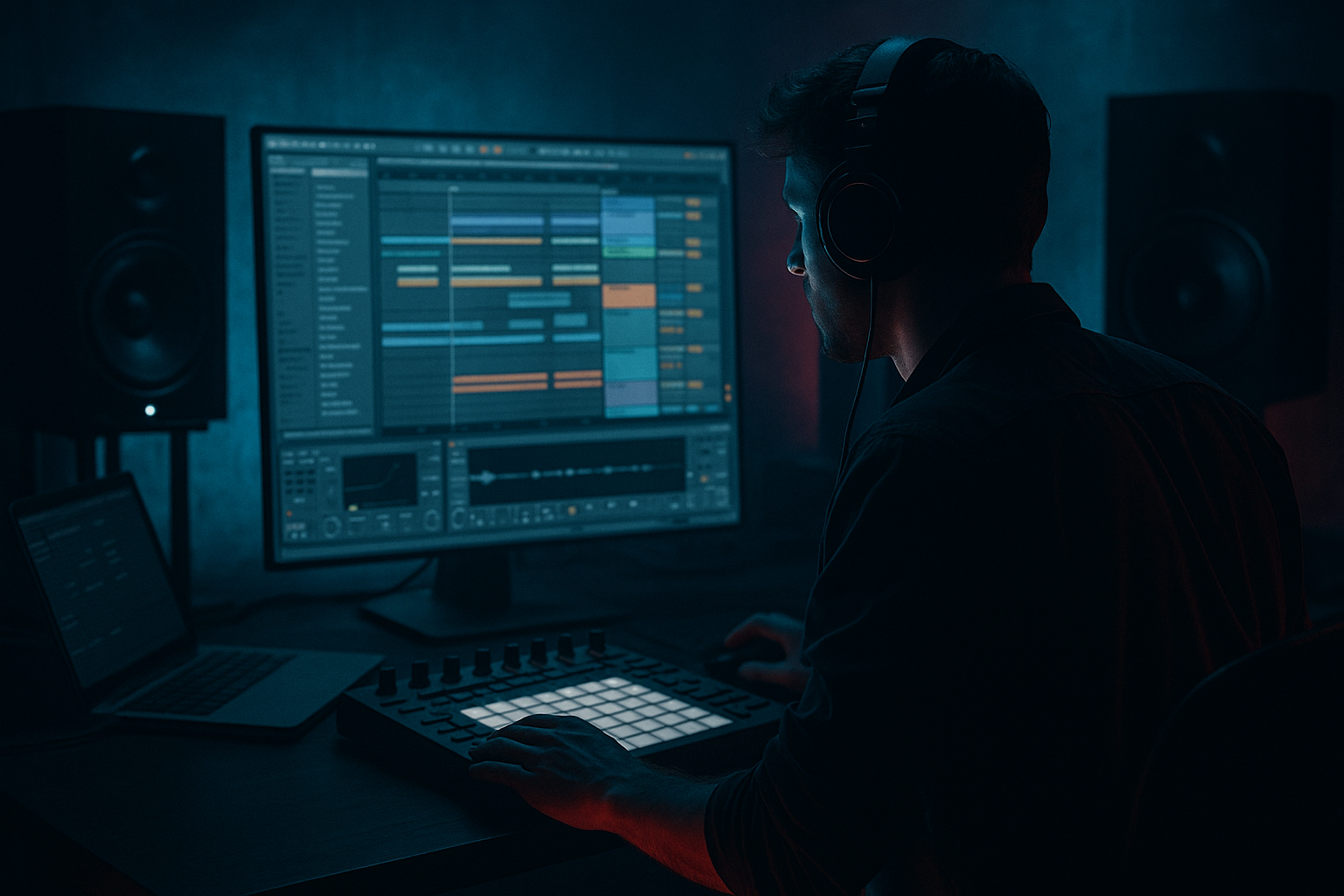
Camo & Krooked Ableton Live 12 roller groove blueprint with automation-first workflow (Intermediate · FX · tutorial) cover image

Narrated lesson audio

The voice track includes the tutorial plus extra teacher commentary.

Open audio file

Main tutorial

1. Lesson Overview

This lesson teaches an intermediate Ableton Live 12 technique: the "Camo & Krooked Ableton Live 12 roller groove blueprint with automation-first workflow." You'll learn to build a classic DnB roller — a repeating, evolving delay/reverb-oriented groove used by Camo & Krooked — using only Ableton stock devices and an automation-first approach: design the motion by writing automation lanes for sends, device parameters and macros, then resample and edit the result into tight Drum & Bass-ready rollers.

2. What You Will Build

  • A two-bar roller groove (stereo, punchy, evolving) that sits in a 174 BPM Drum & Bass mix.
  • Automation-driven repeats: send automation for delays/reverbs, filter sweeps, feedback modulation, and width changes.
  • A resampled audio roller clip you can slice, stretch, and layer over drums/bass.
  • A compact Instrument/Effect Rack with mapped macros for fast recall and further automation.
  • 3. Step-by-Step Walkthrough

    Preparation

  • Set project tempo to 174 BPM (typical Camo & Krooked DnB range).
  • Choose a source: a short synth stab, vocal chop, pad stab or bass stab. Use an existing MIDI synth (Analog, Wavetable, or Operator) or an audio sample on an Audio Track. Name the track "Roller Source".
  • Create two Return tracks: A = Ping Pong Delay (for rhythmic stereo repeats), B = Reverb (for tails). Optionally add C = Grain Delay for textural modulation.
  • A. Create the basic delay + reverb returns (stock devices)

    1. Return A – Ping Pong Delay

    - Drop a "Ping Pong Delay" on Return A.

    - Set Sync to 1/16 (experiment with 1/16T or 1/32 for different rhythmic feels). For a rolling DnB motif try 1/16 triplet (1/16T) or 1/32 for faster rollers.

    - Set Feedback to ~30–45% initially.

    - Dry/Wet to 60–80% (we’ll control send automation for wet/dry).

    - High cut at ~8 kHz, Low cut at ~250 Hz to keep low end out of repeats.

    - Pan knob is automatic; keep stereo spread.

    2. Return B – Reverb

    - Drop "Reverb" on Return B.

    - Decay Time 1.2–2.8s (longer if you want long tails), Dry/Wet 40–60%.

    - High Cut to taste (remove extreme highs), Low Cut around 400 Hz (helps low end clarity).

    - Use a moderate Diffusion and some Modulation for movement.

    3. Optional Return C – Grain/Texture

    - Put "Grain Delay" on Return C.

    - Grain Size 20–40 ms, Spray small, Dry/Wet 30–50%. Use this for occasional textured stutters.

    B. Route and initial levels

  • On the "Roller Source" track, set Send A (to Ping Pong) and Send B (to Reverb) at -inf (off). We'll fully automate them.
  • Add an "EQ Eight" after the synth to carve low end (high-pass at ~120–200 Hz) so repeats don't muddy the sub.
  • Add "Utility" for gain control and mono bass if needed.
  • C. Automation-first approach: painting motion

    1. Use Arrangement View for detailed automation (CTRL/CMD+TAB to ARR).

    2. Create automation lanes for the Roller Source track:

    - Show Send A (A) and Send B (B) automation lanes.

    - Also show device parameter automation lanes you’ll use: Ping Pong Delay Feedback (on Return A), Ping Pong Delay Sync/Time (if you want to switch note divisions), Reverb Decay or Dry/Wet (Return B), EQ Eight Frequency (cutoff), Utility Width, and source track Volume (for manual gating).

    3. Paint a basic two-bar pattern:

    - Draw Send A automation to create repeated bursts: e.g., on bar 1, steps of high/low to create 8x 1/16 repeats. For a rolling feel, create a ramp where Send A goes from -inf → -6 dB (fast) then back.

    - For a classic roller, automate Send A to open quickly on beat 2 of the bar, then close mid-bar to create a wave of repeats.

    - Automate Ping Pong Delay Feedback (on Return A) to increase slightly during the open portion (30% → 55%) so the repeats build in intensity.

    - Automate Ping Pong Delay Sync between 1/16 and 1/32 for variation (draw automation to switch on the first half-bar). Note: switching Sync changes timing, so make the transition on weak points or crossfade using resampling later.

    4. Add reverb automation for tails and contrast:

    - Automate Send B to create a longer tail where the delay burst decays into reverb. For example, after the main Send A burst, ramp Send B from -inf → -4 dB and hold for 1/2 bar so reverb swells.

    - Automate Reverb Decay/Size slightly up during big moments for lushness (e.g., 1.5s → 2.5s).

    D. Tone shaping and rhythmic gating

    1. Use Auto Pan on the source or a separate track for rhythmic amplitude gating:

    - Put "Auto Pan" after EQ Eight on the Roller Source.

    - Set Shape to square (gating) or triangle (smoother) and Rate to a synced division (1/8 or 1/16). Phase at 0° for mono gate, 90° for stereo offset.

    - Automate Amount (Amount knob) so gating engages only where you need it — e.g., 0% in verse, 80% in roller section.

    2. Use Filter Automation for build/release:

    - Place "Auto Filter" on the Return A or directly on the Roller Source (depending on whether you want the filter before or after delays).

    - Automate cutoff frequency to sweep during the repeats. For instance, low-pass the repeats at 3 kHz, then open to 10 kHz across a bar to let high harmonics shine as the repeats continue.

    E. Sidechain and Glue

  • Insert "Compressor" on Return A (or on the resampled roller later) and enable Sidechain from the Kick/Bass track to duck repeats gently with the kick.
  • Set Ratio 2:1–4:1, Attack short, Release synced to 1/16 or 1/8 to maintain groove.
  • F. Resampling and comping the roller

    1. Create an Audio Track named "Resample Roller".

    - Set Input to "Resampling" (this captures master output), or route only the source and its returns to an isolated group bus and set input to that bus.

    - Arm and record while the automation plays for 2–4 bars to capture the exact repeats and dynamics.

    2. Trim start and end, normalize, then use "Simpler" or "Slice to New MIDI Track" to slice patterns for further sequencing.

    G. Final polish and creation of an Effect Rack

    1. Once satisfied, put the resampled audio into an Audio Effect Rack.

    - Macro Map: Macro 1 = Delay Feedback (mapped to return feedback or a similar plugin parameter), Macro 2 = Delay Time (map to modulated parameter or simulate by switching between two returns via Utility Gain automation), Macro 3 = Reverb Decay, Macro 4 = Filter Cutoff (mapped to Auto Filter).

    - Save rack as "C&K Roller Blueprint" for reuse.

    4. Common Mistakes

  • Automating too many parameters simultaneously without grouping: creates unmusical chaos. Map key parameters to macros to keep control manageable.
  • Overfeeding low frequencies into Ping Pong Delay or Reverb: repetitive low-end mud. Always HP filter the source or the returns.
  • Switching delay Sync values abruptly without masking: changing sync creates audible jumps. If you must switch divisions, automate dry/wet crossfades or resample and edit the timing manually.
  • Relying solely on device LFOs: for an automation-first workflow, hand-drawn automation is more musical and precise. Avoid Auto Filter LFOs when you intend explicit, phase-locked motion.
  • Forgetting to sidechain the roller: un-ducked rollers can mask kick and bass in DnB.
  • 5. Pro Tips

  • Use Arrangement View’s Draw Mode (B) for precise, micro-editor automation shapes. Hold Shift to get finer resolution.
  • For humanized rollers, nudge some resampled repeats by 10–30 ms off-grid; duplicate and offset slices for swing.
  • Create two Ping Pong delays with slightly detuned times and crossfade between them for a richer stereo field.
  • For instant variation, automate the Delay Feedback with small random jumps using an LFO device mapped to the parameter but reduced in Amount; the LFO provides micro-variation while primary motion is hand-drawn automation.
  • Use Freeze Track → Flatten when CPU limits delay/resonant reverb processing; then continue editing the flattened audio.
  • Make multiple resampled versions at different loop lengths (1 bar, 2 bar, 4 bar) — useful for arrangement variety.
  • Keep an emergency low-cut bus on the master (Utility or EQ) and automate it when a roller moment is too bass-heavy.

6. Mini Practice Exercise

Goal: Build a 2-bar roller from a short synth stab.

1. Load a short stab or create a 1-note MIDI stab using Wavetable (1–2 octaves). Place it on a single clip repeating every 2 bars.

2. Create Return A (Ping Pong Delay 1/16T) and Return B (Reverb 1.8s).

3. Mute both sends, then in Arrangement view:

- Automate Send A: open to -6 dB on the first 1/4 bar, ramp down over the next 1/2 bar, close to -inf at the end. Repeat for bar 2 but increase Feedback by +15% via automation on Return A.

- Automate Send B: small swell (open to -8 dB) immediately after Send A closes on each bar to create reverb tails.

4. Add Auto Pan on the source with Shape square and automate Amount from 0 → 70% on bar 1 to gate the stab rhythmically.

5. Resample the 2 bars, trim, and drop into Simpler. Play the resampled clip alongside a basic DnB drum loop at 174 BPM. Save the rack.

7. Recap

You’ve built a "Camo & Krooked Ableton Live 12 roller groove blueprint with automation-first workflow" that emphasizes hand-drawn automation for send levels, delay feedback, filter sweeps and reverb tails. The method uses Ableton stock devices (Ping Pong Delay, Reverb, Auto Filter, Auto Pan, Grain Delay, Compressor) and a resampling step to convert live automation into editable audio. Key points: automate sends for rhythmic motion, HP filter repeats to protect sub, sidechain for clarity, and resample for tight editing/recall. Save your Effect Rack and resampled clips as presets for quick incorporation into future DnB productions.


Ask GPT about this lesson

Chat with the lesson tutor, get follow-up help, or use quick actions.

Bigup 👽 Ask me anything about this lesson and I’ll answer in context.

Narration script

Show spoken script
Title: Camo & Krooked Ableton Live 12 roller groove blueprint with automation-first workflow

Welcome. In this lesson we’ll build a classic Camo & Krooked-style roller in Ableton Live 12 using an automation-first workflow. You’ll design musical motion by drawing automation for sends, device parameters and macros, then resample and edit the result into a tight two-bar Drum & Bass roller at 174 BPM. We’ll only use Ableton stock devices.

What you’ll end up with:
- A two-bar, stereo, punchy and evolving roller that sits in a 174 BPM DnB mix.
- Automation-driven repeats: delay and reverb send automation, filter sweeps, feedback modulation and width changes.
- A resampled audio roller clip you can slice, stretch and layer.
- A compact Effect Rack with mapped macros for quick recall and further automation.

Let’s get started.

Preparation
- Set your project tempo to 174 BPM.
- Choose a short source: a synth stab, vocal or bass stab. Put it on a track named “Roller Source.” Use a MIDI synth like Analog, Wavetable or Operator, or drop an audio sample onto an Audio Track.
- Create two return tracks: Return A for Ping Pong Delay and Return B for Reverb. Optionally add Return C with Grain Delay for texture.

Create the returns (stock devices)
- Return A — Ping Pong Delay:
  - Drop Ping Pong Delay on Return A.
  - Set Sync to 1/16. Try 1/16T or 1/32 for different feels; triplet can be great for rolling motion.
  - Feedback around 30–45% to start.
  - Dry/Wet 60–80% — we’ll keep send levels off and automate them.
  - High cut ~8 kHz and low cut ~250 Hz to keep low end out of repeats.
  - Leave stereo behavior as-is for wide movement.

- Return B — Reverb:
  - Drop Reverb on Return B.
  - Decay 1.2–2.8 seconds depending on tail length you want. Dry/Wet 40–60%.
  - Low cut around 400 Hz and high cut to taste.
  - Use moderate Diffusion and some Modulation for movement.

- Optional Return C — Grain Delay:
  - Grain Size 20–40 ms, Spray small, Dry/Wet 30–50% for occasional textured stutters.

Routing and initial levels
- On “Roller Source” set Send A and Send B to -inf — muted. We’ll paint their motion.
- Put an EQ Eight after the synth and high-pass at ~120–200 Hz to protect the low end.
- Add a Utility for gain control and mono bass if needed.

Automation-first workflow: paint the motion
- Switch to Arrangement View for precise automation.
- Show automation lanes for Send A and Send B on the Roller Source track.
- Also expose device parameter lanes you’ll automate: Ping Pong Delay Feedback and Time (on Return A), Reverb Decay or Dry/Wet (Return B), EQ Eight cutoff, Utility Width and the source track Volume for manual gating.
- Draw a basic two-bar pattern:
  - Paint Send A automation to create repeated bursts. For example, create fast opens to -6 dB and closes at -inf to make groups of 1/16 repeats.
  - For a rolling feel, open Send A quickly on beat 2 of the bar, then close mid-bar to form a wave of repeats.
  - Automate Ping Pong Delay Feedback to rise during the open portion — for instance 30% up to 55% — so repeats build.
  - Consider automating Ping Pong Delay Sync between 1/16 and 1/32 for variation but be careful — switching sync changes timing. If you must switch, do it on weak points or plan to resample and fix timing.

Reverb automation and tails
- Automate Send B so reverb swells after delay bursts. A typical move: after the main Send A burst, ramp Send B from -inf to around -4 dB and hold for half a bar to create a tail.
- Automate Reverb Decay or Size slightly up during big moments — for example 1.5s to 2.5s — to add lushness.

Tone shaping and rhythmic gating
- Add Auto Pan on the Roller Source after EQ Eight:
  - Shape square for gating or triangle for smoother movement.
  - Rate synced to 1/8 or 1/16. Phase 0° for mono gate or 90° for stereo offset.
  - Automate the Amount knob so gating only kicks in where you want it — zero in sections where you don’t want gating, then ramp up to 70–80% in the roller section.
- Use Auto Filter on either the Return A or the source depending if you want the filter before or after the delays:
  - Automate cutoff to sweep the repeats. A good starting point is to low-pass at 3 kHz and open to 10 kHz across the bar so high harmonics come through as the repeats evolve.

Sidechain and glue
- Insert a Compressor on Return A or on the eventual resampled roller and enable Sidechain from your kick or bass track.
- Use a 2:1–4:1 ratio, short attack and a release synced to 1/16 or 1/8 so the repeats duck around the kick and stay groovy.

Resampling and comping the roller
- Create an Audio Track named “Resample Roller.”
- Set its input to Resampling to capture the master output, or route the source and returns to an isolated bus and set input to that bus if you only want the roller elements.
- Arm and record 2–4 bars while your automation plays. This prints exactly what you hear, including sidechain and crossfades.
- Trim the start and end, normalize if you like, then use Simpler or Slice to New MIDI Track to slice for further sequencing.

Final polish and Effect Rack
- Load the resampled audio into an Audio Effect Rack for performance control.
- Map useful macros. For example:
  - Macro 1: Delay Feedback (or a send trim)
  - Macro 2: Delay Time or a crossfade between two delay chains to simulate sync changes
  - Macro 3: Reverb Decay
  - Macro 4: Filter Cutoff
- Save the rack as “C&K Roller Blueprint” so you can reuse it.

Common mistakes to avoid
- Don’t automate everything willy-nilly — too many simultaneous changes create chaos. Map key controls to macros.
- Don’t feed low frequencies into delays and reverb; HP filter the source and returns.
- Don’t abruptly switch delay Sync on one device without masking it — it causes audible jumps. Crossfade between separate delay chains instead.
- Avoid relying only on device LFOs when you want precise, phase-locked motion. For this workflow, hand-drawn automation is the primary tool.
- Don’t forget to sidechain — an unducked roller will mask kick and bass in DnB.

Pro tips
- Use Draw Mode in Arrangement View and hold Shift for finer control.
- For human feel, nudge resampled repeats by 10–30 ms off-grid.
- Create two Ping Pong delays with slightly different times and crossfade between them for a richer stereo field instead of switching sync on one device.
- For small micro-variation, map a low-depth LFO to Delay Feedback while keeping your main automation hand-drawn.
- If CPU becomes an issue, Freeze and Flatten tracks after you’re happy with a print, but keep backups of your originals.
- Resample multiple loop lengths — 1, 2 and 4 bars — to give arrangement options.
- Keep an emergency low-cut on the master and automate it if a roller moment becomes too bass-heavy.

Mini practice exercise — build a 2-bar roller
1. Load a short stab or make a one-note MIDI stab in Wavetable. Make a clip repeating every two bars.
2. Make Return A with Ping Pong Delay at 1/16T and Return B with Reverb at about 1.8 seconds.
3. Mute both sends, then in Arrangement:
   - Automate Send A: on each bar open to -6 dB for the first quarter, ramp down over the next half, then close to -inf. On bar two, increase the Feedback on Return A by about 15% via automation.
   - Automate Send B: add a small swell to -8 dB right after Send A closes to create reverb tails.
4. Put Auto Pan on the source set to square and automate Amount from 0 to 70% on bar one to gate the stab rhythmically.
5. Resample the two bars, trim and drop the result into Simpler, then play it with a basic DnB drum loop at 174 BPM and save the rack.

Recap
You’ve learned an automation-first method to create Camo & Krooked-style rollers: draw send-level automation for rhythmic repeats, automate delay feedback, add filter sweeps and reverb tails, then resample and compact the result into a reusable Effect Rack. Key reminders: HP filter source and returns, sidechain to keep space for kick and bass, and save presets and printed clips with tempo and notes.

Quick checklist before you save
- HP filters set on source and returns.
- Small fades on resampled clip edges to avoid clicks.
- Check mono compatibility and phase.
- Map 4–6 macros for arrangement control and save the rack with a clear name and version.
- Export your resampled audio with tempo in the filename and a short note about the key automation moves.

Final mindset
Treat the roller like a performed phrase: commit the musical motion to audio and make the automation choices deliberate. Save multiple resampled variations — soft to aggressive — and build a small library you can pull from when arranging.

That’s it — go build your roller, resample it, and make it your own.

mickeybeam

Go to drumbasscd.com for +100 drum and bass YouTube channels all in one place - tune in!

Generating PDF preview…