Show spoken script
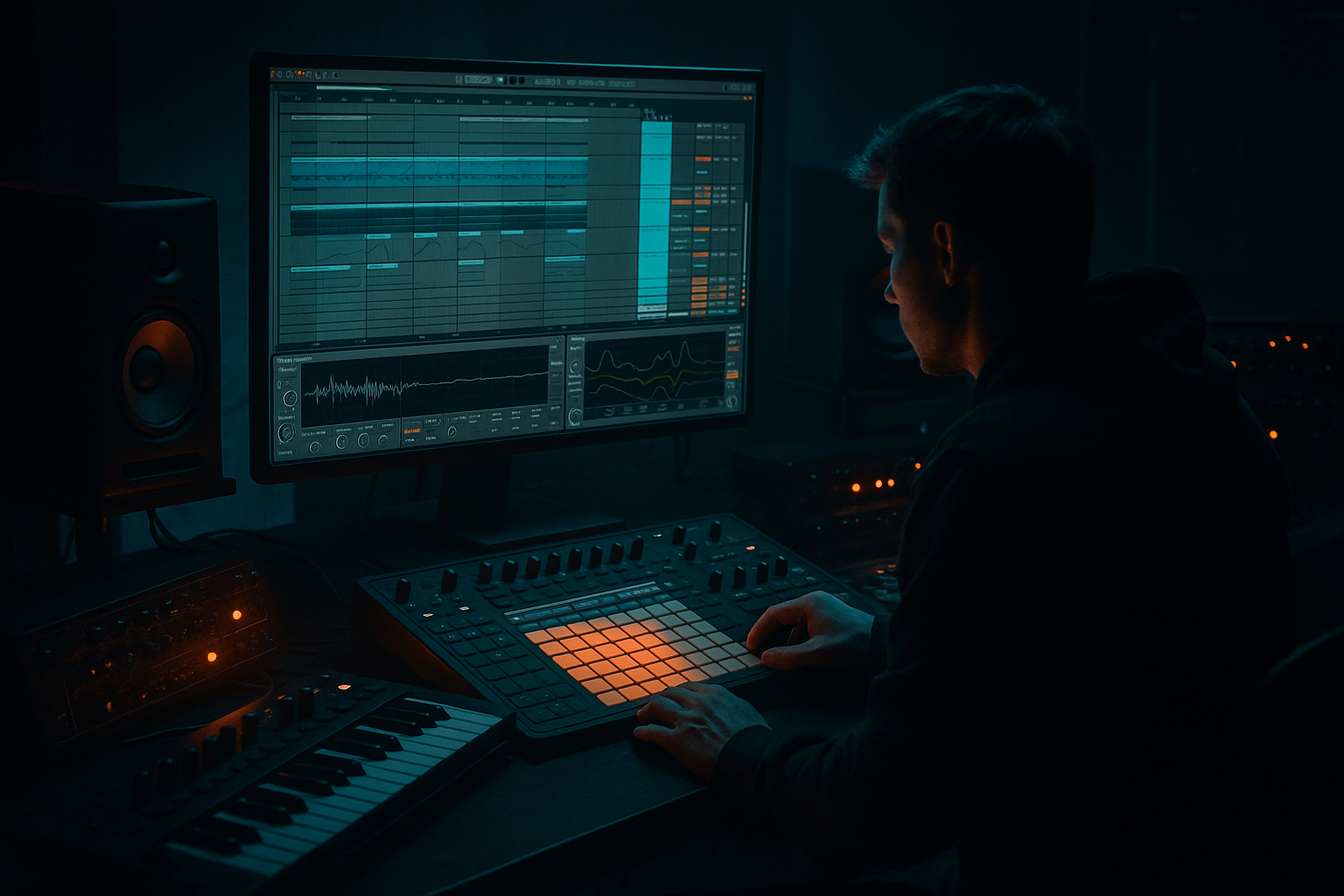
Alright, let’s build an advanced call-and-response system with samples for drum and bass in Ableton Live. The goal is simple: make your loop feel like it’s talking to itself. Not just repeating. Not just filling space. Actually having a conversation that pulls you through phrases in a DJ-friendly way.

We’re aiming for a 16-bar rolling idea at around 170 to 175 BPM, and we’ll set it up so it’s easy to expand to 32 bars later. You’ll end up with a clear “speaker” as the call, and a second “speaker” as the response, plus drums, a break layer that behaves like punctuation, and a bass foundation that supports the whole conversation.

First, set your tempo to 174 BPM. That’s a sweet spot for rolling DnB because it’s fast enough to feel urgent, but still leaves room for swing and micro-timing.

Optional but very useful: add a groove from the Groove Pool. Something like Swing 16-65. Don’t go crazy. Start with an amount around 20 to 35 percent. The reason is we’re going to do some tight call-and-response placements, and a little swing helps it feel less “programmed,” but we still want the snare to feel like a concrete wall.

Now create your tracks. You want a drums group, a break layer track, a bass group with sub and mid, a call sample track, and a response sample track. And if you like working with throws, set up two return tracks: one for a reverb throw and one for a delay throw. If you already have a template with returns, even better.

Before we pick sounds, I want you thinking like a coach would: decide the speaker roles before you write a single note. The call is identity. It’s the motif. It’s what the listener remembers. The response is punctuation. It reacts, it comments, it sets up the next bar. If both feel like identity, your hook won’t read. It’ll sound like two leads arguing in the same room.

Now choose your samples, and choose them for contrast, not competition.

A great pairing is: call is a vocal chop living in the midrange, something human and recognizable, and response is a metallic stab or a bright FX reply living higher up. Or flip it: call is a dark chord stab, response is a short vocal like “oi” or “yeah.” Another classic move is making the call a mid-bass one-shot and the response a resampled bass growl pitched to a different register.

Here’s your frequency discipline rule of thumb. Call often sits in that 700 Hz to 3 kHz zone, where presence lives. Response can either be brighter, like 2 to 8 kHz for spark and air, or it can be body-focused in 200 to 800 Hz if you want a chunkier reply. Just don’t let both sit in the exact same band with the same stereo width, or they’ll mask each other and you’ll lose the conversation.

Next, build your drum foundation. Keep it clean and leave space for the dialogue.

Classic DnB grid: snare on beats 2 and 4. That’s non-negotiable if you want it to feel like DnB. For the kick, start simple. A common starting point is kick on 1, another around 1.3, and sometimes something around 3.1 depending on your vibe. Don’t overfill the kick pattern right now, because we want the samples and mid-bass to have places to speak.

On your drum group, use a practical chain. Drum Buss is a great start. Drive somewhere around 5 to 15 percent, Boom around 20 to 35 and tune it so it doesn’t fight your sub, Crunch 5 to 10 if you want a bit of edge. Then EQ Eight: high-pass around 25 to 30 Hz just to kill nonsense. If it’s boxy, a small dip around 250 to 400 Hz can help. Then Glue Compressor: attack around 3 milliseconds, release on auto, ratio 2 to 1, and only aim for one to two dB of gain reduction. If you’re slamming it, you’re probably stealing the snap from your snare.

Now ghost notes and shuffle. Add hats or shaker ghosts about 12 to 18 dB quieter than the snare. Then the advanced move: micro-nudge some hats slightly early, like 5 to 12 milliseconds, for urgency. But do it by ear. If it starts sounding like flammy chaos, you went too far.

Now layer a break, but don’t let it become a constant wall of noise. The break is not the main story. It’s the chatter that answers fills.

Drop your break into the break layer track. Warp it in Beats mode, preserve at 1/16, transients up around 100. Then high-pass it aggressively, usually somewhere around 180 to 300 Hz. We want tops and texture, not extra low-end competing with your kick and sub.

Here’s the trick that makes it call-and-response instead of “break layer always on”: gate it rhythmically and automate it so it only speaks on certain bars.

Use Auto Pan as a rhythmic gate. Set amount to 100 percent, rate to 1/8 or 1/16, phase at zero, and shape toward square so it’s actually chopping. Then automate that gate to turn on only during response bars, like bar 4, 8, 12, and 16. Now the break is acting like punctuation at the ends of phrases, which is exactly what we want.

Next, bass. We’re going to separate stability from speech.

Sub bass is stability. It’s steady, it’s consistent, it doesn’t argue with the samples. Use Operator with a sine wave. Add a Saturator with soft clip on, drive maybe 2 to 5 dB. Sidechain it to the kick with a Compressor: ratio 4 to 1, attack 1 to 3 milliseconds, release 60 to 120 milliseconds. Write a simple sub line. Often one or two notes over the whole 16 bars is enough, because the mids and samples are where the phrasing happens.

Mid bass is speech. This is your call’s partner sometimes, or at least the supporting actor. Use Wavetable or Operator for a reese-ish tone, and write a two-bar phrase with rests. And I’m saying rests on purpose. Silence is part of the groove. If your mid bass is constant, it steals the conversational space from the call and response.

Now let’s program the call.

On the call sample track, load Simpler. Keep it focused, not in a Drum Rack yet. Put Simpler in Classic mode, warp on if needed, snap on. Shape the envelope so it’s punchy: attack 0 to 5 milliseconds, decay maybe 150 to 400, sustain all the way down if you want one-shots, release 30 to 120 depending on how tight you want it.

Then EQ it. High-pass around 120 to 250 Hz. If it’s biting your face, notch a bit around 2.5 to 4.5 kHz. Don’t over-EQ. You’re just carving it into its role.

For vibe, add Echo, but controlled. Try 1/8 dotted or 1/4 timing, feedback 15 to 30 percent, filter it so the delay isn’t muddy: high-pass around 300 Hz, low-pass around 6 to 9 kHz. Keep dry/wet low, like 8 to 18 percent, or keep it totally dry and plan to do delay as a throw on a return track.

Now write a two-bar call pattern. This is important: make it recognizable and repeatable. It’s the identity. And leave a gap at the end of bar 2 for the response. Literally silence is part of the hook.

A placement idea: put call hits on bar 1 at 1.2 and 1.4. Then bar 2, maybe a hit around 2.2, and then stop early. That “stop early” is your question mark.

This is a concept I want you to internalize: use question marks and periods in MIDI. Question mark rhythms end slightly early. You leave a 1/8 or even a 1/16 void right before a snare or phrase turn. Period rhythms land confidently on the grid, often just after the snare or on an upbeat. In practice, let the call end before the backbeat, and let the response lean into the next backbeat.

Now create the response.

On the response sample track, also use Simpler. The response should usually be shorter, cheekier, and different in contour. That difference can be rhythmic, pitch movement, or tone. And it needs its own frequency and stereo pocket.

A solid response chain is: Simpler, then Redux just a little for grit. Downsample around 2 to 6, dry/wet 10 to 25 percent. Then Auto Filter, MS2 or PRD type, and automate cutoff between about 800 Hz and 6 kHz, resonance 0.2 to 0.6. Then Utility for width decisions. If it’s a bright response, you can widen it, like 120 to 160 percent. If it’s meant to be a mono reply, set it to zero percent. Choose deliberately. Don’t just widen everything because it sounds exciting in solo.

Write the response only in the gaps. If your call ends mid-bar, the response should start right after. And here’s a very DnB-specific tip: make the response feel like it’s pulling into the next snare. That forward motion is what makes a loop feel like it’s driving.

Now let’s add micro-timing, because this is where advanced call-and-response starts feeling alive.

Keep the call hits closer to the grid. That’s your stable reference point. Then allow the response hits to be nudged slightly late, like 5 to 15 milliseconds, so it feels like talkback. Do it by ear. If it starts sounding behind the beat, pull it back. We’re aiming for conversational, not sloppy.

Also, clip gain staging matters more than adding another plugin. Before processing, set the call so it peaks a bit higher than the response. Then you compress or saturate if needed. If you do it backwards, you’ll hide the dynamic relationship and you’ll end up over-processing.

Now we make it feel like a real conversation across phrases.

Think in four-bar sentences. Bars 1 and 2 are the basic call and response. Bar 3, the call changes slightly, maybe one extra hit or a pitch move. Bar 4, the response becomes more like a fill, and that’s where your break gate can wake up.

Duplicate your two-bar clip to make four bars. Then only in bar 4, do one clear change. Pitch the response up 3 or 7 semitones, or add a single extra 1/16 hit, or shorten the decay so it feels more urgent. One change is enough. Too many changes and the listener can’t learn the language.

Now build a throw and return system. This is how you get big moments without washing out your groove.

On Return A, set up a reverb throw. Use Hybrid Reverb, hall algorithm, decay maybe 2.5 to 6 seconds, pre-delay 15 to 30 milliseconds, high-pass 300 to 600 Hz, low-pass 6 to 10 kHz. Then put a Gate after it. The gate is key. You want a bloom that stops, not a tail that muddies the next bar. Automate Send A only on the last response hit of bar 4, or bar 8, or bar 16. Phrase endings only.

On Return B, set up a delay throw. Use Echo, 1/8 dotted, feedback 35 to 55 percent, subtle modulation, filter it with high-pass 250 to 400 and low-pass 6 to 8 kHz. Add a Saturator after Echo, drive 2 to 6 dB, so the repeats feel excited without being louder.

Now, advanced workflow: resample and re-contextualize.

Create an audio track called resample print. Solo call and response, maybe include the mid bass too, and record 8 bars. Then chop that recording into new one-shots. Load those into a Drum Rack, assign your best hits to pads, and now you can perform new call-and-response patterns using your own material. This is how you get that “one world” cohesive sound where everything feels like it came from the same record.

While we’re in mix discipline mode, assign roles like an engineer.

Call: mostly midrange, slightly narrower stereo. Response: brighter or wider, but quieter. Sub: mono and steady. Mid bass: controlled stereo, maybe Utility width between 80 and 120. Break layer: mostly tops, tucked low in level.

Use Spectrum on the call and response tracks. Don’t guess. Look at where they’re living. If both are screaming in the same zone, fix it with filtering, envelope shaping, or a small EQ move. Not with volume wars.

Now do the translation tests. These are quick, and they save you from building a cool loop that collapses in real life.

Mute the call. Does the response still feel like it belongs in timing and tone, or does it feel random? Mute the response. Does the call still feel like a hook, or does it feel empty? Then do a mono test. If your response relies entirely on width, it might disappear in mono. Make sure there’s a mono core, even if it’s quieter, or add a subtle mono “shadow response” layer.

That shadow response is a great extra: duplicate the response track, pitch it down 12 semitones, low-pass it heavily, keep it mono and very quiet. It adds weight and intent exactly on those reply moments without turning into a new bassline.

Let’s talk common mistakes so you can avoid wasting an hour polishing the wrong thing.

If both phrases are equally complex, it feels like two leads arguing. Fix it by shortening the response, reducing notes, reducing bandwidth. If there’s no silence, there’s no conversation. Mute gaps intentionally, even if it feels scary at first. If the response is louder than the call, your hook loses direction. Make the call slightly louder; the response can be brighter but lower in level. If you put too much reverb on the main hits, you lose punch. Use throws, not constant wetness. And if your break layer runs constantly, you mask groove and phrasing. Automate it so it answers at key moments.

Now a couple pro moves for darker, heavier DnB.

Make the response a distortion event. Automate saturator drive so it jumps up only on response hits. Or do a pitch drop response: take a vocal “yeah” and pitch it down 5 to 12 semitones for menace. Use EQ Eight in mid-side mode on the response: dip some 2 to 5k in the mid so it doesn’t stab your snare in the chest, and add a tiny lift in the sides above 6 to 10k for air. And try sidechaining the response very subtly to the snare, just one to two dB, so the snare stays king.

Now, if you want structured variation without adding new samples, use what I call echo grammar.

Tier one: every two bars, the response is dry. Tier two: end of four bars, response gets delay only. Tier three: end of eight or sixteen, response gets delay plus reverb plus a pitch or formant change. Now your listener learns the structure subconsciously, and your loop feels arranged even before you “arrange” it.

One more advanced idea: call stays, response rotates. Take one response source sample and make three characters. One is short and bright, high-passed. One is mid-focused, band-passed, almost phone-like. One is dark and mono, pitched down with low-pass. Swap them per four-bar block. That gives you evolution without introducing a whole new melodic element.

At this point, you should have a solid 16-bar sketch. But if you want to upgrade it into something DJ-functional, stretch it to 32 bars.

Bars 1 to 8 establish: call prominent, response minimal. Bars 9 to 16 develop: response more frequent, small tonal shifts. Bars 17 to 24 variation: new response version, break layer a bit more active. Bars 25 to 32 pre-drop signaling: strip elements, then hit a final big response throw right at bar 32.

And here’s a sick arrangement trick: right before the drop, remove the call and keep the response. Let the response tease alone with minimal drums. Then when the call returns at the drop, it feels like resolution. Like the conversation finally completes the sentence.

Now your quick practice assignment, if you want to lock this in fast.

Pick two samples: vocal chop for the call, metallic stab or FX for the response. Write a two-bar call with two to four hits. Write a two-bar response with one to three hits only in the gaps. Duplicate to eight bars. In bar 4, add a reverb throw on the final response hit. In bar 8, pitch the response up seven semitones and shorten the decay. Then add a break layer that only gates on bars 4 and 8.

Your deliverable is an eight-bar loop where you can mute either track, call or response, and the hook still makes sense.

If you want the full advanced homework challenge after that: make three versions of the call clip, and three response characters from one sample, arrange a 32-bar sketch with planned role changes, then print and chop bars 17 to 24 and replace at least two response hits with your own resampled chops.

That’s how you level this up from “cool loop” to “actual record language.”

Recap: call and response in DnB is contrast plus space plus repetition with evolution. Build steady drums and sub, let the mids and samples talk. Use Simpler, EQ, Auto Filter, and throws for controlled movement. Think in four-bar sentences. Test with mute and mono. And remember: silence is not empty. Silence is the part where the listener’s brain hears the reply coming.

If you tell me your target style, like jungle, roller, foghorn, or neuro-ish, I can suggest a few call-and-response rhythm templates and device chain tweaks that match that exact lane.