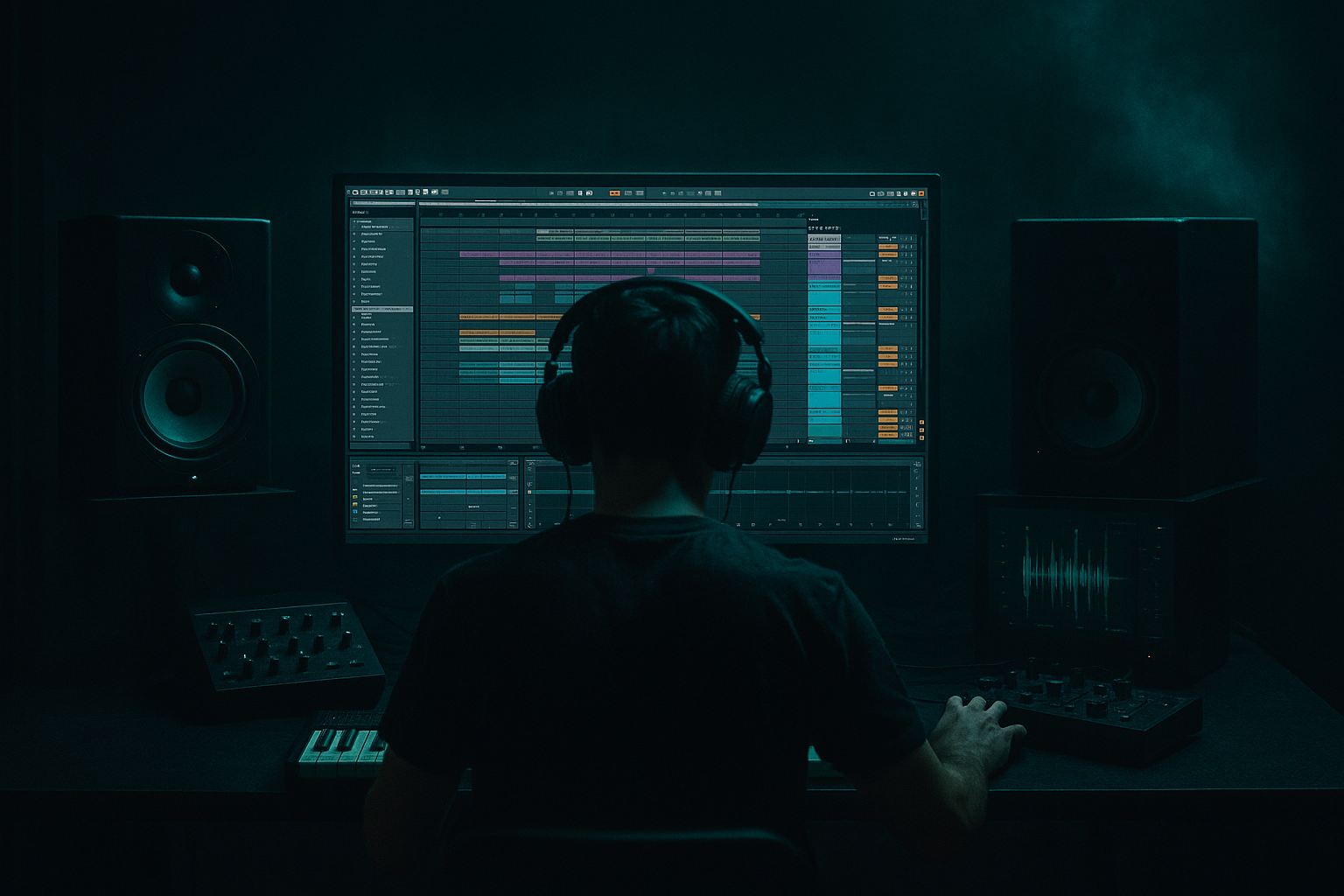
Main tutorial
Build an Amen-Style Reese Patch with Jungle Swing in Ableton Live 12
1. Lesson overview
In this lesson, you’ll build a dark, rolling Amen-infused reese bass patch in Ableton Live 12 and make it sit in a jungle-style swing pocket. This is a very practical DnB production workflow: we’ll combine sampled content, sub layering, resampling, and groove placement to create something that feels authentic in a rolling jungle tune. 🥁
You’ll learn how to:
- build a wide, aggressive reese using Ableton stock devices
- add grit and movement without losing low-end control
- place the bass against an Amen break with proper swing
- use Groove Pool, clip timing, and note placement for jungle feel
- shape it for dark drum and bass / jungle / rolling bass music
- a 2-layer reese patch
- a jungle swing groove that locks to an Amen break
- a bass MIDI pattern with offbeat pushes and call-and-response phrasing
- a resampled audio version you can chop, automate, and arrange like a real DnB tune
- murky, dark, and rolling
- not a bright neuro bass
- more classic jungle / halftime-to-fulltime movement
- tight enough for 170–174 BPM
- Drag the Amen break into an audio track.
- Warp it carefully if needed.
- Use Complex Pro or Beats warp modes depending on the sample.
- Keep the original transient energy intact.
- Open the Groove Pool.
- Try:
- Apply groove lightly at first:
- Instrument Rack
- Oscillator A: Sine
- Volume: around -6 dB to start
- Turn off other oscillators
- Filter: off or minimal
- Add Saturator very lightly if needed
- Saturator
- EQ Eight
- mono
- clean
- stable
- Osc 1: Saw
- Osc 2: Saw
- Detune Osc 2 slightly, around 5–15 cents
- Unison: 2 voices for moderate width
- Spread: low to medium
- Filter: Low-pass 24 dB
- Add a tiny bit of resonance
- Modulate cutoff with a slow LFO if desired
- LFO on filter cutoff:
- Add Glide/Portamento:
- Sub = mono and centered
- Reese = stereo and mid-focused
- put Utility on the sub chain
- put Utility on the reese chain
- Bar 1:
- Bar 2:
- Use 1/16 grid with some notes nudged off-grid
- Keep note lengths varied:
- Use velocity variation to create groove
- breakbeat timing
- slight bass pushes/pulls
- syncopation around the snare hits
- space for the drums to breathe
- Put the main bass hits slightly ahead of or just after the kick/snare accents
- Leave room around the Amen snare
- Let the bass “duck” into the break rather than fighting it
- same groove as drums, or
- a lighter swing groove
- Timing 10–25%
- Velocity 0–10%
- Sidechain input: kick or drum bus
- Ratio: 2:1 to 4:1
- Attack: 1–5 ms
- Release: 40–120 ms
- Threshold: set for 2–5 dB gain reduction
- chop the bass into phrases
- reverse tails
- automate transitions
- add tape-like variation
- create one-shot impact layers
- warp micro-timing if needed
- slice to pads or MIDI
- reverse hits for fills
- add Echo, Reverb, or Redux for transitions
- Drive: low to medium
- Crunch: subtle
- Boom: very cautious
- Use it more for density than obvious coloration
- Intro: drums + atmosphere + filtered bass hints
- Drop 1: full Amen + main reese phrase
- Variation: change bass rhythm, add fills
- Breakdown: remove sub, let sampled texture breathe
- Drop 2: heavier variation with more distortion or octave movement
- Outro: strip back to drums or filtered bass
- Use 8-bar phrases
- Introduce a new bass variation every 8 or 16 bars
- Automate:
- filter cutoff
- drive
- chorus depth
- width
- compressor sidechain amount
- rolling
- dark
- slightly unhinged, but controlled
- clearly rooted in jungle/DnB
- start with an Amen break
- shape a split sub + reese bass
- use Wavetable, Operator, Saturator, EQ Eight, Compressor, Utility
- program syncopated bass rhythm around the drums
- apply light swing and human timing
- resample for real jungle-style editing and arrangement
- a rack preset recipe
- a MIDI pattern example
- or a companion tutorial for Amen break chopping in Live 12
This is aimed at intermediate producers, so I’ll assume you know your way around Ableton, MIDI clips, and basic mixing.
---
2. What you will build
By the end, you’ll have:
- sub layer: clean mono low-end
- mid/top layer: detuned, stereo, distorted motion
Sound target
Think:
---
3. Step-by-step walkthrough
Step 1: Set the project up for DnB
1. Open Ableton Live 12.
2. Set tempo to 172 BPM as a starting point.
3. Create:
- one Audio Track for your Amen break
- one MIDI Track for the bass
- optionally one more Audio Track for resampling
4. If you have a drum break sample, load an Amen break into Simpler or directly into an audio clip.
Step 2: Build the Amen groove foundation
Before bass design, get the drums breathing.
#### Option A: Use the break as-is
#### Option B: Slice the break to MIDI
1. Right-click the Amen clip.
2. Choose Slice to New MIDI Track.
3. Use a slicing preset like Warp Markers or Transient slicing.
4. Now you can rearrange hits and create your own jungle rhythm.
#### Groove setup
- MPC 16 Swing 54
- MPC 16 Swing 57
- or any subtle swing groove around 54–58%
- Timing: 20–40%
- Random: 0–10%
- Velocity: 5–20%
This keeps the break human without destroying the forward drive. Jungle should feel loose, but still push hard.
---
Step 3: Create the reese bass core with stock Ableton devices
We’ll build the bass in Wavetable because it’s flexible and clean for layered DnB work.
#### Layer 1: Sub
Create a new MIDI track and load:
- Chain 1: Operator
- Chain 2: Wavetable or another synth for the mid layer
For the sub chain, use Operator:
Suggested settings:
- Drive: 1–3 dB
- Soft Clip: On
- Low-pass nothing
- Cut a tiny bit around 200–300 Hz if muddy
Keep this layer:
#### Layer 2: Reese body
On the second chain, load Wavetable.
Suggested starting patch:
##### Important bass movement settings
- Rate: 1/8 or 1/4 synced
- Amount: subtle
- Time: 40–90 ms
- Use on selected notes for that sliding jungle feel
#### Add movement and edge
After Wavetable, insert:
1. Saturator
- Drive: 4–8 dB
- Soft Clip: On
2. Roar if you want aggressive character
- Use a mild drive and a filter stage
- Keep it controlled, not overcooked
3. Chorus-Ensemble
- Mix: 10–25%
- Use gently to widen mids
4. EQ Eight
- High-pass the reese layer around 80–120 Hz
- This leaves sub to the sine layer
- Cut harshness around 2–5 kHz if needed
Step 4: Lock the sub and reese together
Use an Instrument Rack or group both layers on the same MIDI track.
#### Key routing goal
If needed:
- Width: 0%
- Width: 120–150% if it sounds good
This is crucial in DnB. If your sub is wide, the whole tune can collapse on club systems.
---
Step 5: Program a jungle-style bass phrase
Now write something that feels like it belongs under an Amen break.
#### Rhythm idea
Use short, syncopated notes with a few longer holds. In jungle, the bass often answers the drums rather than constantly filling every gap.
Try a 2-bar pattern at 172 BPM:
- note on the 1
- short note on the “a” of 1
- hit on 2&
- slide into 3
- rest early
- hit on 1&
- stutter on 2e/2a
- longer note leading into bar 3
#### Practical MIDI advice
- short stabs for movement
- longer notes for weight
Step 6: Add jungle swing through MIDI timing
Jungle swing is not just “shuffle.” It’s the combination of:
#### How to do it in Ableton
1. Open your bass MIDI clip.
2. Turn on Draw Mode if needed.
3. Move some bass notes:
- slightly late for laid-back pressure
- slightly early to create urgency before the snare
4. Use nudge rather than randomizing timing wildly
A good method:
#### Groove Pool on bass
You can also apply groove to the bass clip:
Do not over-groove the bass unless you want it to feel very human and loose. In DnB, the groove should still feel engineered.
---
Step 7: Use sidechain compression for bounce
Classic DnB bass needs space.
#### Stock device option: Compressor
Add Compressor to the bass rack or group.
Settings:
If you want cleaner timing, use volume automation or Shaper style movement, but Compressor is a good starting point.
Step 8: Resample the bass for editing
This is where the sound starts to feel like real jungle production.
#### Why resample?
Because once the patch sounds good, resampling lets you:
#### How to do it
1. Route your bass to a new Audio Track.
2. Set the track to Resample or choose the bass track as input.
3. Record a few bars.
4. Consolidate the best bits.
Now you can:
---
Step 9: Process the bass for a darker DnB tone
Once resampled, use a focused chain.
#### Example processing chain
1. EQ Eight
- cut mud around 250–400 Hz
- tame fizz if needed around 6–10 kHz
2. Saturator
- Drive: 2–6 dB
3. Redux or Erosion
- very subtle for grime and texture
4. Compressor
- light glue
5. Utility
- check mono compatibility
- narrow low mids if stereo is too messy
#### If you want more weight
Try Drum Buss on the resampled bass:
---
Step 10: Arrange it like a jungle record
A good DnB arrangement often works in sections.
#### Suggested structure
#### Arrangement tips
- filter cutoff
- distortion amount
- stereo width
- reverb sends for transitions
A jungle tune stays interesting by constantly evolving, but the core loop remains recognizable.
---
4. Common mistakes
1. Making the reese too wide in the lows
If your sub or low-mid bass is stereo, the mix will fall apart on clubs and headphones with phase issues.
Fix: Keep everything below about 120 Hz mono.
2. Overdistorting the patch
Too much saturation can flatten the groove and turn the bass into noise.
Fix: Drive in stages. Use several light saturators instead of one extreme one.
3. Ignoring the Amen’s transient space
If bass notes are sitting right on top of every snare and kick, the track will feel crowded.
Fix: Leave gaps. Jungle breathes.
4. Using too much swing on everything
If drums, bass, and fills all swing heavily, the track loses propulsion.
Fix: Apply swing selectively. Let some elements stay straighter.
5. Not separating sub and mid
A single bass patch doing everything usually sounds weaker and harder to mix.
Fix: Split your bass into layers.
6. Too much low-mid buildup
Classic DnB gets muddy fast around 200–400 Hz.
Fix: Use EQ carefully, especially on the reese body and drum bus.
---
5. Pro tips for darker/heavier DnB
Tip 1: Use a moving filter envelope
On the reese layer, map a subtle envelope or LFO to filter cutoff. Small movements create life without obvious wobble.
Tip 2: Automate distortion only in transitions
Keep the main groove controlled, then crank drive or filter resonance at the end of an 8-bar phrase for impact.
Tip 3: Resample with effects printed
A lot of dark jungle character comes from committing to the sound. Print the bass with saturation, then chop it.
Tip 4: Try pitch movement in small doses
A tiny bend into the root note can add menace. Keep it subtle so it stays musical.
Tip 5: Layer in a noise or texture bed
Use a quiet Operator noise layer or sampled vinyl/tape texture under the bass for grime.
Tip 6: Reference classic rolls
Listen to how old-school jungle bass phrases leave space for the break. The bass often feels like it’s dancing around the snare, not fighting it.
Tip 7: Use automation lanes like an arrangement instrument
Automate:
That’s how you get a living bassline instead of a static loop.
---
6. Mini practice exercise
Exercise: Make a 4-bar Amen + reese loop
Do this in Ableton Live 12:
1. Load an Amen break and slice it to MIDI.
2. Program a 4-bar break variation with:
- one extra kick fill
- one snare variation
- one ghost note turn-around
3. Build a 2-layer reese rack:
- sine sub
- detuned saw reese
4. Write a 4-bar bassline using:
- short offbeat notes
- one slide note
- one longer held note at the end of bar 4
5. Apply MPC swing 54–57% lightly to drums only.
6. Sidechain the bass to the kick.
7. Resample the bass and add one reverse hit into bar 4.
Goal
By the end, your loop should feel:
---
7. Recap
You just built a practical Amen-style reese patch with jungle swing in Ableton Live 12. The core workflow was:
If you keep your sub mono, your mids dirty but controlled, and your rhythm locked to the break, you’ll get that authentic DnB pressure fast. 🔥
If you want, I can also turn this into:

