DNB COLLEGE

Drum & Bass Ableton Live 12 Tutorials

LESSON DETAIL

Break Lab Ableton Live 12 mid bass method using Session View to Arrangement View for jungle oldskool DnB vibes (Intermediate)

An AI-generated intermediate Ableton lesson focused on Break Lab Ableton Live 12 mid bass method using Session View to Arrangement View for jungle oldskool DnB vibes in the FX area of drum and bass production.

Back to lessons
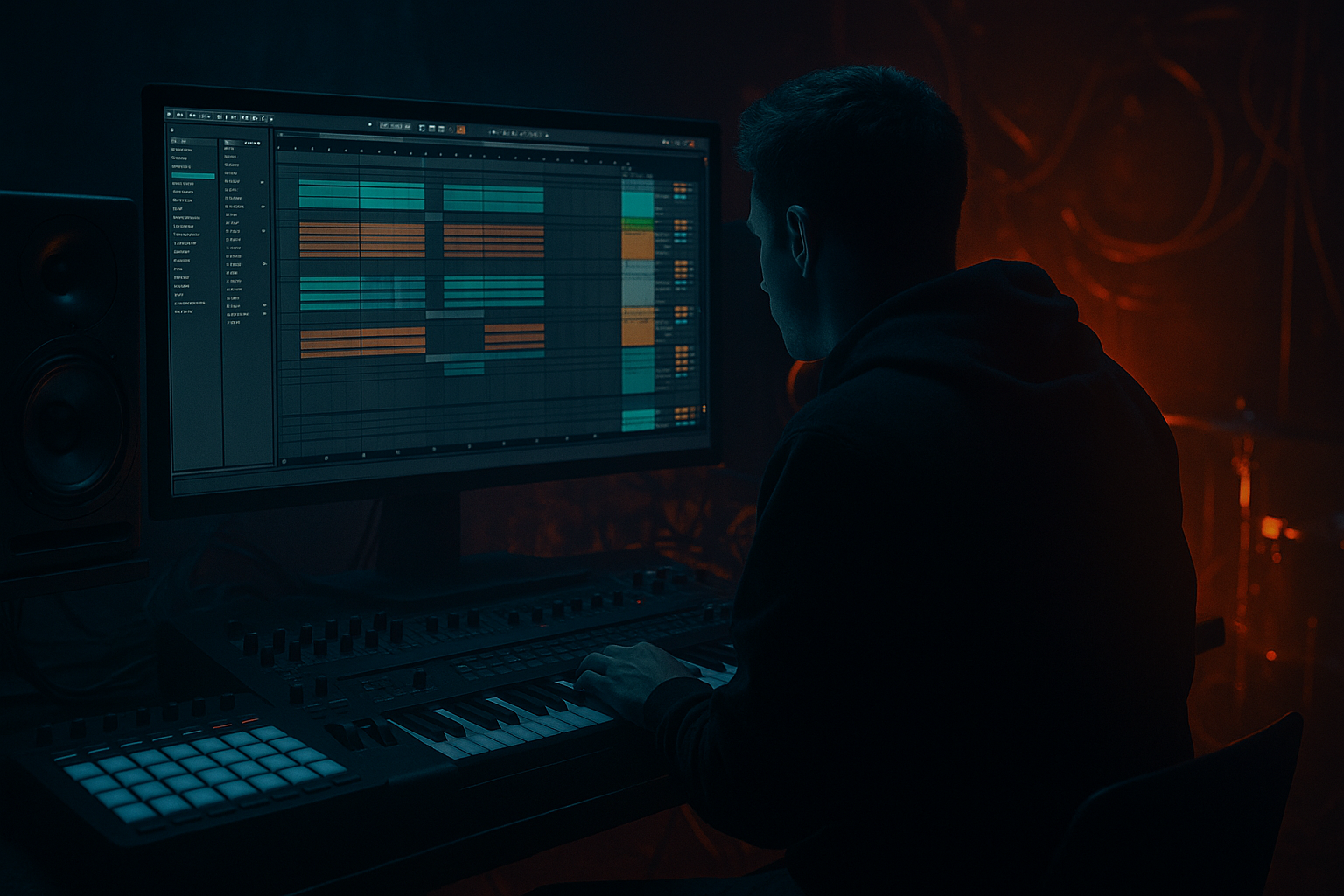
Break Lab Ableton Live 12 mid bass method using Session View to Arrangement View for jungle oldskool DnB vibes (Intermediate) cover image

Narrated lesson audio

The voice track includes the tutorial plus extra teacher commentary.

Open audio file

Main tutorial

Break Lab: Ableton Live 12 Mid Bass Method Using Session View to Arrangement View for Jungle / Oldskool DnB

1. Lesson overview

In this lesson, you’re building a mid-bass performance system in Ableton Live 12 that starts in Session View and gets arranged into a full oldskool jungle / drum & bass track. The goal is to create a dirty, moving, character-rich mid bass that works like a break-driven weapon: it supports the drums, adds tension, and brings that ragged, energetic 90s vibe ⚡

This approach is especially useful if you want:

  • a live-feeling bass groove instead of a static loop
  • a bass sound that can mutate across sections
  • a workflow that makes it easy to jam ideas in Session View and then commit them into Arrangement View
  • a sound palette that feels at home in:
  • - jungle

    - oldskool DnB

    - rolling breakbeat

    - darker halftime-inflected DnB

    We’ll use Ableton stock tools and focus on practical chain building, clip design, and arrangement control.

    ---

    2. What you will build

    You’ll create:

  • 1 MIDI bass rack with a gritty midrange tone
  • 3–5 MIDI clips in Session View:
  • - root note bass

    - moving call-and-response phrase

    - tension phrase

    - fill / turnaround

  • a performance-ready FX chain for movement and aggression
  • a Scene-based arrangement strategy that translates into Arrangement View
  • an intro, drop, variation, and breakdown structure
  • Final result

    A bassline that sounds like it was made for:

  • chopped break loops
  • sub-heavy jungle energy
  • dark atmospheres
  • gritty warehouse system playback
  • ---

    3. Step-by-step walkthrough

    ---

    Step 1: Set up your project for DnB workflow

    Before sound design, get your template right.

    #### Recommended settings

  • Tempo: `160–174 BPM`
  • - For classic jungle feel, try `162–168 BPM`

    - For more modern DnB, go `172–174 BPM`

  • Time signature: `4/4`
  • Warp: on for break loops
  • Global quantization: `1 Bar` for clip launching
  • Launch mode: use Follow Action if you want evolving variations later
  • #### Track layout

    Create these tracks:

    1. Drums / break loop

    2. Sub bass

    3. Mid bass

    4. Atmos / FX

    5. Risers / hits

    For this lesson, focus on the Mid bass track, but keep the drum loop playing so you can hear the bass against the break.

    ---

    Step 2: Build the mid bass instrument chain

    We want a mid bass that has body, bite, and movement without stepping on the sub.

    #### Use this stock device chain:

    Instrument Rack

  • Wavetable or Operator
  • Saturator
  • Auto Filter
  • Roar or Overdrive
  • EQ Eight
  • Glue Compressor or Compressor
  • optional Utility
  • ---

    Step 3: Create the core bass sound

    #### Option A: Wavetable mid bass

    This is a great choice for a reese-ish oldskool tone.

    Wavetable settings:

  • Osc 1: Saw
  • Osc 2: Square or Saw
  • Unison: `2–4 voices`
  • Detune: subtle, around `5–12%`
  • Filter: Low-pass, but keep it fairly open
  • Envelope: short decay, little or no sustain
  • LFO: assign to filter or wavetable position for motion
  • #### Option B: Operator mid bass

    This gives a more raw, FM-leaning character.

    Operator settings:

  • Algorithm: simple FM routing
  • Carrier: sine or triangle
  • Modulator: add just enough FM bite
  • Use slight pitch envelope for aggression
  • Add distortion afterward
  • #### Quick tonal target

    You want the bass to sound:

  • midrangey
  • slightly nasty
  • not too sub-heavy
  • able to cut through breaks
  • ---

    Step 4: Shape the tone with stock FX

    Here’s a strong practical chain.

    #### 1) Saturator

  • Mode: `Analog Clip`
  • Drive: `3–8 dB`
  • Soft Clip: `On`
  • Use this to thicken harmonics
  • #### 2) Auto Filter

  • Mode: `Low-pass 24` or `Band-pass` for movement
  • Add a little resonance
  • Map cutoff to an LFO or automate it in clips
  • For jungle vibes, short filter sweeps work beautifully
  • #### 3) Roar or Overdrive

    If you have Roar in Live 12, it’s excellent for aggressive tonal shaping.

  • Keep drive moderate at first
  • Try different color/saturation modes
  • Use parallel-style multiband feel if available in your setup
  • If using Overdrive:

  • Drive: `15–30%`
  • Tone: adjust until the mid feels focused
  • Frequency: place emphasis around the bass’ character range
  • #### 4) EQ Eight

    Use EQ to carve space.

    Suggested starting points:

  • High-pass at `30–40 Hz` if there’s accidental sub buildup
  • Cut muddy low-mids around `180–350 Hz` if needed
  • Slight boost around `700 Hz–1.5 kHz` for growl
  • Tame harshness around `2.5–5 kHz` if the bass gets fizzy
  • #### 5) Glue Compressor

  • Attack: `10–30 ms`
  • Release: `Auto` or `0.1–0.3 s`
  • Aim for gentle control, not over-squash
  • This helps the bass sit with break transients
  • #### 6) Utility

  • Use Width = 0% for anything below the mid range if the sound gets too wide
  • If the bass is stereo, consider keeping it narrower for club translation
  • ---

    Step 5: Write the bass in Session View

    This is where the method becomes powerful. Instead of building a linear bassline first, you’ll create loopable bass phrases that can be launched and tested against your break.

    #### Create 4 MIDI clips

    Make clips in 1-bar or 2-bar lengths:

    1. Main groove

    2. Answer phrase

    3. Variation

    4. Fill / turnaround

    ---

    Step 6: Write the first bass clip

    Start simple. Jungle and oldskool DnB bass often works best when it’s rhythmically tight and harmonically minimal.

    #### Example approach:

  • Use notes from the root, b3, 4, 5, or b7 if you want darker minor energy
  • Keep some notes short and staccato
  • Leave gaps so the break can breathe
  • #### Example in D minor:

  • D
  • F
  • G
  • A
  • C
  • #### Rhythm idea:

  • Hit on the offbeat
  • Leave space after snare hits
  • Syncopate around kick patterns in the break
  • Use short 1/8 and 1/16 notes for bounce
  • #### Practical MIDI advice:

  • Don’t fill every sixteenth note
  • Use velocity variation
  • Nudge certain notes slightly for human feel if needed
  • Consider note length differences to create groove
  • ---

    Step 7: Add movement with clip envelopes

    In Session View, each MIDI clip can have its own automation envelopes. This is crucial for evolving bass.

    #### In the clip envelope:

    Automate:

  • Filter cutoff
  • Resonance
  • Device on/off
  • Saturator drive
  • Wavetable position
  • Operator frequency offset if applicable
  • #### Example:

  • Bar 1: filter slightly closed
  • Bar 2: filter opens gradually
  • End of bar 2: resonance peak for tension
  • This creates that classic “it’s alive” bassline feeling without needing a huge arrangement.

    ---

    Step 8: Use variation clips for jungle energy

    Oldskool DnB and jungle work because phrases respond to the drums.

    #### Variation ideas:

  • Add a quick pick-up note before the snare
  • Use octave jumps
  • Create a call-and-response every 2 bars
  • Insert a short chromatic passing tone for tension
  • Use a pitch bend or short glide on one note
  • #### Helpful Live devices:

  • Pitch MIDI effect for fast octave shifts
  • Arpeggiator for short stutter fills
  • Chord if you want synthetic stacked movement, but use lightly
  • Note Length for controlled gate-style rhythm
  • ---

    Step 9: Make it heavier with resampling and layering

    To get authentic jungle grit, resample your mid bass or layer a textured top.

    #### Layer ideas:

    1. Clean mid layer

    - Gives note definition

    2. Dirty resampled layer

    - Print the bass with distortion

    - Warp it slightly if needed

    - Use it quietly underneath

    3. Noise/top layer

    - Add a subtle noise burst

    - Use filtered vinyl-like grit

    - Great for attack and oldskool texture

    #### In Ableton:

  • Resample the bass to audio
  • Chop the best bits
  • Reverse a tiny phrase for tension
  • Drop the resampled layer into Arrangement View for impact edits
  • ---

    Step 10: Jam in Session View like a performer

    Now treat Session View like an instrument.

    #### Workflow:

  • Loop the breakbeat
  • Launch the main bass clip
  • Trigger variation clips every 4 or 8 bars
  • Mute and unmute layers
  • Use automation to ride filter and distortion
  • Record the session performance into Arrangement View
  • This is one of the fastest ways to capture a natural DnB arrangement. You’re making decisions in real time, which often leads to better energy than drawing everything manually.

    ---

    Step 11: Record into Arrangement View

    Once the groove feels right, hit Global Record and perform your scene launches.

    #### What to capture:

  • bass clip launches
  • filter sweeps
  • effect changes
  • mutes/unmutes
  • fill transitions
  • breakdown moments
  • After recording:

  • zoom into the Arrangement View
  • clean up awkward clip launches
  • duplicate the best phrases
  • create the intro / drop / breakdown structure
  • ---

    Step 12: Arrange the track like a jungle / DnB tune

    A practical structure:

    #### Intro

  • break loop only
  • filtered bass hints
  • atmosphere
  • short bass teaser every 8 bars
  • #### Drop 1

  • full drum break
  • main bass groove
  • minimal variation
  • keep it punchy
  • #### Development

  • introduce a second bass phrase
  • automate filter opening
  • add fill every 8 bars
  • #### Breakdown

  • strip bass to a filtered texture
  • use echoes, reverb tails, and chopped bits
  • create tension with resonant filter sweeps
  • #### Drop 2

  • bring back the full bass
  • add variation clip or octave jump
  • make this section heavier or more chaotic
  • #### Outro

  • remove bass gradually
  • leave drums and atmos
  • ---

    Step 13: Use FX sends for classic space and impact

    For DnB, the bass usually stays focused, but short FX moments help the arrangement breathe.

    #### Recommended sends:

  • Reverb
  • - short decay

    - pre-delay to keep clarity

  • Delay
  • - ping-pong on selected fill notes only

  • Echo
  • - for dubby jungle tails

  • Redux
  • - for occasional lo-fi destruction, not on the main bass constantly

    #### Pro move:

    Automate send levels only on fill clips or the last note of a phrase.

    ---

    4. Common mistakes

    1) Making the bass too sub-heavy

    Mid bass should live above the sub, not fight it.

    If the bass sounds huge in headphones but collapses on a system, you may have too much low end in the mid layer.

    2) Overfilling the rhythm

    Oldskool DnB feels powerful because of space.

    If your bass plays on every subdivision, the break loses impact.

    3) Too much distortion without EQ

    Distortion creates harmonics, but it also creates mud and harshness.

    Always follow distortion with EQ shaping.

    4) No contrast between clips

    If every clip does the same thing, the arrangement will feel flat.

    Make distinct roles:

  • groove
  • answer
  • fill
  • breakdown texture
  • 5) Ignoring drum interaction

    The bass should lock with the break, not just exist beside it.

    Listen for how it reacts to snares, ghost notes, and kick placements.

    6) Stereo bass problems

    Wide bass can sound impressive but weak in a club.

    Keep the low-mid core controlled and mono-friendly.

    ---

    5. Pro tips for darker/heavier DnB

    Use note choice for mood

    For darker jungle vibes, lean into:

  • minor keys
  • modal movement
  • tritones
  • chromatic approach notes
  • Push movement with automation, not more notes

    A simple bassline with automated filter, distortion, and wavetable motion often feels heavier than a complicated MIDI pattern.

    Resample aggressively

    Print your bass to audio and manipulate it:

  • reverse tiny sections
  • slice transients
  • re-pitch phrases
  • add warp-based instability
  • Try parallel dirt

    Duplicate the bass track:

  • one clean
  • one distorted and filtered
  • Blend them subtly for controlled aggression.

    Add oldskool character

    Use:

  • bit reduction very lightly
  • saturated tape-style drive
  • short room reverb on specific fills
  • sample-like textures instead of polished synth perfection
  • Make the bass “answer” the break

    A classic jungle trick:

  • bass hits after the snare
  • short response before the next kick
  • small pitch drop at the end of a bar
  • That call-and-response relationship is pure movement.

    ---

    6. Mini practice exercise

    Exercise: 8-bar jungle bass sketch

    Build an 8-bar session using just one mid bass patch.

    #### Task

    1. Create 3 MIDI clips

    - Clip A: main groove

    - Clip B: variation

    - Clip C: fill

    2. In the bass sound, automate:

    - filter cutoff

    - saturation drive

    - one delay throw on the last note

    3. Arrange the performance into:

    - 4 bars groove

    - 2 bars variation

    - 1 bar fill

    - 1 bar empty or stripped-down break

    #### Constraints

  • Use only notes from a minor scale
  • Keep the bass mostly below the upper midrange
  • Leave at least 25% of the bars with intentional space
  • #### Goal

    Make it feel like the bass is dancing with the break, not fighting it.

    ---

    7. Recap

    You now have a practical Ableton Live 12 workflow for building a mid bass system for jungle and oldskool DnB:

  • design a strong mid-bass patch with stock devices
  • write short, rhythmically smart clips in Session View
  • use clip envelopes for motion and tension
  • launch variations like a live performance
  • record the best take into Arrangement View
  • shape the track with breakdowns, fills, and contrast
  • The big idea

    In drum and bass, the bass doesn’t need to be busy to be powerful.

    It needs to be rhythmically precise, harmonically focused, and constantly evolving 🔥

    If you want, I can turn this into:

  • a downloadable Ableton device chain recipe
  • a bar-by-bar MIDI example
  • or a full jungle drop arrangement template.

Ask GPT about this lesson

Chat with the lesson tutor, get follow-up help, or use quick actions.

Bigup 👽 Ask me anything about this lesson and I’ll answer in context.

Narration script

Show spoken script
Welcome back. In this lesson, we’re building a break lab style mid bass system in Ableton Live 12, and we’re doing it the jungle way, oldskool DnB style, with Session View as the playground and Arrangement View as the final destination.

The big idea here is simple, but powerful. We’re not just making a bass loop. We’re designing a bass performance system. Something that can jam with chopped breaks, evolve over time, and then get recorded into a full tune structure with intro, drop, variation, breakdown, and all that good energy.

This approach is perfect if you want a bassline that feels alive. Not polished and flat. Alive. Slightly dirty, moving, characterful, and ready to bounce off the snare pocket like it belongs in a 90s jungle set.

So let’s dive in.

First, set your project up for drum and bass workflow. Keep the tempo somewhere around 160 to 174 BPM. If you want that classic jungle feel, 162 to 168 is a sweet spot. If you’re leaning more modern DnB, go a bit faster, around 172 to 174. Keep the time signature in 4/4, turn warp on for your break loops, and set global quantization to one bar so your clip launches feel tight but musical.

Now build a simple track layout. You want at least a drums or break loop track, a sub bass track, a mid bass track, an atmos or FX track, and maybe a risers and hits track. For this lesson, the real focus is the mid bass track, but keep the break running the whole time so you can hear exactly how the bass interacts with the rhythm. That interaction is everything in jungle.

Now let’s build the bass sound itself.

You can do this with Wavetable or Operator, both stock devices in Ableton. If you want a more classic reese-type vibe, Wavetable is a great place to start. Load up a saw wave on oscillator one, and either a square or another saw on oscillator two. Keep the unison fairly small, maybe two to four voices, with subtle detune. You want movement, not a giant washed-out pad. Open the filter fairly wide, but not all the way wide open, and give it a short envelope so the note has some punch and decay. If you want extra motion, map the wavetable position or filter cutoff to an LFO or clip envelope later.

If you prefer a more raw and edgy tone, Operator is brilliant. Use a simple FM style patch. A sine or triangle as the carrier, then just enough modulation to bring out that gritty bite. You can also add a slight pitch envelope at the front of the note to make it hit harder. Then we’ll shape it with distortion and EQ.

Now let’s put some stock effects behind the synth.

Start with Saturator. Put it in analog clip mode, add a few dB of drive, and turn soft clip on. That gives you harmonic thickness and a bit of attitude without instantly destroying the sound.

Next, add Auto Filter. A low-pass 24 mode is a strong starting point, or band-pass if you want something more nasal and moving. Add a touch of resonance, then automate the cutoff or map it to an LFO. Short filter sweeps are very effective in jungle because they create motion without crowding the drums.

After that, try Roar if you have it in Live 12. Roar is excellent for aggressive tonal shaping. If not, Overdrive still works well. Keep the drive controlled. You want character, not mud. If you use Overdrive, adjust the tone and frequency until the bass speaks in the midrange where it needs to.

Then use EQ Eight to carve space. High-pass any accidental low rumble below about 30 to 40 Hz. If the bass feels muddy, cut a little around 180 to 350 Hz. If you want more growl, a gentle lift somewhere around 700 Hz to 1.5 kHz can help. If the top gets too fizzy, tame it around 2.5 to 5 kHz. The goal is to make the bass cut through the break, not fight it.

After that, add Glue Compressor or Compressor for a bit of control. Don’t smash it. Just let it hold the sound together so the notes sit nicely against the break transients. If the bass feels too wide, use Utility and pull the width down, especially in the low-mid range. Keeping the core of the bass mono-friendly is a big deal for club playback.

Now comes the fun part: writing the bass in Session View.

This is where the workflow really opens up. Instead of building one static bassline, make a few short MIDI clips that each have a different job. Think in phrases, not just loops. Create at least four clips. One main groove, one answer phrase, one tension variation, and one fill or turnaround.

Start with the main groove. Keep it simple. Jungle and oldskool DnB bass often works best when it’s rhythmically sharp and harmonically minimal. Use notes from a minor scale. For example, if you’re in D minor, try D, F, G, A, and C. You do not need a lot of notes. What matters more is where the notes land, how long they hold, and where you leave space.

And here’s a very important teacher note: build around the snare pocket. Let the bass phrase leave room where the snare hits hardest. In oldskool DnB, the bass often feels like it’s bouncing off the drum accents. It’s not just sitting on top of the break. It’s dancing with it.

So write some short notes, maybe some offbeat hits, maybe a little syncopation after the snare. Don’t fill every sixteenth note. That’s one of the fastest ways to lose the groove. Use velocity variation too. Even small changes in velocity can make the synth respond in a more organic way, especially if velocity is mapped to filter or amp.

Now add clip envelopes. This is one of the real secrets to making the bass feel alive without overcomplicating the MIDI. In each Session View clip, automate things like filter cutoff, resonance, saturation drive, wavetable position, or device on and off. You can start a clip with the filter slightly closed, then open it as the phrase moves forward. Maybe let the resonance peak right at the end of the bar for a little tension. That kind of motion makes a simple bassline feel like it’s developing in real time.

Now create your variation clips. This is where you get that jungle response energy. Add a pick-up note before the snare. Try an octave jump. Add a small chromatic passing note. Make one clip answer another clip every two or four bars. You can even use Pitch for quick octave shifts, Arpeggiator for tiny stutter fills, or Note Length for more controlled gate-style rhythms. Keep it tasteful. The point is movement, not chaos.

If you want more authenticity, resample the bass. Print a dirty version of the patch to audio, then chop it up, reverse a tiny bit, or warp it slightly for instability. You can layer a clean mid bass with a dirtier resampled layer underneath. That’s a really strong oldskool approach. One layer gives you note definition, the other gives you grime and attitude.

You can also add a subtle noise or attack layer on top. Just a tiny click, a filtered noise burst, or a short percussive hit can help the bass cut through dense break drums. Keep it subtle, though. This is seasoning, not the main dish.

Now treat Session View like a performance tool.

Loop your break. Launch the main bass clip. Bring in the variation clips every four or eight bars. Mute and unmute layers. Ride the filter. Push the saturation a little in the build. Maybe throw in one delay on the last note of a phrase. You want to think like a performer, not a copy and paste technician. That live decision-making is what gives the arrangement energy.

Once the groove feels right, hit Global Record and perform your scene launches into Arrangement View. Capture the clip changes, the filter sweeps, the effect moves, the mutes, the fills, the little transitions. Then go into Arrangement View and clean it up. Tighten the launch points if needed, duplicate the best phrases, and shape the sections into a proper tune structure.

A strong jungle arrangement often looks something like this. An intro with the break, some filtered bass hints, maybe atmosphere and little teaser hits. Then the first drop with the full drum loop and main bass groove. Then a development section where you introduce a second phrase or a more animated variation. Then a breakdown where you strip the bass back into texture, maybe with reverb tails, echoes, and chopped audio bits. Then a second drop where you bring the full energy back, maybe with a bigger fill or a more aggressive answer phrase. And finally an outro where you gradually remove the bass and leave the drums and atmos to breathe.

For classic space and impact, use return effects carefully. A short reverb, a ping-pong delay on selected fill notes, or a bit of Echo for dubby jungle tails can all work beautifully. But keep the main bass focused. In this style, effects are usually for transitions and accents, not constant wash.

Here are a few common mistakes to watch out for.

First, don’t make the bass too sub-heavy. Mid bass lives above the sub. If it sounds huge on headphones but disappears on a system, the mid layer may be carrying too much low end. Simplify and focus the groove.

Second, don’t overfill the rhythm. Oldskool DnB feels powerful because of space. If the bass is constantly busy, the break loses impact.

Third, don’t distort first and EQ later as an afterthought. Distortion is great, but it creates mud and harshness too. Always shape after the dirt.

Fourth, make sure each clip has a purpose. Groove, answer, tension, fill. If every clip does the same thing, the tune will feel flat.

And fifth, always listen to the drums. The bass should react to the break, not just exist beside it.

A few extra pro tips before we wrap up. If you want darker mood, lean on minor keys, modal movement, tritones, and chromatic approach notes. If you want more energy, push automation rather than writing a more complicated bassline. Sometimes one smart filter sweep does more than twenty extra notes. And if the track needs more attitude, resample aggressively. Print the bass, reverse tiny sections, re-pitch phrases, or slice and rearrange the strongest hits. That often gives you more character than endless synth tweaking.

Here’s a great practice challenge. Build an 8-bar jungle bass sketch with just one patch. Make three clips: main groove, variation, and fill. Automate filter cutoff, saturation drive, and one delay throw on the last note. Arrange it into four bars of groove, two bars of variation, one bar of fill, and one bar of stripped-back space. Keep it mostly in a minor scale. Leave room for the break to breathe. The goal is to make the bass feel like it’s dancing with the drums, not fighting them.

So the big takeaway is this. In jungle and oldskool DnB, the bass does not need to be huge to be powerful. It needs to be rhythmically precise, harmonically focused, and constantly evolving. Use Session View to jam out ideas, use clip envelopes to add life, and use Arrangement View to shape that energy into a full tune.

That’s the method. Now it’s your turn to make a bassline that bounces, snarls, and hits like classic break science.

mickeybeam

Go to drumbasscd.com for +100 drum and bass YouTube channels all in one place - tune in!

Generating PDF preview…
