Main tutorial
Bassline Theory: Bassline Resample for VHS-Rave Color in Ableton Live 12
Advanced Sampling Tutorial for Jungle / Oldskool DnB Vibes
1. Lesson overview
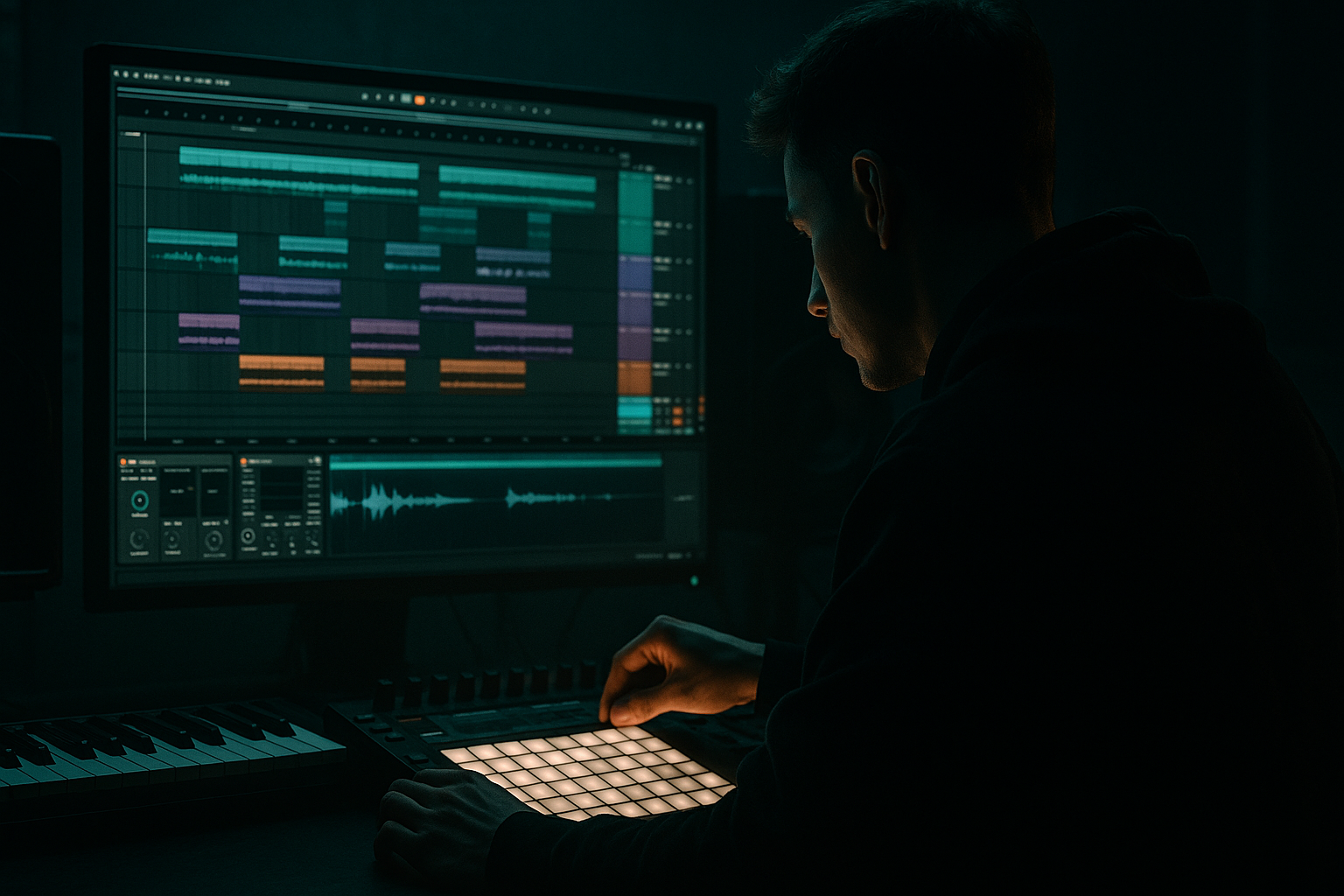
In this lesson, you’ll learn how to turn a clean, controlled bassline into a gritty, VHS-rave-stained, oldskool jungle / DnB character layer by resampling it inside Ableton Live 12. The goal is not just “distortion.” We’re building a second version of the bass with:
- unstable harmonics
- lo-fi pitch drift
- midrange texture
- tape-ish compression
- resonant movement
- chopped sampler-style artifacts
- a dubplate cassette
- an early pirate-radio recording
- a warped VHS rave tape
- a 1994 warehouse system with smoke and red lights 🎛️
- Wavetable or Operator
- Utility
- EQ Eight
- Saturator
- Overdrive
- Amp / Cabinet
- Redux
- Auto Filter
- Glue Compressor
- Drum Buss
- Sampler or Simpler
- Hybrid Reverb
- Frequency Shifter (optional but deadly for texture)
- printing bass to audio
- chopping it like sample material
- adding tape-style movement
- reintegrating it into an arrangement without wrecking the sub
- Osc 1: Saw or basic analog-style wavetable
- Osc 2: Sine or triangle, an octave down or at unison
- Filter: Low-pass 24 dB
- Drive: moderate
- Unison: 1–2 voices max
- Detune: very subtle
- Amp envelope:
- Osc A: sine
- Osc B: sine, slightly detuned or frequency-modulated
- Add a little pitch envelope for attack bite
- Use moderate saturation later for grit
- repeated notes
- a few pitch jumps
- syncopation against the break
- space for the kick/snare
- enough movement to make the resample interesting
- root note + minor 3rd
- passing note
- fifth
- octave jump
- little “answer” notes at the end of the bar
- clean pass
- driven pass
- pass with filter automation
- pass with note variations or octave jumps
- Simpler for fast chopping
- Sampler for deeper playback control
- Mode: Classic or Slice
- Warp: On if needed, but don’t overdo it
- Start: tighten the transient
- Filter: enable and low-pass if needed
- Glide: add small slide for bass movement
- key tracking
- velocity layers
- more precise envelope control
- pitch modulation
- Downsample: start around 8–12 bits
- Downsample rate: moderate, not crushed to death
- Mix: 10–35%
- Goal: introduce digital grit, not destroy the groove
- Resonance: moderate
- Frequency: automate between phrases
- This helps mimic old sampled hardware filtering
- Fine mode: small amount
- Frequency: 0.10–1.50 Hz for slow wobble
- Dry/Wet: low
- Drive: 5–20%
- Crunch: low to medium
- Transients: slightly negative if the bass is too pokey
- Boom: usually off for bass layers unless you want extra thump
- Ratio: 2:1 or 4:1
- Attack: 10 ms
- Release: Auto or 0.1–0.3 s
- Gain reduction: only a few dB
- High-pass around 100–150 Hz if this is only a texture layer
- Dip muddy areas around 250–500 Hz if needed
- Add a gentle boost around 1–2.5 kHz for audibility on smaller systems
- move Start position slightly
- use velocity to modulate start for variation
- this mimics chopped sample playback
- Map pitch to an LFO in Max for Live if available
- If not, automate small pitch changes manually
- Keep it subtle: ±5 to ±20 cents
- Too much sounds gimmicky
- Short decay
- Moderate resonance
- Make each hit “bark” then fold back
- mono
- sine or near-sine
- no stereo widening
- little or no distortion below 120 Hz
- high-pass around 100–150 Hz
- stereo can be allowed above the low end
- more distortion and filter movement
- Width: 110–140% if it helps spread the upper harmonics
- Bass Mono: if needed, keep the bottom controlled
- Gain: balance against the sub
- high-pass it more aggressively
- reduce stereo widening
- use EQ Eight to remove low-mid phase clutter
- Intro texture
- Call and response
- Drop reinforcement
- Fill moments
- filter frequency
- dry/wet on Saturator
- Redux amount
- sample start position
- reverb send for only transitional hits
- Time: 1/8, 1/8D, or 1/4 depending on tempo
- Feedback: low to moderate
- Filter the return heavily
- Add saturation after Echo
- Decay: short to medium
- Predelay: 10–25 ms
- High cut: quite low
- Low cut: high enough to avoid mud
- low-pass for sub-heavy murk
- band-pass for nasal 90s attitude
- high-pass for gritty midrange layer
- Track 1: clean-ish
- Track 2: heavily saturated, high-passed, compressed
- filter automation
- envelope shape changes
- subtle pitch wobble
- amplitude accents
- 1/8ths
- 1/16ths
- custom hits
- attack: 0 ms
- decay: 20–60 ms
- pitch drop: small, just enough to hear the snap
- remain tight with the drums
- feel gritty and sample-based
- have audible character on small speakers
- avoid muddying the sub
- Build a clean, musical bass source
- Shape it before printing
- Resample it to audio
- Rebuild it as a texture layer in Simpler or Sampler
- Add VHS-style coloration with stock Ableton devices
- Keep the sub separate
- Arrange the resampled layer as a performance element, not constant wallpaper
This technique is especially useful when you want your bass to feel like it came from:
You’ll take a modern sub/reese/bass stab, resample it, and rework it into a character bass layer that can sit above your clean low-end. This is a classic DnB move: keep the sub disciplined, and let the resampled layer bring the attitude.
---
2. What you will build
By the end, you’ll have:
A dual-layer bass system
1. Clean low bass
- mono
- controlled
- strong below ~120 Hz
2. Resampled VHS-rave bass layer
- band-limited
- crunchy and unstable
- moved through EQ, saturation, warping, and resampling
- perfect for fills, call-and-response, or full groove sections
The Ableton chain will use stock devices like:
You’ll also learn a workflow for:
---
3. Step-by-step walkthrough
Step 1: Start with a bassline designed to resample
Before you resample, the source matters. Don’t resample a messy bass unless that mess is intentional.
Build a source patch
Use Wavetable or Operator.
#### Option A: Wavetable starting point
- Attack: 0–5 ms
- Decay: 80–250 ms
- Sustain: 40–70%
- Release: short
#### Option B: Operator for oldskool purity
Compose a bass phrase
Write a 2-bar or 4-bar loop that has:
Think in classic jungle terms:
✅ Good resample phrases are often simple but active.
You want repetition with tiny variations.
---
Step 2: Process the source bass before printing
Before you resample, put on a pre-print chain that creates the “VHS-rave” raw material.
Suggested pre-print chain
1. Utility
- Width: 0% if the bass should stay mono
- Gain: trim so you’re not clipping the channel
2. EQ Eight
- High-pass gently at 25–35 Hz to remove junk
- Small dip if there’s harshness around 200–400 Hz
- Optional high shelf boost if you want extra upper-mid bite for the resampled layer
3. Saturator
- Drive: +2 to +6 dB
- Soft Clip: On
- Analog Clip: optional for edge
- Keep it musical; don’t flatten everything yet
4. Overdrive or Amp
- Drive low to moderate
- Tone adjusted to emphasize harmonics around 700 Hz–3 kHz
- Use this for “cassette speaker” style coloration
5. Auto Filter
- Low-pass or band-pass automation can make the resample feel alive
- Try subtle filter movement across 2 bars
Why do this?
Because the recorded audio will preserve the harmonics, saturation, and movement. If you wait until after resampling, you’ll miss the chance to capture those interactions as audio texture.
---
Step 3: Resample in real time
Now you print the bass to audio.
Method A: Audio track resampling
1. Create a new Audio Track
2. Set Audio From to the bass track or Resampling
3. Arm the track
4. Record the bassline while the track plays
Method B: Freeze and flatten
If the bass is already MIDI and you like the exact performance:
1. Right-click the track
2. Freeze
3. Flatten
This is faster, but less flexible than recording through an audio track.
Best practice
Record multiple passes:
Then comp the best moments later.
---
Step 4: Turn the recording into a sample instrument
This is where the VHS-rave color starts to emerge.
Drag the recorded audio into:
If you want classic jungle sample treatment, Simpler is usually the quickest.
In Simpler
In Sampler
Use Sampler if you want:
---
Step 5: Make the sample feel like VHS-rave material
Now we add the “tape wobble / off-air / dubplate” character.
Character chain for the resampled layer
Try this after Simpler/Sampler:
1. Redux
Use this carefully.
2. Auto Filter
Use a band-pass or low-pass with envelope movement.
3. Frequency Shifter
Great for unstable analog-ish weirdness.
This creates the impression of tape drift or imperfect playback.
4. Drum Buss
Not just for drums.
5. Glue Compressor
This glues the resampled harmonics into a believable sample “chunk.”
6. EQ Eight
---
Step 6: Add tape-style motion and “wrongness”
The VHS-rave vibe comes from imperfection.
Ways to create it in Ableton
#### A. Sample start variation
In Simpler:
#### B. Pitch wobble
#### C. Filter envelope tweaks
#### D. Reverse phrases
Reverse the last note of a bar or a short tail.
This is a classic jungle trick for creating transitions and tension.
#### E. Resample the resample
Print your processed sample layer again after the character chain.
Yes — print twice if needed. That second bounce often gives you the “already sampled off a tape deck” feeling.
---
Step 7: Make it work with the sub
This is critical in DnB.
Your VHS layer should usually not carry the sub.
Split the roles
#### Clean sub layer
#### Resampled texture layer
Use Utility on the texture layer
Check phase
If the resampled layer is hollowing out the low end:
---
Step 8: Place it in the arrangement like a jungle producer
The best bassline resample isn’t always playing the entire track.
Great arrangement uses
- filtered bass snippets
- tape noise intro
- one-note stabs with delay
- clean bass answers
- resampled layer plays the “reply”
- resampled layer enters only on bar 5 or bar 9
- increases energy without overcrowding the whole drop
- reverse tail into snare
- chopped bass pickup before a break edit
Try automation
Automate:
This gives the track a living, “hardware performed” feel.
---
Step 9: Use send effects for depth, not mush
For oldskool atmosphere, send the resampled layer to a return track.
Return A: Dub delay
Use Echo
Return B: Space
Use Hybrid Reverb
For jungle, the reverb should feel like room smear, not modern polished ambience.
---
4. Common mistakes
1. Resampling a bass that is already too full
If your source patch is overloaded, the resample becomes a muddy block instead of a useful texture.
Fix: simplify the source. Let harmonics come from the chain, not from chaos.
---
2. Letting the resampled layer carry the sub
This destroys the mix fast.
Fix: high-pass the character layer and keep the sub separate.
---
3. Overusing Redux and bitcrush
Too much destruction makes the bass thin and fake.
Fix: blend it in lightly. You want “aged,” not “broken speaker only.”
---
4. Too much stereo on the low end
Oldskool bass can feel wide in the mids, but the low end must stay controlled.
Fix: use Utility, EQ, and frequency discipline.
---
5. No note variation
A resampled bassline with no rhythmic interest becomes wallpaper.
Fix: add note-length differences, offbeat accents, reverses, and bar-end movement.
---
6. Forgetting the breakbeat context
Bassline theory in jungle lives with the drums. A great bassline alone may still fail if it fights the break.
Fix: test the bass against your Amen, Think, or chopped break loop early.
---
5. Pro tips for darker/heavier DnB
Tip 1: Use band-limited resampling for aggression
Before printing, filter the source so only a specific band is emphasized:
This is how you get that “sampled from a rack unit” feeling.
---
Tip 2: Try parallel distortion
Duplicate the bass layer:
Blend the dirty duplicate under the clean one for controlled violence 💥
---
Tip 3: Resample with movement already happening
If the source has:
…the printed sample will already sound more “performed” and less static.
---
Tip 4: Use short audio clips as instruments
Instead of a long bass loop, slice a 1-bar resample into:
Then rearrange the slices like a drum pattern. This is very jungle.
---
Tip 5: Combine resampled bass with ghost notes
Add low-velocity passing notes or muted MIDI hits under the main line, then resample that performance. It creates a more human, cassette-like phrasing.
---
Tip 6: Use subtle pitch envelopes for “rave bark”
A tiny pitch drop at the start of each note can make the bass feel more like a squelch or sampler hit.
Suggested envelope idea:
---
6. Mini practice exercise
Goal
Create a 4-bar oldskool DnB bass resample layer that sounds like a worn VHS capture.
Exercise steps
1. Make a bass patch in Wavetable or Operator
2. Write a 2-bar phrase using:
- root
- fifth
- octave
- one passing note
3. Put on this pre-print chain:
- Utility
- EQ Eight
- Saturator
- Auto Filter
4. Record the bass to audio
5. Load it into Simpler
6. Add:
- Redux
- Auto Filter
- Drum Buss
- Glue Compressor
7. High-pass the layer at 120 Hz
8. Duplicate it and make one copy:
- more distorted
- more filtered
- quieter
9. Automate sample start or filter cutoff over 4 bars
10. Test it with a chopped breakbeat at 170–174 BPM
Success criteria
Your bass should:
---
7. Recap
Here’s the core idea:
This is one of the most effective ways to make modern Ableton bass feel like oldskool jungle history while still hitting hard in a contemporary mix.
If you want, I can also turn this into:
1. a device-by-device Ableton rack template, or
2. a follow-up lesson on resampling a Reese into chopped jungle bass phrases.

