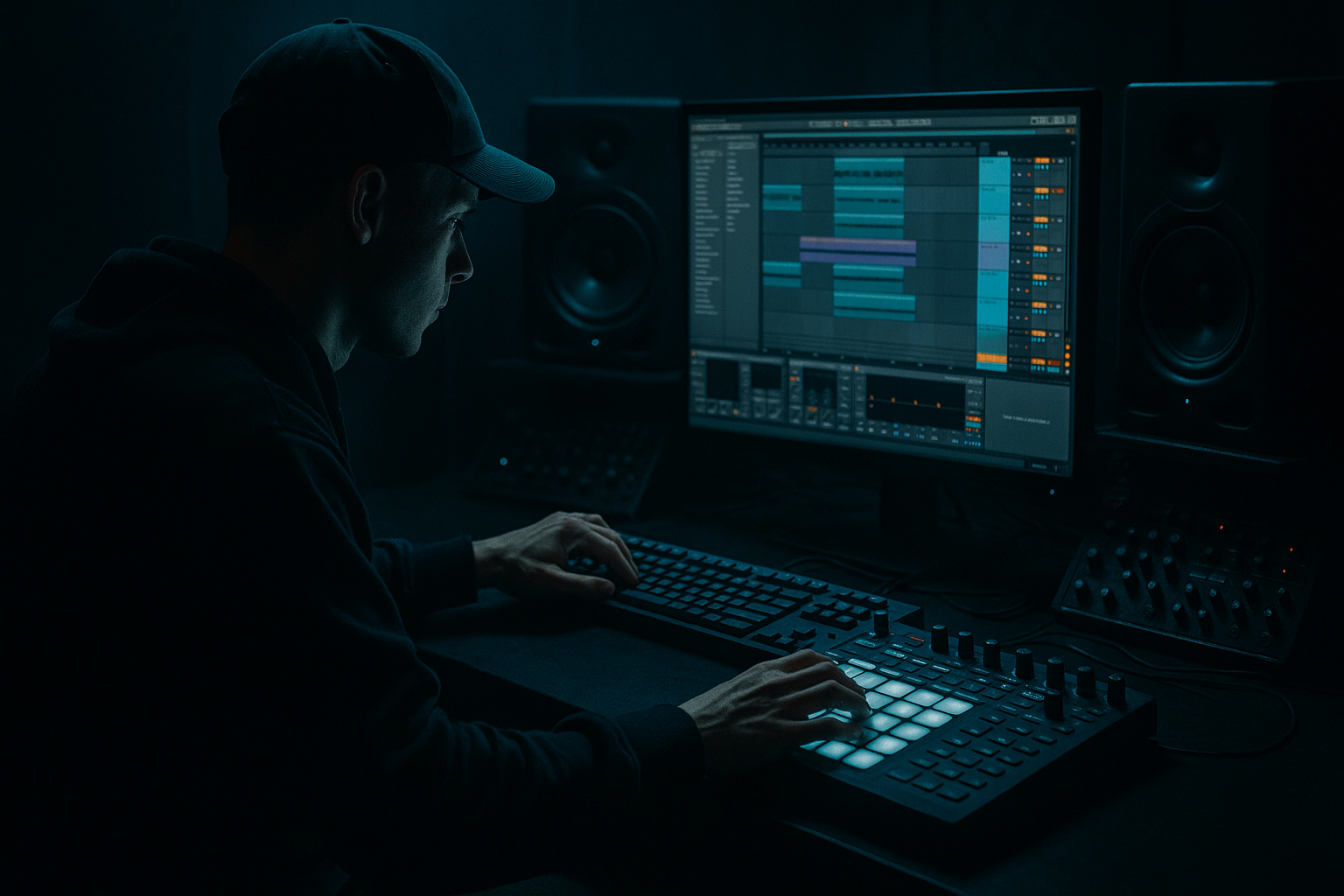
Main tutorial
Bassline Theory + Ableton Live 12 Switch‑Up Blueprint
Timeless Roller Momentum (Jungle/Oldskool DnB Vibes) — Ableton Live 12
Skill level: Intermediate
Category: Vocals (we’ll use vocal phrases to drive bass switch‑ups + call/response)
---
1) Lesson overview
You’re going to build a rolling, oldskool/jungle‑leaning DnB bassline that never loses momentum—and you’ll learn a switch‑up blueprint you can reuse in any tune. The twist: we’ll use short vocal stabs/phrases (classic rave DNA) as the musical cue to switch bass rhythm, note choice, or timbre—without killing the roll. 🎛️🎤
You’ll practice:
- Bassline theory for rollers: root movement, passing tones, rhythmic “engine”
- Switch‑ups that feel natural: rhythmic, harmonic, timbral, and call/response
- Ableton Live 12 workflows: Session → Arrangement, Follow Actions, MIDI Transformations, and stock devices for bass + vocal processing
- Main roller bass (sub + mid layer) with consistent forward motion
- Two switch‑ups (8‑bar and 16‑bar) that keep the groove glued
- Vocal call/response: short vocal chops that trigger bass changes
- Arrangement blueprint you can expand into a full tune
- F minor or G minor (both are DnB‑friendly and sit well on subs)
- Root (1), minor 3rd (♭3), 4th (4), 5th (5), minor 7th (♭7)
- Use chromatic passing notes sparingly to create movement (especially into the downbeat)
- Place notes mostly on 1/8ths, with gaps right before key drum hits (kick/snare)
- Let the bass answer the snare, not fight it
- Bar 1: notes on 1.1, 1.1.3, 1.2.2, 1.3, 1.3.3, 1.4.2
- Bar 2: similar, but shift one note earlier/later to create “turn”
- Draw a simple line on the root first (F) with short lengths (e.g., 1/8 notes).
- Then nudge a couple notes earlier/later (use Alt to fine‑move with Grid off).
- Add velocity variation (important for movement even on subs):
- Device: Operator
- Oscillator A: Sine
- Level: 0 dB
- Add a tiny bit of harmonic content if needed:
- Pitch Envelope: off
- Amp Envelope:
- Device: Wavetable
- Osc 1: Basic Shapes → Square/Saw-ish (or “Saw”)
- Unison: 2 voices (subtle)
- Filter: MS2 or PRD style
- Gate (tighten)
- EQ Eight (HP at 120–200 Hz, tame harsh 3–6 kHz)
- Echo
- Reverb
- Optional Redux (tiny bit) for rave grit
- Keep the same pitch set (root + 5th), but:
- Add Syncopation lightly
- Or Generate Variation (small amount) then manually fix anything off‑style
- In F minor: E → F (one 1/16 or 1/8 before the drop back to F)
- Wavetable Filter Cutoff opens slightly over 2 bars
- Add a touch more Saturator Drive (or automate wet/dry)
- Bar 8 → open cutoff
- Bar 9 → snap back darker
- Extend the last bass note’s length
- Or add a higher note (5th or ♭7) on the response
- Main bass pattern (dark, filtered MID)
- Minimal vocals (or none)
- Rhythmic Flip + small vocal chops
- Slightly more MID brightness
- Passing tone turnaround every 4 bars
- Add a second vocal phrase or echo throw
- Bring back the simplest bass (contrast = impact)
- One vocal “tag” at bar 31–32 leading into next section
- Too many notes / too busy rhythm: Rollers breathe. If you fill every 1/16, you lose the bounce.
- Sub not mono / stereo low end: Always mono your sub (Utility width 0%, Bass Mono on).
- Switch‑ups that change everything at once: Change one axis at a time (rhythm OR pitch OR timbre OR vocals).
- Vocals too long / too wet: Jungle vocal stabs are short and functional—trim tails and control reverb.
- Sidechain release fighting the groove: If it pumps weirdly, adjust release to match your kick pattern.
- Parallel distortion for MID only:
- Resampling vocal grit:
- Sub harmonic support (carefully):
- Keep the roller “intentional” with frequency slots:
- Roller momentum comes from a steady rhythmic engine and controlled variation.
- Use sub for stability, mid for character, and vocals as the cue for switch‑ups. 🎤
- Switch‑ups that work every time:
- In Ableton Live 12, lean on: Operator/Wavetable, EQ Eight, Utility, Saturator, Auto Filter, Compressor sidechain, Echo, Reverb, and Live 12’s MIDI Transformations for quick variation you then “DnB‑ify” by hand.
---
2) What you will build
A 32‑bar loop/section with:
Target vibe: oldskool/jungle roller (think 90s swing, minimal but relentless), modern clarity.
---
3) Step‑by‑step walkthrough
Step 0 — Set the project up (tempo, swing, routing)
1. Tempo: 172–176 BPM (start at 174 BPM).
2. Groove: Add classic swing:
- Open Groove Pool → try MPC 16 Swing 57–60 (or similar).
- Apply to your drums + bass MIDI at 40–60% (don’t overdo).
3. Create tracks:
- Drums (group)
- Bass SUB (mono)
- Bass MID (stereo allowed, but keep low end mono)
- Vocal Chops (audio)
- Optional: Bass Bus (return or group processing)
Routing tip: Group SUB + MID into a Bass Group. Put “glue” processing on the group, not on each layer first.
---
Step 1 — Choose a key + roller‑friendly note set (theory that works fast)
For jungle/rollers, minor keys are common. Pick:
Roller note set (safe + musical):
Example in F minor:
F, Ab, Bb, C, Eb (+ occasional E natural as a passing tone into F)
---
Step 2 — Build the “engine” rhythm (the roller pocket)
The “timeless roller” bass feel is mostly rhythm, not complexity. Start with a 2‑bar loop.
MIDI pattern blueprint (2 bars, 1/8 + syncopation):
A classic approach:
Ableton workflow:
- Downbeats ~90–110
- Off‑beats ~60–85
🎯 Goal: It should loop hypnotically without sounding robotic.
---
Step 3 — Design the SUB (clean, stable, mono)
On Bass SUB track:
Option A: Operator (fast + clean)
- Osc B: Sine at +1 octave, very low level (‑24 to ‑30 dB)
- Attack 0–5 ms
- Decay ~200 ms (optional)
- Sustain 0 dB
- Release 60–120 ms (avoid clicks, keep roll)
Processing (stock chain):
1. EQ Eight
- HP filter at 25–30 Hz (gentle, 12 dB/Oct)
- Optional: small dip around 200–300 Hz if muddy
2. Utility
- Bass Mono: On
- Width: 0%
3. Limiter (light safety)
- Ceiling: ‑0.3 dB
- Aim for just catching peaks (1–2 dB GR max)
---
Step 4 — Design the MID layer (character + oldskool edge)
On Bass MID track:
Option: Wavetable (controlled grit)
- Cutoff around 200–800 Hz (automate later)
- Drive: 3–8 dB
MID processing chain (stock):
1. Saturator
- Mode: Analog Clip
- Drive: 3–8 dB
- Soft Clip: On
2. Auto Filter
- HP at 90–140 Hz (keep low end for SUB only)
3. EQ Eight
- Notch any harshness around 2–4 kHz
4. Chorus-Ensemble (very light) or Delay (micro movement)
- Keep it subtle; you want roll, not wobble.
Layering tip: Make MID follow the exact same MIDI as SUB initially. You’ll switch it up later.
---
Step 5 — Glue the bass with sidechain and timing (drum/bass relationship)
On Bass Group:
1. Compressor (sidechain from Kick)
- Sidechain: Kick (or full drums if you prefer)
- Ratio: 3:1 to 5:1
- Attack: 5–15 ms
- Release: 60–120 ms (match groove)
- Gain reduction: 2–5 dB on kick hits
2. Optional Glue Compressor
- Gentle: 1–2 dB GR to “sit” the layers
🎛️ Pro feel: If your bass feels late/heavy, nudge the MIDI a few ms earlier (track delay or manual note shift). Jungle rollers often feel like the bass leans forward into the drums.
---
Step 6 — Add VOCAL chops as the switch‑up trigger (Category: Vocals)
This is where your roller becomes “oldskool” fast. 🎤
1. Pick a short vocal phrase like:
- “listen”, “rewind”, “come again”, “original”, “selector”
2. Drop into Vocal Chops track.
3. Use Warp Mode: Beats
- Preserve: 1/16 or 1/8
- Transient loop: ON (if needed)
4. Convert into playable chops:
- Right‑click → Slice to New MIDI Track
- Slicing preset: Built‑in
5. Program a simple 8‑bar call:
- Bar 7–8: vocal hits that announce a change
- Keep space—don’t clutter the groove
Vocal processing chain (stock):
- 1/8 or 1/4 dotted (try 1/8D)
- Feedback 15–30%
- Short (0.6–1.2s), low cut high (so it doesn’t muddy)
---
Step 7 — The Switch‑Up Blueprint (8/16/32 bar roller momentum)
Here are four switch‑up types that keep the roll. Use one at bar 9 and another at bar 17 (or wherever your phrase turns over).
#### Switch‑Up A: Rhythmic Flip (same notes, new pattern)
- Add a 1/16 pickup into the downbeat
- Or remove one note to create a “breath” before the snare
Ableton trick: Duplicate the 2‑bar bass clip → open MIDI Transformations (Live 12) and try:
#### Switch‑Up B: Passing Tone Turnaround (tiny theory move, huge momentum)
At the end of an 8‑bar phrase, do a chromatic walk into the root:
This creates that “rewind tension” without changing the whole bassline.
#### Switch‑Up C: Timbre Automation (same MIDI, different energy)
Automate the MID layer only:
Automation targets:
That “open then slam” is roller gold. 🔥
#### Switch‑Up D: Vocal Call/Response (arrangement switch that feels musical)
When a vocal chop hits (e.g., “listen!”), answer it with a bass “tail”:
Think: vocal says it, bass replies.
---
Step 8 — Arrangement blueprint (32 bars you can expand)
Use this as a proven roller structure:
Bars 1–8:
Bars 9–16 (Switch‑Up 1):
Bars 17–24 (Switch‑Up 2):
Bars 25–32 (Payoff):
🎯 The key is contrast without stopping the engine. Keep the sub rhythm consistent while you change one element at a time.
---
4) Common mistakes
---
5) Pro tips for darker/heavier DnB
Send MID to a return with Saturator + Overdrive, then blend low (5–15%). Keeps sub clean but adds menace.
Freeze/Flatten the vocal track after Echo/Reverb, then chop the printed audio for more “hardware” vibe.
Add a tiny 2nd harmonic (Operator Osc B) so the bass translates on smaller systems.
If your vocals are bright, keep bass mids a bit lower (200–800 focus) and let drums own 2–6 kHz.
---
6) Mini practice exercise (15–25 minutes)
1. Create a 2‑bar bass loop in F minor using only F + C (root + 5th).
2. Duplicate it to 8 bars.
3. Add a vocal stab at bar 7 (“listen!”) and bar 8 (short response).
4. Make two switch‑ups:
- Bar 9: Rhythmic Flip (no new notes)
- Bar 17: Passing tone E→F at the turnaround
5. Automate MID filter cutoff:
- Slowly open from bar 15–16
- Snap shut at bar 17
Deliverable: Export a 32‑bar audio bounce and check: does it still feel like one rolling groove even with changes?
---
7) Recap
1) rhythmic flip, 2) passing tone turnaround, 3) timbre automation, 4) vocal call/response
If you want, tell me your preferred sub style (pure sine vs. reese‑ish sub), and I’ll tailor a specific 8‑bar MIDI pattern + device rack for your exact jungle/oldskool reference.

