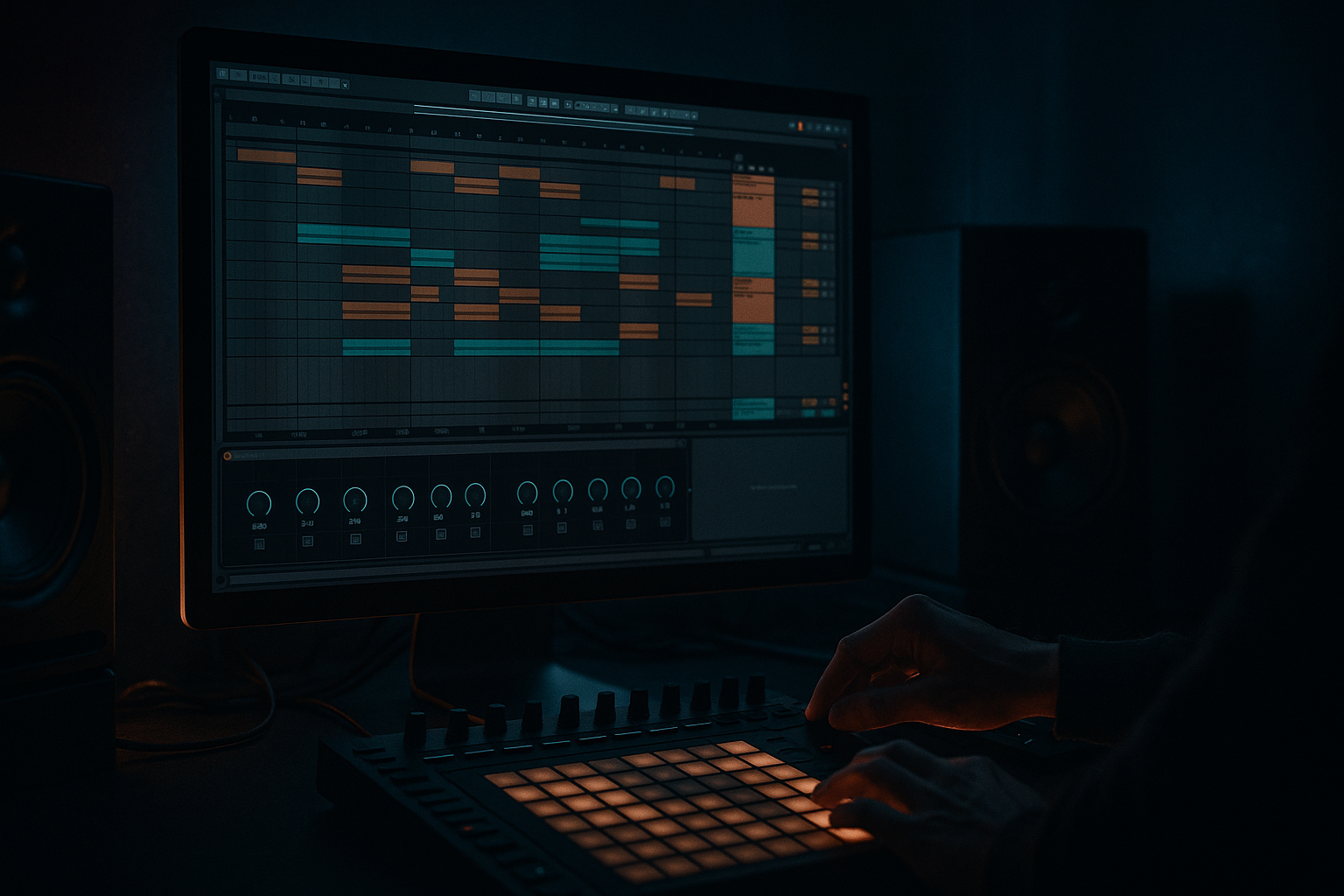
Main tutorial
Bass Wobble in Ableton Live 12: Pitch It Using Stock Devices Only for Jungle / Oldskool DnB Vibes
1. Lesson overview
In this lesson, you’ll build a classic pitch-based wobble bass in Ableton Live 12 using stock devices only. This is perfect for jungle, oldskool drum and bass, and rolling DnB where the bass doesn’t just filter up and down — it moves in pitch for that raw, animated, early-rave energy. 🔥
Instead of relying on a modern filter wobble, we’ll create motion by:
- playing a simple bass sound
- turning it into a MIDI phrase
- pitching notes in a controlled rhythmic pattern
- shaping it with Ableton’s stock synths and FX
- how wobble bass rhythm works in DnB
- how to program bass movement around a breakbeat
- how to make your bassline feel musical, not random
- Wavetable or Operator for the bass source
- MIDI effects like Pitch, Scale, and Arpeggiator if needed
- Saturator, EQ Eight, Compressor, and Auto Filter for polish
- arrangement ideas that fit jungle / oldskool DnB
- a 1-bar or 2-bar wobble bass phrase
- a sub-friendly bass patch
- pitch movement that lands on the groove with the drums
- a simple call-and-response bass pattern
- an arrangement-ready loop that can sit under a breakbeat
- deep sub on the root note
- short pitched jumps for motion
- a slightly gritty, growling edge
- movement that feels like classic rave/jungle bass energy
- Osc 1: Sine
- Osc 2: Square, -12 dB or lower
- Filter: Low-pass
- Cutoff: around 120–200 Hz to start
- Resonance: low, around 10–20%
- Amp envelope:
- Example key: F minor
- Place F1 or F2 depending on your sound design and octave choice
- Bar 1: long F note
- Bar 2: another F note with rhythmic gaps
- F minor
- G minor
- A minor
- C minor
- F
- Ab
- Bb
- F
- Eb
- 1/8 notes
- 1/16 notes
- syncopated offbeat hits
- 0 semitones = root note
- +2 = major second
- +3 = minor third
- +5 = perfect fourth
- -12 = octave down for sub weight
- fast pitched repeats
- oldskool rave-style bass phrases
- variation without rewriting the whole MIDI clip
- Beat 1: F
- Beat 1.3: Ab
- Beat 2: F
- Beat 2.3: Eb
- Beat 3: F
- Beat 3.3: G
- Beat 4: F
- The root note keeps the bass grounded
- The pitched notes create motion
- The rhythm locks to the drums
- It feels like a classic jungle call-and-response
- Short notes = more aggressive and percussive
- Slightly longer notes = more legato, more weight
- root note: longer
- pitched notes: shorter
- Downbeats: higher velocity
- Offbeat pitch notes: slightly lower velocity
- Accent the note that lands with the snare or kick
- Drive: 2–6 dB
- Soft Clip: On
- Output: adjust to avoid clipping
- Cut unnecessary mud around 200–400 Hz
- Keep the sub region strong
- If the bass sounds boxy, try a gentle dip around 250 Hz
- If it needs more bite, boost a little around 700 Hz–1.5 kHz
- Turn on Sidechain
- Sidechain from the kick drum or drum bus
- Ratio: 2:1 to 4:1
- Attack: 5–20 ms
- Release: 50–120 ms
- Ratio: 2:1
- Attack: slow-ish
- Release: Auto or moderate
- Only a few dB of gain reduction
- Filter type: Low-pass
- Cutoff: fairly open
- Resonance: low to medium
- Add slow automation or an LFO if you want subtle movement
- Bars 1–8: Drums only or drums + tiny bass teaser
- Bars 9–16: Main bass wobble enters
- Bars 17–24: Remove a few bass notes for tension
- Bars 25–32: Bring bass back stronger, maybe with a lower octave
- Leave gaps for breaks and fills
- Use a call-and-response between bass and drums
- Repeat the phrase but change the last note every 4 or 8 bars
- Drop the bass out for one bar before a new section
- Use Operator or a clean Wavetable sine
- Mono
- Keep it simple
- Mostly follow the root note
- Use the pitched Wavetable layer
- Add Saturator or a touch of distortion
- Keep the low end filtered out a bit so it doesn’t clash with the sub
- sub = weight
- mid = movement
- drums = drive
- kick
- snare
- breakbeat
- percussion
- F minor
- G minor
- A minor
- C minor
- chop it
- reverse it
- pitch it further
- add extra arrangement variation
- the last note drops an octave
- the second bar is slightly different from the first
- the bass becomes more sparse in the final half of bar 2
- Use Wavetable or Operator for your bass source
- Build movement with MIDI pitch changes, not just filtering
- Keep the rhythm tight and sync it with the drums
- Use Saturator, EQ Eight, and Compressor to shape the sound
- Think in phrases and spaces, not endless loops
- a Live 12 device chain preset recipe
- a step-by-step MIDI example in F minor
- or a full jungle bass arrangement template
This approach is great for beginners because it teaches you:
We’ll use:
---
2. What you will build
By the end, you’ll have:
Sound goal
Think:
---
3. Step-by-step walkthrough
Step 1: Set up a DnB-friendly project
1. Open Ableton Live 12.
2. Set the tempo to 170 BPM to 174 BPM.
- For oldskool jungle vibes, 172 BPM is a great start.
3. Create:
- 1 MIDI track for bass
- 1 Drum Rack or audio break track for drums if you want to test the bass against a beat
If you already have a breakbeat, loop it first. Bass movement in DnB should always work against the drums, not in isolation.
---
Step 2: Choose a stock bass instrument
For beginner-friendly results, use Wavetable.
#### Option A: Wavetable bass patch
1. Drop Wavetable onto the MIDI track.
2. Start with:
- Oscillator 1: Sine or Triangle
- Oscillator 2: Square or Saw, very low in level
3. Lower unison or keep it off for now.
4. Turn filter down a little to keep the tone controlled.
5. Add a tiny amount of Drive if needed.
#### Quick starting settings:
- Attack: 0 ms
- Decay: 100–250 ms
- Sustain: 70–100%
- Release: 50–120 ms
This gives you a bass that can punch and still support pitch movement.
#### Option B: Operator sub bass
If you want a cleaner oldskool sub:
1. Load Operator.
2. Use a sine wave.
3. Keep it mostly clean.
4. Add effects later for character.
Tip: For this lesson, Wavetable is easier because you can hear the pitch changes more clearly.
---
Step 3: Write a simple root note bassline
Create a MIDI clip of 1 or 2 bars.
Start with one note:
A simple first pattern:
Don’t overcomplicate it yet. The wobble comes from motion, not from a busy melody.
#### Good beginner notes for DnB/jungle
Try minor keys:
These are common in darker DnB and jungle.
---
Step 4: Add pitch movement with MIDI notes
This is the key part: instead of using an LFO filter wobble, we’ll pitch the notes themselves.
#### Method 1: Create a pitched bassline manually
In the MIDI clip:
1. Keep the main root note on the downbeat.
2. Add short notes above or below it to create movement.
3. Use small interval jumps for that classic bass bounce.
Example in F minor:
This creates a dark, oldschool feeling without sounding too melodic.
#### Rhythm idea
Use short note lengths like:
For jungle, the bass often answers the drums with short stabs.
---
Step 5: Use Ableton’s MIDI Pitch device for transposition
If you want fast pitch-based wobble patterns, use MIDI Pitch.
1. Add Pitch in the MIDI effects chain before your instrument.
2. Automate or step-sequence pitch changes.
3. Use it to transpose the bass line in semitones.
Example:
#### Practical use
Create a repeating note on one pitch, then use Pitch automation or clip notes to change the perceived wobble movement.
This is useful for:
---
Step 6: Build a wobble phrase from notes, not effects
A good beginner DnB pitch wobble can be as simple as this:
1-bar example in F minor
Keep the notes short and punchy.
#### Why this works
---
Step 7: Add groove with note length and velocity
Pitch wobble becomes much more musical when the notes are not all the same.
#### Adjust note lengths
Try:
#### Adjust velocity
Use velocity to make some notes hit harder:
This makes the bass feel performed, not programmed robotically.
---
Step 8: Make it punch with Saturator and EQ Eight
Now shape the tone.
#### Add Saturator
Drop Saturator after the instrument.
Suggested settings:
This adds grit and helps the bass cut through the mix.
#### Add EQ Eight
Use EQ Eight to clean the low end:
Be careful: for jungle bass, too much midrange can make the bass sound modern and less raw. Keep it focused.
---
Step 9: Control the low end with Compressor or Glue Compressor
If the bass is fighting the kick or break, use compression carefully.
#### Compressor
This creates space for the drums.
#### Glue Compressor
If you want to gently glue the bass into the mix:
Don’t overcompress. Oldskool DnB bass should breathe.
---
Step 10: Optional movement with Auto Filter
Even though the main effect is pitch wobble, you can add Auto Filter lightly for extra animation.
Suggested settings:
Use this sparingly. The star of the show is still the pitch movement.
---
Step 11: Add an oldskool arrangement structure
A good jungle/DnB bassline often works in phrases, not endless loops.
#### Simple arrangement idea
#### Bass arrangement tricks
That “dropout then slam back in” is very DnB-friendly. 😈
---
Step 12: Layer sub and mid bass if needed
For a fuller DnB sound, split your bass into two layers:
#### Layer 1: Sub
#### Layer 2: Mid wobble
This is a very common drum and bass workflow:
---
4. Common mistakes
1. Making the bassline too busy
Beginners often add too many notes.
In DnB, space is power. A few well-placed pitched notes hit harder than a constant stream.
2. Forgetting the drums
If your bass sounds good solo but weak with breaks, it needs rhythmic adjustment. Always test with:
3. Using too much stereo width on the sub
Keep the sub bass mono. Wide low end can weaken the track and cause phase issues.
4. Overusing saturation
A little grit is great. Too much turns your bass into noisy mush. Keep the low end clean enough to hit hard.
5. Pitching everything by huge intervals
Oldskool wobble works best with small to medium pitch jumps. If every jump is huge, it can sound random or more like a synth lead than a bassline.
6. Ignoring note length
Short notes and tight envelopes are crucial. Long notes can blur the groove and clash with the break.
---
5. Pro tips for darker/heavier DnB
Tip 1: Use minor keys
Stick to:
These are easy starting points for dark jungle energy.
Tip 2: Add octave drops
An occasional -12 semitone drop can make the bass feel massive. Use it at the end of a phrase or before a drop.
Tip 3: Use a single-note riff
Some of the hardest DnB basslines are built on one note with clever rhythm and pitch variation. Don’t assume you need a full melody.
Tip 4: Let the break lead
Oldskool jungle often feels powerful because the bass locks to the break, not against it. Leave room for the snare and ghost notes.
Tip 5: Use subtle glide if needed
If your synth supports it, add a little portamento/glide for a liquid-but-dark feel. Keep it controlled so it still sounds gritty and vintage.
Tip 6: Automate filter cutoff between sections
Even though this is a pitch wobble lesson, a gentle cutoff opening in the build-up can make the drop feel bigger.
Tip 7: Resample your bass
Once you like the sound, freeze and flatten or resample the bass into audio. Then you can:
This is very useful in jungle-style production.
---
6. Mini practice exercise
Exercise: Build a 2-bar oldskool wobble bass phrase
#### Goal
Create a bass loop in F minor that sounds like it could sit under a jungle break.
#### Instructions
1. Set your project to 172 BPM.
2. Load Wavetable with a simple sine/square patch.
3. Write a 2-bar MIDI clip.
4. Use only these notes:
- F
- Ab
- Bb
- Eb
5. Make the root note appear on strong beats.
6. Use short notes for pitched movement.
7. Add Saturator and EQ Eight.
8. Test it with a breakbeat loop.
9. Tweak the rhythm so the bass leaves space for the snare.
#### Challenge version
Make a second version where:
This teaches you phrase variation, which is essential in DnB.
---
7. Recap
You’ve now built a pitch-based wobble bass in Ableton Live 12 using stock devices only — a perfect foundation for jungle and oldskool DnB vibes.
Key takeaways
Most important mindset
In DnB, the bass is part of the drum groove.
If it moves like a rhythm section instrument, not just a synth, it starts sounding authentic fast. 🔊
If you want, I can also turn this into:

