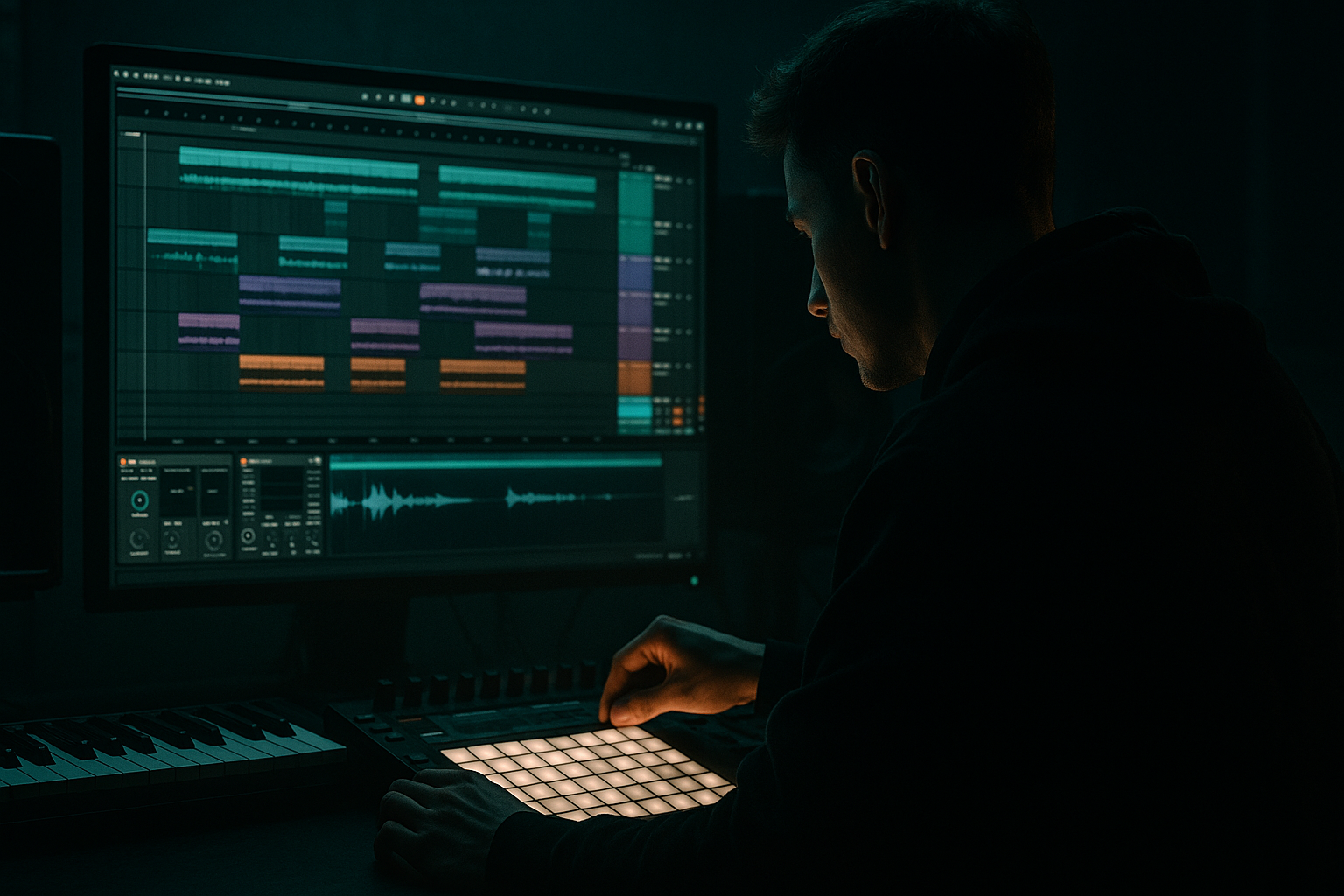
Main tutorial
Lesson Overview
A sunrise set intro in Drum & Bass is not just “an atmospheric intro” — it’s the moment where the room shifts from pressure and darkness into emotional release without losing the weight that makes DnB hit. In the Ragga Elements lane, that means fusing jungle heritage, vocal attitude, tape grit, and dubwise space with a DJ-friendly structure that lets a selector mix in cleanly while the energy slowly blooms.
In this lesson, you’ll build a balanced jungle DJ intro in Ableton Live 12 that feels ready for a sunrise moment: warm but tense, root-note-driven but not empty, emotional but still functional for mixing. The key skill here is balance — between sub and space, ragga vocal chops and percussion, nostalgia and modern low-end control, cinematic atmosphere and practical DJ phrasing.
Why this matters in DnB: a sunrise intro often needs to do three jobs at once:
1. Signal identity immediately, so the track feels like yours.
2. Hold mix compatibility, so a DJ can blend it with the tail of the previous tune.
3. Prepare emotional payoff, so the drop or main groove feels like a release rather than a reset.
In advanced DnB production, the intro is where you can show restraint. The best sunrise intros don’t over-explain themselves. They create a world in 8, 16, or 32 bars, then invite the drop to land with contrast. 🌅
What You Will Build
You’re going to make a DJ-intro arrangement for a jungle / ragga DnB track in Ableton Live 12 with these traits:
- 16 to 32 bars of DJ-friendly intro
- A clean sub foundation that hints at the main bass identity without full aggression
- Ragga vocal phrases or chopped call-and-response elements
- Rolled jungle drums with break edits, ghost notes, and controlled transient bite
- Atmospheric sunrise texture using pads, vinyl noise, dub echoes, and filtered FX
- A structure that works for mixing into or out of another tune
- A tonal arc that moves from shadowy and loose into open, emotional, and slightly euphoric
- sparse break fragments and distant ambience for the first 8 bars,
- a ragga phrase entering with tape-delay throws,
- a sub pulse or sustained root note that anchors the tune,
- a gradual lift in harmonic brightness as the intro approaches the first drop or groove entry.
- Too much low end too early
- Ragga vocal samples that feel pasted on
- Breaks that are either too clean or too messy
- Atmosphere masking the groove
- No clear emotional arc
- Over-widened mix
- Use saturation as weight, not volume
- Resample your vocal chain
- Blend one clean break with one dirty layer
- Use call-and-response between bass and vocal
- Automate micro-shifts, not giant moves
- Keep the intro emotionally dark but harmonically open
- Use transient control to preserve impact
- Is the sub stable?
- Does the vocal feel intentional?
- Does the intro open up emotionally without becoming messy?
- A sunrise jungle intro should feel balanced, emotional, and mix-friendly.
- Use break edits, mono sub discipline, ragga vocal phrasing, and dubwise FX to create identity.
- Build the arc in 8-bar phrases so the energy opens naturally.
- Keep the low end clean and use Ableton stock devices like Operator, Wavetable, Drum Buss, Echo, Auto Filter, EQ Eight, Utility, and Hybrid Reverb to shape character.
- The best intros in Ragga DnB don’t overdo it — they create a world, then let the drop feel like daylight breaking through.
Musically, think of a track opening with:
This is not a hyper-complex drop design lesson. It’s about crafting a functional, characterful intro that still feels like a complete musical statement.
Step-by-Step Walkthrough
1. Set the tempo, key center, and intro length before sound design
Start by deciding the track’s role in a set. For a sunrise intro, a typical DnB tempo of 172–174 BPM works well because it keeps the dancefloor energy intact while letting your atmosphere breathe. Choose a tonal center that supports emotional lift but doesn’t get overly sugary — F minor, G minor, or D minor are strong choices for ragga-jungle moods.
In Arrangement View, sketch a 16-bar intro first, then extend to 24 or 32 bars if you want a slower emotional reveal. A useful sunrise structure might be:
- Bars 1–8: filtered drums, space, and distant vocal texture
- Bars 9–16: bass hint, more percussion, clearer vocal call
- Bars 17–24: tension increase, wider atmosphere, riser / break fill
- Bars 25–32: mix-ready setup for the main groove or drop
Why this works in DnB: the floor expects momentum. Even when you’re being restrained, the arrangement should still imply forward motion through phrasing and low-end anticipation.
2. Build a drum core from a break, then edit it for jungle movement
Drag in a classic break source or record your own break loop, then slice it in Simpler or Warp it in Arrangement View. For authentic jungle motion, use a break with strong ghost-note detail — Think Amen-style flow, but don’t make it too busy too early.
In Ableton Live 12:
- Put the break on an audio track and warp it in Beats mode if needed.
- Use Slice to New MIDI Track if you want direct control over each hit.
- Layer a clean kick and snare underneath if the break is too lo-fi or inconsistent.
Suggested processing chain on the break bus:
- Drum Buss: Drive around 5–15%, Crunch 2–8, Boom lightly or off if the low end conflicts with your sub
- EQ Eight: High-pass at 120–180 Hz on the break if the sub will carry the low end
- Saturator: Soft Clip on, Drive 2–4 dB for controlled bite
For balance, don’t let the break own the whole spectrum. In a sunrise intro, the break should feel like movement and texture, not full-on domination. Let the transient character support the emotional arc while leaving room for bass and vocal elements.
3. Design the ragga vocal identity with chops, delays, and dub space
Ragga elements are strongest when they feel phrased like a performance, not just a sample pasted on top. Pick one vocal phrase, chant, or ad-lib with attitude — something short, memorable, and rhythmically strong. Then create a call-and-response system.
Practical Ableton workflow:
- Load the vocal into Simpler in Slice mode if you want individual phrase hits.
- Or keep it on audio and automate clip gain and filters for a more performance-like feel.
- Use Echo for dub throws; start with 1/8D or 1/4 timing and set Feedback around 25–40%.
- Add Auto Filter before or after Echo and automate a band-pass or low-pass sweep.
Good ragga intro behavior:
- A dry vocal chop lands on bar 1 or 5.
- A delayed response blooms into the next 2 bars.
- One or two words get repeated as a hook, not a full lyric dump.
Parameter suggestions:
- Echo Dry/Wet: 10–25% for subtle throws, or automate up to 40% for transitions
- Auto Filter cutoff: 400 Hz to 8 kHz depending on whether you want murky or open phrasing
Keep the vocal in the center or slightly narrow at first. If you widen it too early, you can lose the “voice in the room” intimacy that makes sunrise intros emotionally strong.
4. Create a sub line that implies the drop without fully revealing it
The intro needs low-end promise. That doesn’t mean a full riff. It means a sub phrase or root-note pulse that hints at the main bass groove while leaving space for the listener to imagine what’s coming.
Use Operator or Wavetable to make a clean sine-based sub. Then keep it disciplined:
- Oscillator as a sine or very soft waveform
- Mono mode on
- No unnecessary stereo widening
- Short-ish note lengths for movement, or longer notes if the intro needs more emotional suspension
For a sunrise feel, try a phrase like:
- Root note held for 2 bars
- A small climb or drop in the last bar of every 8-bar phrase
- A call-and-response with the vocal: the vocal speaks, then the sub answers
Add gentle harmonic support with:
- Saturator at 1–3 dB Drive
- EQ Eight with a slight cut around 200–350 Hz if the sub feels muddy
- Utility to keep the sub mono
If you want more movement without losing clarity, layer a second bass track above the sub with a restrained Reese or mid-bass texture:
- Use Wavetable with detuned oscillators
- Filter around 180–500 Hz so it doesn’t fight the vocal
- Add Chorus-Ensemble subtly, then check mono compatibility
This layered approach lets the intro feel “big” without turning into a full drop.
5. Shape the atmosphere with dubwise FX and filtered harmonic wash
Sunrise emotion comes from contrast: dark foundation, bright horizon. Create that with a pad or texture track that slowly opens over time. Avoid generic cinematic wash; instead, make it feel like jungle air through a dub system.
Build your atmosphere using:
- A sampled field recording, vinyl noise, crowd texture, or dub ambience
- Hybrid Reverb with a larger room or hall component, but filtered
- Auto Filter automation to gradually remove low-pass restriction
- Delay or Echo for smeared space behind the vocal
Suggested settings:
- Hybrid Reverb Dry/Wet: 15–35%
- Reverb decay: medium to long, but use a high-pass or low-cut so it doesn’t cloud the sub
- Auto Filter cutoff slowly opening from 300–600 Hz up to 4–8 kHz
- Resonance low to moderate so the movement stays elegant, not squealy
A smart trick: put the atmospheric layer on a return track, then automate send levels from the vocal and break. That way the space feels reactive, not just permanently washed out.
Why this works in DnB: jungle and ragga music often rely on space as a rhythmic element. The echo is part of the groove, not just decoration.
6. Use arrangement automation to control the emotional reveal
The intro should unfold like a set transition, not a static loop. In Arrangement View, automate the energy in layers:
- Drum filter opens in stages
- Vocal delay feedback increases briefly before key transitions
- Atmosphere widens and brightens
- Bass harmonics become more audible as the drop approaches
An advanced sunrise arrangement might follow this pattern:
- Bars 1–4: filtered break, distant ambience, no sub yet
- Bars 5–8: vocal phrase appears, short delay throw
- Bars 9–12: sub enters on long notes, drums sharpen
- Bars 13–16: percussion fills and a small break edit lead into the groove
- Bars 17–24: tonal lift, more top-end sparkle, bass hints stronger
- Bars 25–32: final intro tension, DJ-friendly mix window, then release
Use automation lanes on:
- EQ Eight high-pass frequency
- Auto Filter cutoff
- Echo feedback
- Utility width on atmospheres only
- Reverb dry/wet for swelling transitions
Keep the intro mix-friendly by avoiding sudden full-spectrum explosions before the intended drop. The emotional rise should feel earned.
7. Balance the mix early: low-end separation, mono discipline, and headroom
Advanced DnB work lives or dies on the low end. Since this is a DJ intro, your low frequencies need to be powerful but controlled. Keep the sub in mono, and make sure the break, vocal, and ambience are carved around it.
Practical mix moves in Ableton:
- Utility on sub: Width 0%
- EQ Eight on breaks and atmospheres: high-pass anywhere from 120 Hz to 250 Hz
- Check the master with Spectrum and Utility for mono checks
- Leave -6 dB to -3 dB headroom on the master while building
If the intro feels thin, resist the urge to add more low end immediately. Instead, increase perceived weight by:
- adding upper bass harmonics with gentle saturation,
- tightening drum transients with Drum Buss,
- and letting the ragga vocal occupy the midrange center.
A balanced intro feels bigger because each element has a job.
8. Add DJ-functional transition tools without overproducing the intro
Since this is meant for a sunrise set, the intro should still be useful to a DJ. That means clean phrasing, clear countability, and a controlled transition path.
Include one or more of these:
- A short reverse cymbal or noise swell into bar 9 or 17
- A single snare fill or break cut before the groove enters
- A dub delay tail that extends into the next phrase
- A 1-bar drum drop-out to create tension before the main section
Keep FX tasteful:
- Use Auto Pan subtly on textures only, with low amount and slow rate
- Use Gate sparingly if a vocal chop needs extra punch
- Use Reverb Freeze-style illusion only if it doesn’t confuse the mix; in Live, it’s often cleaner to automate send levels than to over-stack decay
A strong DJ intro gives the mix enough structure to blend into the previous track while still announcing, “this tune has a point of view.”
Common Mistakes
- Fix: keep sub mono, high-pass non-bass elements, and introduce bass in stages instead of all at once.
- Fix: chop them into rhythmic phrases, automate delay throws, and let them answer the drums or sub.
- Fix: retain ghost-note movement but control the transient and low end with Drum Buss, EQ, and careful layering.
- Fix: filter pads heavily, automate decay, and keep the ambient bed moving around the drums rather than on top of them.
- Fix: plan the intro in 8-bar phrases with progressive opening, not random layer stacking.
- Fix: keep the sub mono, limit stereo spread to higher textures, and check mono regularly.
Pro Tips for Darker / Heavier DnB
- A subtle Saturator or Drum Buss drive can make the bass and drums feel physically larger without adding muddiness.
- Print a ragga phrase with Echo and Reverb, then slice the audio into new chops. This creates organic one-shots that feel more like a real jungle production than a preset loop.
- Keep the main break relatively controlled, then add a lo-fi, band-passed layer for character. High-pass the dirty layer at 200–300 Hz so it contributes grit, not confusion.
- In darker DnB, this creates tension without overcrowding the arrangement. Let the vocal lead, then let the bass respond with a short phrase or filtered hit.
- Small changes in filter cutoff, echo feedback, and drum brightness feel more professional than obvious “EDM-style” sweeps.
- Minor key is fine, but use suspended notes, short melodic fragments, or unresolved intervals so the sunrise lift feels natural when it arrives.
- If your break gets too spiky, use Drum Buss transient shaping lightly or clip gain automation rather than flattening the whole loop.
Mini Practice Exercise
Set a 15-minute timer and build a 16-bar jungle DJ intro in Ableton Live 12 using only stock devices.
1. Choose a key center and tempo: 174 BPM, G minor or F minor.
2. Load one break loop and edit it into a more open jungle pattern.
3. Add one ragga vocal phrase or chopped ad-lib and create at least two delay throws with Echo.
4. Program a mono sub line with Operator or Wavetable using only 2–4 notes.
5. Add one atmosphere track with filtered reverb and automate the cutoff over 16 bars.
6. Make sure the intro has:
- a clear 8-bar phrase change,
- one tension moment at bar 8 or 12,
- and a DJ-friendly opening for mixing.
Finish by listening once in mono and once in full stereo. Ask yourself:
If you have time left, resample the vocal delay return and chop one new fill from it.

