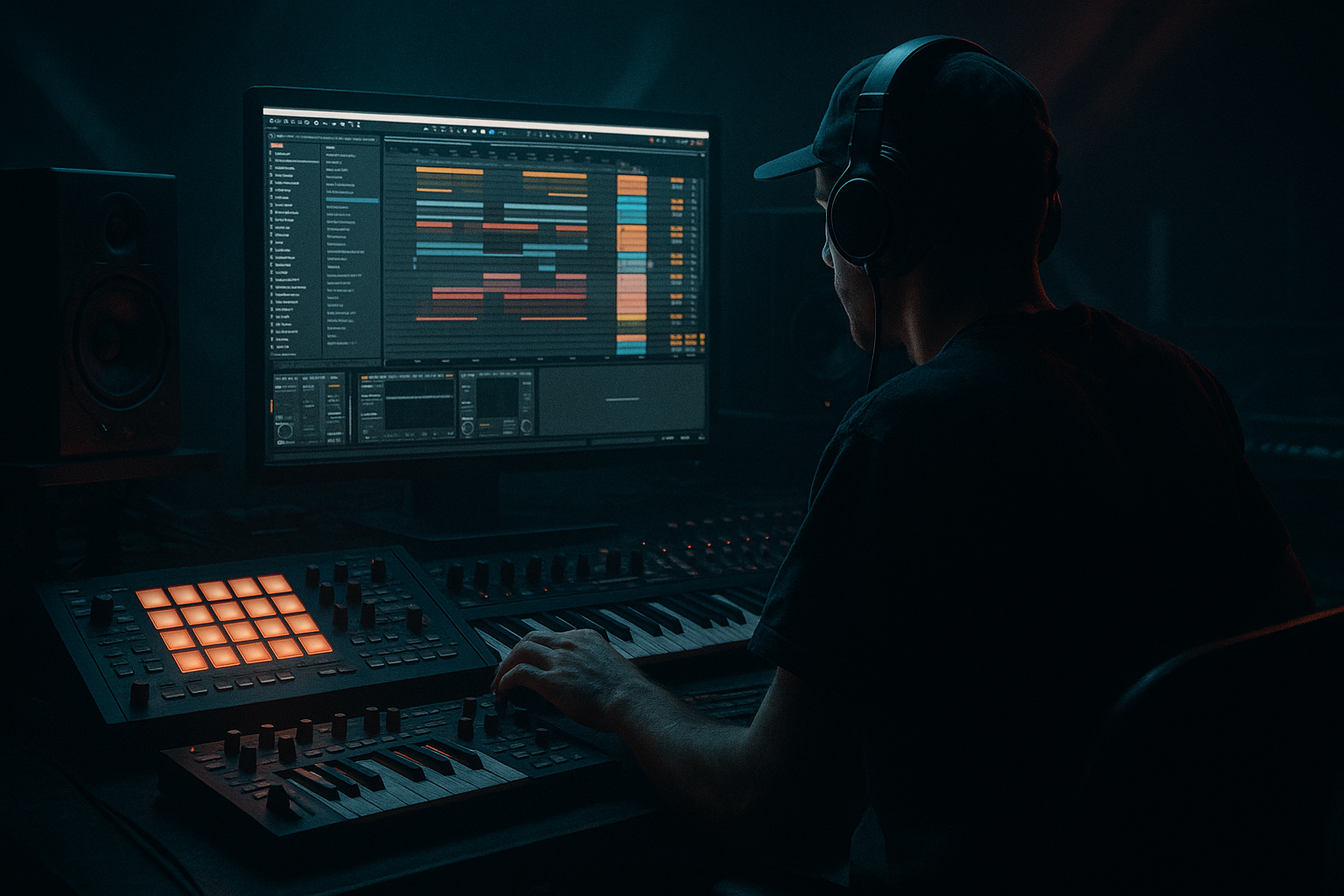
Main tutorial
Lesson Overview
This lesson is about making your DnB arrangement feel alive, gritty, and intentional by polishing an atmosphere breakdown with a crunchy sampler texture in Ableton Live 12. The goal is not to add “random ambience,” but to create a tension-building middle section that sounds like oldskool jungle tape memory meeting modern drum & bass control.
In a real DnB track, this kind of breakdown usually sits:
- after the first drop
- before a second drop or switch-up
- in the DJ-friendly middle section where you want energy to dip without losing pressure
- movement without overcrowding the mix
- nostalgia and grit
- room for automation to do the storytelling
- a smoother path back into the drop
- cracked vinyl haze
- chopped ambient fragments
- short sampler bursts with controlled distortion
- evolving filter and reverb automation
- a clear transition back into a hard DnB drop
- a sampled crunchy texture bed built from a short field recording, vinyl noise, or chopped ambience
- a Sampler-based or Simpler-based layer that gets filtered, pitched, and degraded for character
- automation on filter cutoff, reverb send, distortion amount, and stereo width
- a breakdown that opens up in the first 8 bars and then tightens into tension in the last 8 bars
- a transition that can snap cleanly back into a sub-heavy drop
- enough movement to stay interesting, but not so much that it ruins drum/bass clarity
- a filtered breakbeat
- a reese bass tease
- a sub pedal note
- short vocal fragments or FX hits
- Letting the atmosphere fight the sub
- Making the breakdown too static
- Using too much reverb on the insert
- Crunching the texture until it sounds harsh and cheap
- Ignoring mono compatibility
- No arrangement arc
- Too much movement in the same frequency range as the snare or hats
- Use Utility to automate width: open it in the breakdown, then narrow it before the drop so the drop feels bigger.
- Layer a subtle reese tease under the atmosphere, but high-pass it enough that it reads as tension, not bassline conflict.
- Add tiny ghost drum edits from the break or snare tail in the breakdown. A single chopped ghost hit every 2 bars can make the section feel more “jungle.”
- Use Drum Buss on the texture bus lightly to give it underground grit without flattening it.
- If the atmosphere gets too polished, print it to audio and resample a second pass with slightly different automation. That layered imperfection is very effective in darker DnB.
- For a grimier oldskool edge, try pitching the sample down a few semitones and re-automating the filter so it stays readable.
- Keep your sub simple and absent in the breakdown unless you want a specific tension note. The less low-end clutter, the harder the drop re-entry.
- Reference tracks with DJ-friendly intros/outros and breakdowns that use space intelligently. You’re listening for contrast, not just texture density.
- control the low end
- automate filter, reverb, and width
- shape the breakdown in phases
- keep the texture gritty but mix-friendly
- design the return to the drop with contrast
Why it matters: in jungle, rollers, and darker bass music, the breakdown is often where the track reveals its character. A polished atmosphere with a crunchy sampled texture gives you:
We’ll build a breakdown that feels like:
This is especially useful if your track needs more identity between drum edits and bass sections. A lot of intermediate producers can make a solid drop but leave the breakdown too empty or too generic. This lesson fixes that.
What You Will Build
By the end, you’ll have a 16-bar atmosphere breakdown for a jungle/oldskool DnB track with:
Musically, this could sit under:
Think: foggy intro energy with a crunchy sampler heartbeat underneath.
Step-by-Step Walkthrough
1. Choose the right source material for the atmosphere
Start with one or two audio clips that have character. Good choices for jungle/oldskool DnB:
- a vinyl crackle loop
- a field recording of rain, train noise, static, machinery, or room tone
- a dusty break fragment
- a reversed piano note, ghostly chord, or offcut from your own tune
In Ableton Live, drag the audio into a new audio track and trim it to a short, usable segment. Aim for something with:
- a clear noise floor or texture
- some high-frequency detail
- not too much low-end rumble
If needed, use Warp to lock it loosely to tempo, but don’t over-tighten it. For atmosphere, a little drift can sound more organic. For a jungle vibe, slightly imperfect timing often helps.
Why this works in DnB: oldskool jungle and darker rollers often use texture as emotional glue. A sampled bed gives the listener a sense of space between the drums and bass, which makes the drop hit harder later.
2. Build a crunchy sampler layer with Simpler or Sampler
Create a new MIDI track and drop the chosen texture into Simpler. For intermediate workflow, Simpler is usually enough; use Sampler if you want deeper zone or envelope control, but Simpler keeps this fast.
Try these starting settings in Simpler:
- Mode: Classic or One-Shot
- Warp: Off for gritty/looser texture, On only if timing needs help
- Filter: Low-pass, around 1.2 kHz to 4 kHz depending on brightness
- Attack: 5–20 ms
- Release: 200 ms to 1.5 s
Now create a MIDI clip with a few notes spread across 16 bars. Don’t just hold one note the whole time. Instead, use:
- short repeated notes every 1 or 2 bars
- a held note that fades in slowly
- occasional note changes up or down 3–7 semitones for motion
This gives you a sampled texture pattern rather than static ambience.
If the texture gets too clean, add Saturator after Simpler:
- Drive: 2 to 8 dB
- Soft Clip: On
- Output: trim to match level
For a harsher jungle edge, add Redux very lightly:
- Downsample: subtle, not extreme
- Bit reduction: just enough to roughen the highs
3. Shape the atmosphere with a controlled effects chain
Put the following after Simpler:
- EQ Eight
- Echo or Delay
- Hybrid Reverb
- Auto Filter or another EQ Eight for movement control
Suggested EQ Eight starting point:
- High-pass around 120–250 Hz to keep the atmosphere out of the sub zone
- Gentle dip around 2.5–5 kHz if it gets harsh
- Slight shelf boost around 8–10 kHz only if you need more air
For Echo:
- Feedback: 10–25%
- Filter: roll off some low end and tame extreme highs
- Time: synced to 1/4, 1/8, or dotted values depending on how active you want the tail
For Hybrid Reverb:
- Start with a shorter room or plate-style space for glue
- Decay: 1.5–4 s
- Dry/Wet: keep it modest on insert, or better yet use a send
If you want the breakdown to feel like it opens into a warehouse space, automate the reverb send up over the first 4–8 bars, then pull it back before the drop.
4. Set up a dedicated atmosphere return for cleaner automation
Instead of piling all ambience directly on the track, make a return track with:
- Hybrid Reverb
- Echo
- Frequency Shifter or subtle chorus-like movement using Chorus-Ensemble
- EQ to clean low end
On the return, keep the wet chain pretty obvious, but control it from the send amount.
Use automation on the return send from your sampler track:
- Bar 1–4: send around -18 to -12 dB
- Bar 5–8: increase to -10 to -6 dB
- Bar 9–12: pull down slightly for tension
- Bar 13–16: re-open or cut sharply depending on the transition
This is a very DnB-friendly approach because it lets the atmosphere breathe without muddying the mix bus. It also makes the transition feel arranged, not accidental.
5. Add modulation movement with Auto Filter and subtle device automation
Put Auto Filter on the sampler track and automate:
- Cutoff sweeping from around 300 Hz to 6–10 kHz
- Resonance around 0.20 to 0.45 for focused movement
- LFO only if it complements the groove, not if it distracts
A strong jungle-style breakdown move is to automate the filter opening slowly for 8 bars, then close it quickly in the last 2 bars before the drop.
Also automate:
- Saturator Drive up a little in the middle of the breakdown
- Simpler Filter Frequency down for a murky phrase
- Reverb Wet up during gaps, down when drums return
- Utility Width from 120% in the breakdown to 80–100% before the drop for mono discipline
Good automation in DnB is about contrast. You want the breakdown to feel like it is breathing, not just looping.
6. Make the texture feel crunchy, old, and alive
This is where the “sampled” part becomes musical, not just noisy.
Try one or two of these on the sampler track:
- Saturator with Soft Clip for glue
- Drum Buss very gently for transient weight and crunch
- Redux for lo-fi grain
- Vinyl Distortion if you want a more obvious oldskool edge
Drum Buss starting point:
- Drive: 5–15%
- Crunch: low to moderate
- Boom: usually off or very subtle here, because you do not want low-end buildup in an atmosphere lane
- Damp: use to tame harshness
Then create a few short MIDI note variations:
- one note with a lower velocity
- one note delayed slightly off the grid
- one note as a quick stutter at the end of a bar
This gives the sampler texture a chopped, edited feel that suits jungle and darker breaks. The key is not to over-sequence it into a melody unless the track needs that.
7. Arrange the breakdown like a tension curve, not a loop
Build your breakdown across 16 bars with clear phases:
- Bars 1–4: establish the atmosphere, keep it filtered and wide
- Bars 5–8: add more reverb, open the filter slightly, maybe introduce a reversed drum or ghost hit
- Bars 9–12: strip back some width, reduce reverb send, let the texture get darker and closer
- Bars 13–16: create the transition into the drop with a riser, snare roll, or reverse impact
A useful arrangement example:
- First drop ends
- 16-bar breakdown begins with filtered ambience and chopped sampler haze
- At bar 9, a reese bass tease enters quietly with high-pass filtering
- At bar 13, a snare fill and riser build tension
- Final bar includes a clean cutoff or stop before the second drop
For oldskool jungle flavor, consider dropping in a very short break edit or ghost snare in bars 11–14. That can make the breakdown feel connected to the drums instead of floating above them.
8. Automate the return to the drop with contrast
The transition is where a lot of intermediate tracks lose impact. Don’t just fade the atmosphere out—use automation to create a snap back into weight.
Practical automation moves:
- Cut reverb send down over the final 1–2 bars
- Close Auto Filter quickly in the last 1 bar
- Reduce stereo width on the atmosphere so the drop feels wider by comparison
- Use a short reverse crash or impact leading into the first kick/snare of the drop
If there is a bass tease in the breakdown, automate it to:
- start band-passed and quiet
- become more mid-focused in the final 4 bars
- disappear right before the drop so the new sub can land cleanly
This contrast matters because in DnB, the drop needs space to feel huge. If the breakdown stays too wet or too wide, the drop loses power.
Common Mistakes
- Fix: high-pass the sampler/texture around 120–250 Hz, sometimes higher if the track is already dense.
- Fix: automate at least two things over time, ideally filter and reverb send.
- Fix: move more ambience to a return track so you can control it musically.
- Fix: use saturation and bit reduction subtly; check it against the drums at full level.
- Fix: keep low-end mono and check the atmosphere in Utility with width reduced if needed.
- Fix: divide the breakdown into phases, not one loop repeated for 16 bars.
- Fix: dip 2.5–5 kHz if the texture interferes with snare bite or cymbal detail.
Pro Tips for Darker / Heavier DnB
Mini Practice Exercise
Set a 15-minute timer and build a 16-bar atmosphere breakdown from scratch:
1. Pick one noise source: vinyl crackle, rain, room tone, or a break fragment.
2. Load it into Simpler on a MIDI track.
3. Add EQ Eight and Saturator.
4. Create a 16-bar MIDI clip with 4–6 notes or stabs, not a constant drone.
5. Automate Simpler filter cutoff from dark to brighter over 8 bars, then back down.
6. Add a Hybrid Reverb send and automate it higher in bars 5–8.
7. Add a quick transition in bars 15–16: reverse crash, snare fill, or filter close.
8. Listen in the full arrangement against drums and bass, and fix any low-end clutter.
Goal: by the end, the breakdown should feel like it has a shape, not just texture.
Recap
The core idea is simple: in DnB, atmosphere is not decoration — it is arrangement energy. A crunchy sampler texture built in Ableton Live 12 can turn a plain breakdown into a proper jungle/oldskool tension section if you:
If you remember one thing: make the atmosphere evolve like part of the drum & bass groove, not like a background pad sitting on top of it.

