Main tutorial
Lesson Overview
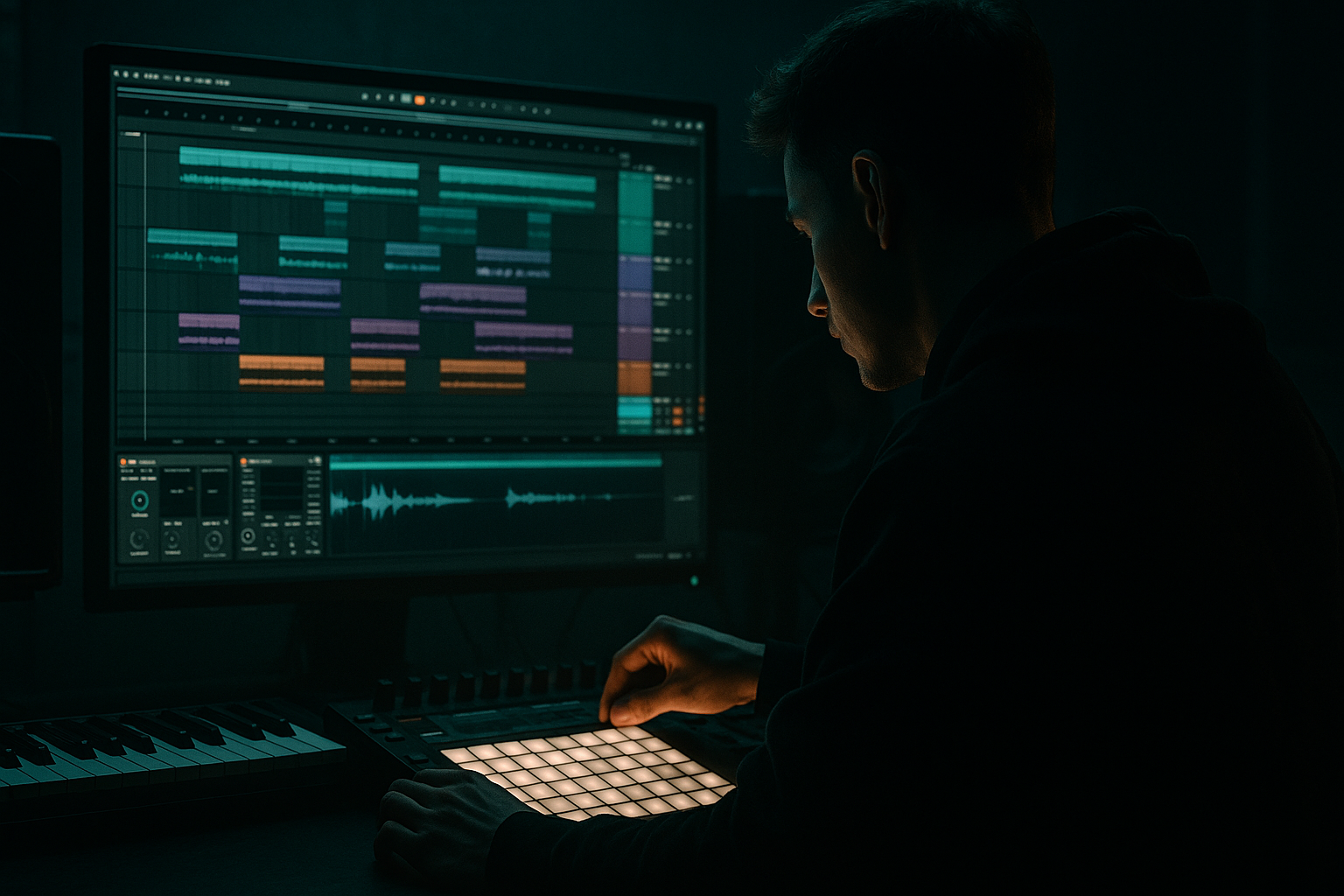
This lesson shows you how to take a jungle bass wobble idea from Session View into a full Arrangement View performance that feels like oldskool DnB: punchy, restless, a little rough around the edges, and built to work with breaks, not against them. The goal is not just to “copy a loop into a timeline” — it’s to turn a short bass phrase into a track-moving arrangement device with proper tension, drop energy, and DJ-friendly flow.
In jungle and older DnB, bass often works best when it’s phrased like an instrument, not just held as a wall of low end. That means your wobble needs contrast: some notes hit hard and stay short, some open up, some leave space for the drums, and some answer the break. This lesson focuses on that exact workflow in Ableton Live 12 using stock devices, clip automation, and arrangement editing.
Why this matters in DnB:
- Oldskool jungle relies on call-and-response between breakbeats and bass
- A bass line that changes over 8/16 bars helps avoid loop fatigue
- Session View is perfect for trying variations fast before you commit to the arrangement
- Arrangement View is where you shape drops, switch-ups, DJ intros, and tension/release
- Moves between subby held notes and midrange wobble phrases
- Uses filter, oscillator, and saturation automation for motion
- Sits tightly with a breakbeat or break edit without muddying the kick/snare
- Evolves across 8, 16, and 32-bar sections
- Includes drop variations, a breakdown turn, and a simple DJ-friendly intro/outro
- Feels rooted in oldskool jungle / rollers / darker DnB rather than modern EDM bass design
- 174 BPM
- A moody minor-key loop, maybe D minor or F minor
- A chopped Amen-style break or tight two-step break layer
- A bass phrase that hits on the “and” of 1, ducks under the snare, then opens into a wobble answer on bar 2
- Drums: one audio track for your break loop or chopped break
- Sub Bass: one MIDI track for low-end support
- Wobble Bass: one MIDI track for the moving mid bass layer
- Load Operator or Wavetable on the Wobble Bass track
- For a classic weight foundation, use a sine or triangle base for the Sub Bass
- Keep the sub and wobble separate so you can control mono compatibility and arrangement clarity
- Operator: sine wave, no extra oscillators, pitch envelope off, filter off
- Wavetable: start with a simple saw or square-based table, low-pass filter around 150–300 Hz, drive modestly
- Add Saturator after the synth with Drive around 2–6 dB for character
- Use 2–4 notes total
- Let at least one note sustain longer
- Leave gaps where the snare and break fill the space
- Note 1: short hit on beat 1
- Note 2: sustained note on the “and” of 2 or beat 3
- Note 3: answer phrase on beat 4 or the “and” of 4
- Keep the sub mostly root note or root + fifth
- Let the wobble layer do the rhythmic movement
- Avoid overplaying; oldskool bass often hits harder when it breathes
- One note for the sub track
- One slightly higher octave note for the wobble track
- Short notes: 1/16 to 1/8
- Held notes: 1/4 to 1/2 bar
- Use clip legato only if it helps the filter motion feel smoother
- Set filter to low-pass
- Cutoff range: roughly 120 Hz to 1.2 kHz depending on how aggressive you want the wobble
- Add LFO to filter cutoff at a rate synced to 1/8 or 1/16
- Keep LFO depth moderate; too much can blur the groove
- Use a low-pass filter with resonance around 10–25%
- Automate cutoff across the clip or set clip envelopes
- Add gentle drive if needed
- Saturator Drive: from 2 dB in the verse to 5–8 dB in the drop
- Filter resonance: small increases on phrase endings
- Pan or width only on upper harmonics, never on the sub
- Use EQ Eight to cut low rumble below 30–40 Hz
- If the break is fighting the sub, make a gentle dip around 80–120 Hz
- Use Glue Compressor lightly on the drum bus if needed, with a slow attack to preserve transients
- Keep the snare crisp around 180–250 Hz and 2–5 kHz
- Don’t let the bass sustain mask the snare hit
- Consider sidechaining the bass very lightly with Compressor from the kick or snare, but keep it subtle — jungle usually benefits from groove more than pump
- Group all drums into a Drum Bus
- Put Drum Buss on it with Drive around 5–15% and Transients just enough to add snap
- If the break needs more bite, add Erosion very subtly for top-end grit
- Arm the arrangement record button
- Trigger your bass clips live while the drum loop runs
- Record a few passes with slightly different energy
- Bar 1–8: basic wobble phrase
- Bar 9–16: variation with a higher note or more open filter
- Bar 17–24: a break in the bass for tension
- Bar 25–32: drop variation with stronger saturation or denser rhythm
- Leave the bass out for the first 1–2 bars of the drop, then slam it in with the drums
- Or let the sub arrive first, then bring in the wobble layer on bar 3 for a classic call-and-response feel
- Intro: 16 bars of drums, atmos, and filtered bass hints
- Drop A: 16 bars of core groove
- Switch-up: 8 bars with a bass gap, fill, or break edit
- Drop B: 16 bars with heavier wobble or extra layer
- Outro: strip back to drums and sub for mixing out
- Duplicate your strongest 2-bar loop and modify only one or two notes
- Remove bass notes from bars where the snare needs impact
- Add a stop/start moment before a new section, especially before a fill or break chop
- Filter down the bass before a drum fill
- Cut the wobble for half a bar
- Bring it back with more drive on the first hit of the new section
- Auto Filter cutoff opens over 4 or 8 bars into a drop
- Reverb send on the last bass note before a break
- Echo on a single snare or bass stab to create a transition tail
- Utility width reduced to 0% on the sub, widened slightly on the mid layer only
- Resample a short bass phrase into audio
- Chop it and reverse one fragment for a transition
- Use Simpler or Sampler to re-trigger a bass stab as a fill
- Low-pass the bass heavily for 2 bars
- Let a tiny high-mid wobble peek through
- Open the filter on the downbeat of the drop
- Keep the sub mono
- Keep stereo width out of anything below about 120 Hz
- If the wobble sounds wide, make sure the actual low-end stays centered
- Drums should feel like the main transient force
- Bass should support and push, not smear
- If the kick disappears, lower bass sustain or reduce filter resonance
- Dip a little around 2.5–4.5 kHz if it bites too hard
- Cut muddy build-up around 200–350 Hz if the arrangement feels cloudy
- Making the wobble too continuous
- Letting the sub and wobble fight each other
- Over-automating everything
- Ignoring the break
- Using too much stereo width in the low end
- Arranging a loop instead of a track
- Add Saturator before and after your filter for a more aggressive bass tone, but keep gain staged so you don’t flatten the drop.
- Try Redux very lightly on the wobble layer for a gritty, old tape-ish edge. Use it sparingly.
- Use Drum Buss on the drum group for extra smack and sub harmonics, but avoid over-compressing the break.
- For a darker neuro-leaning vibe, automate a narrow resonant filter peak on select notes to create a snarling midrange bite.
- Resample your bass phrase, then reverse one note or chop the tail to create a nasty transition hit.
- If the bass is too clean, layer a very quiet distorted duplicate an octave higher and high-pass it aggressively so it adds attitude without muddying the low end.
- For tension before a drop, mute the bass for one bar and let the drums + atmosphere carry it. That pause can hit harder than another fill.
- Use Echo on a single bass stab with short feedback for a destabilized, underground feel, especially before a switch-up.
- Build the bass idea in Session View first so you can test phrasing fast.
- Separate sub and wobble for cleaner jungle low-end control.
- Use filter automation, saturation, and note spacing to make the bass breathe with the break.
- Record into Arrangement View to shape proper DnB phrasing, switch-ups, and drop design.
- Keep the drums dominant, the sub mono, and the arrangement evolving every 8 or 16 bars.
- In jungle and oldskool DnB, the best basslines don’t just wobble — they interact with the break.
Think of this as building a bass “performance sketch” in Session View, then turning it into a proper DnB arrangement that supports drums, fills, and transition energy.
What You Will Build
By the end, you’ll have a jungle-style bass wobble that:
Musically, imagine:
The result should feel like a proper DnB section where the drums stay in charge, and the bass adds pressure, movement, and attitude.
Step-by-Step Walkthrough
1) Build the Session View starting point with a drum-first mindset
Start in Session View and create at least three tracks:
If you already have a break, keep it looped at 174 BPM. If not, use a stock break sample and warp it in Complex Pro only if needed; for oldskool energy, many breaks sound better with minimal stretching and some grit.
For the bass tracks:
Useful starting settings:
Why this works in DnB: the drums need transient space, and the bass needs to be split into sub responsibility and midrange movement. That separation is a huge part of clean jungle low-end.
2) Program a short wobble phrase that leaves room for the break
In Session View, create a 1-bar or 2-bar MIDI clip on the Wobble Bass track. Keep it simple at first:
A strong jungle-style starting point is:
Try these phrase rules:
For the MIDI clip, add a second note layer if your sound supports it:
Suggested note lengths:
This is your “performance loop.” Keep it raw and repeatable.
3) Create wobble movement using stock modulation and automation
Now shape the motion. If you’re on Wavetable, map the filter cutoff and LFO to make the wobble speak. If you’re on Operator, use filter automation and saturation to fake movement.
On Wavetable:
On Auto Filter:
Also automate:
A good DnB wobble usually has a predictable cycle, but it should still feel alive. Think of the filter as the “vocal” of the bass. The drums handle the hard punctuation; the bass provides the talking.
4) Tighten the drums against the bass before arranging
Before you move anything to Arrangement View, make sure the break and bass are actually interacting properly. This is where many jungle ideas fall apart.
In your drum track:
If you have kick and snare layered on separate tracks:
Practical route:
This step matters because the arrangement will only feel like DnB if the bass is already making room for the break before you expand the song.
5) Record a Session View performance into Arrangement View
Now comes the key move: perform the bass into the timeline.
In Session View:
Aim for one clean pass where you introduce:
Don’t worry if it’s not perfect. The point is to capture a musical performance, not a static loop.
Arrangement tip:
That little delay makes the drop feel bigger because the listener gets a moment of anticipation.
6) Edit the arrangement into classic jungle phrasing
Open Arrangement View and shape the recorded performance into DnB structure.
A useful oldskool layout:
Now refine the bass phrases:
A simple musical context example:
If your track is in F minor, you can use F as the root in the first 8 bars, then move to Ab or Eb for short answers in the next phrase. That tiny harmonic shift creates movement without losing the low-end center.
Use clip fades and automation breaks to keep transitions clean:
7) Polish with automation, resampling, and transition details
Now make the arrangement feel finished.
Useful automation ideas:
If you want a more authentic jungle texture:
A strong trick is to create a “pre-drop” bass tease:
This increases impact without needing a massive new sound.
8) Check the low-end balance and make the bass speak like part of the drums
At this stage, switch to mix judgment.
Do a mono check with Utility on the bass bus:
Balance targets:
Use EQ Eight if the wobble is too harsh:
A well-arranged jungle bassline doesn’t just sit underneath the drums — it “answers” them. The groove should still feel strong if you mute the bass for one beat, which is a sign the drums are carrying the arrangement correctly.
Common Mistakes
- Fix: leave gaps. In jungle, space is part of the groove.
- Fix: split them into separate tracks and keep the sub mono and simple.
- Fix: use a few intentional filter and saturation moves instead of nonstop motion.
- Fix: edit bass notes around the snare and kick; the drums must stay readable.
- Fix: mono the sub with Utility and keep width above the bass fundamentals only.
- Fix: create 8-bar changes, switch-ups, and drop variations.
Pro Tips for Darker / Heavier DnB
Mini Practice Exercise
Spend 15 minutes building a full 16-bar jungle bass arrangement from one Session View idea.
1. Make a 2-bar bass clip in Session View using Operator or Wavetable.
2. Create one sub track and one wobble track.
3. Add filter automation so the wobble opens on the second half of the phrase.
4. Record at least one live trigger pass into Arrangement View.
5. Duplicate the 2-bar phrase until you have 16 bars.
6. Change only three things:
- one note in bars 5–8
- one filter movement in bars 9–12
- one half-bar bass drop in bars 13–16
7. Add a drum fill or break chop before bar 9.
8. Do a mono check and make sure the sub stays solid.
Goal: finish with a rough but musical 16-bar section that feels like a real DnB drop, not just a loop.

