Main tutorial
Lesson Overview
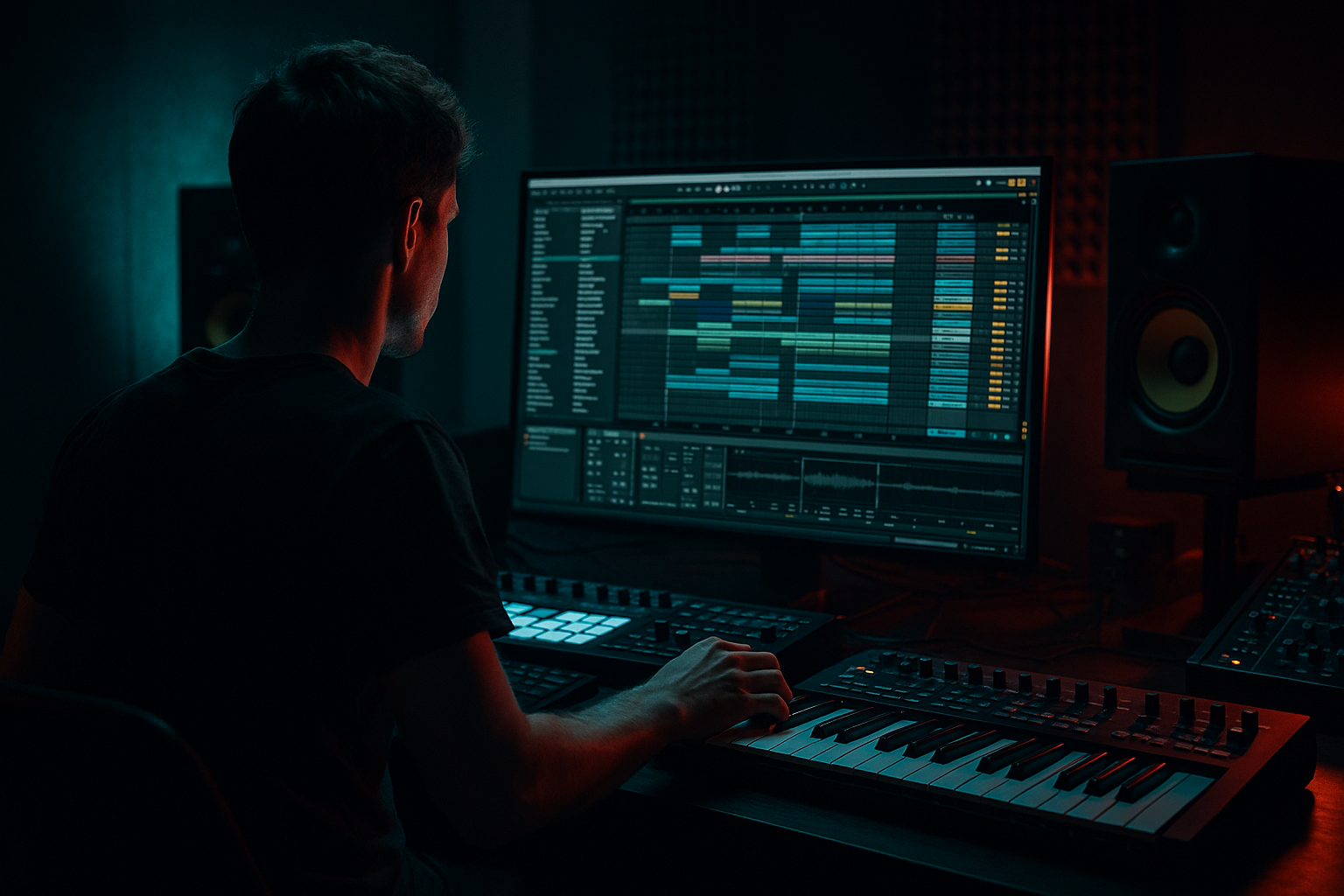
In this lesson, you’ll build a DJ-intro style Amen Science bassline session in Ableton Live 12 that blends modern punch with vintage soul. The goal is to create a bassline-led intro that feels ready for a mix into a full DnB track: deep enough for rollers, gritty enough for jungle-influenced cuts, and controlled enough to sit under a DJ transition.
Why this matters in Drum & Bass: the intro is often where the tune earns its identity before the drop. A strong intro bassline gives you instant vibe, helps the DJ phrase the track cleanly, and sets up the energy curve. In DnB, especially jungle and darker rollers, the bassline is not just low-end support — it’s part of the arrangement and the groove. A good intro bassline can tease the main hook, imply the drop’s attitude, and keep the track moving even before the full drums arrive.
We’ll use Ableton stock devices and keep everything practical: Wavetable, Operator, Drum Rack or Simpler for Amen chops, Saturator, EQ Eight, Auto Filter, Utility, Drum Buss, Glue Compressor, Echo, and basic automation. This is beginner-friendly, but it’s built like a real DnB session, not a bedroom-demo exercise.
What You Will Build
By the end, you’ll have a short DJ-intro composition with:
- a sub-focused bassline that holds the groove
- a slightly dirty reese-style layer for movement and tension
- a call-and-response phrasing pattern that leaves space for the Amen break
- a vintage-soul flavoured top texture created with filtering and saturation
- a DJ-friendly 16- or 32-bar intro that can lead naturally into a drop
- clean low-end discipline so the sub stays mono and controlled
- automation that gradually opens the tune in a way that feels musical, not random
- Making the sub bass too busy
- Widening the sub bass
- Over-processing the Amen break
- Using too many notes in the intro
- Ignoring phrase length
- Too much reverb on low end
- Bass and kick fighting for the same space
- Add a tiny amount of Saturator drive to the mid-bass and then pull the output down so the bass feels denser without getting louder.
- Use Auto Filter on the mid-bass with a slow opening movement over 8 bars to create tension without obvious buildup clichés.
- Resample your bass phrase to audio once it feels good, then make small edits in Arrangement view. This can help you commit to a stronger groove.
- Keep the sub note lengths slightly longer than the mid-bass hits. That creates weight while the top layer gives movement.
- Use ghost Amen hits or a filtered snare tail before bass responses to make the groove feel more underground.
- For a darker edge, try reducing the brightness of the texture track and adding a little frequency roll-off above 6–8 kHz.
- If the bassline feels too clean, add a second layer in Wavetable with mild detune and filter it so it only speaks in the 200–800 Hz region.
- For a heavier DJ intro, leave a short gap right before a key bass phrase. Silence can hit harder than another fill.
- Build the intro around a clean mono sub and a simple, strong bass motif.
- Add movement with a mid-bass layer, not by overloading the sub.
- Use the Amen break as rhythmic identity, not just background noise.
- Shape the vibe with filtering, saturation, and subtle automation.
- Keep the arrangement DJ-friendly with clear 8- and 16-bar phrasing.
- In DnB, the best basslines balance weight, space, and motion — especially in a DJ intro.
Musically, think: a dark 170 BPM intro where the Amen break is teased in pieces, the bassline answers the drums in short phrases, and the whole thing has that “old-school soul filtered through modern damage” feeling.
Step-by-Step Walkthrough
1. Set up a clean DnB session and sketch the intro length
Open a new Ableton Live 12 set and set the tempo to 170 BPM. That’s a strong starting point for modern DnB, jungle, and rollers. If you want it slightly looser and more classic, you can also try 172 BPM later, but 170 keeps it beginner-friendly.
Create these tracks:
- Drums / Amen
- Sub Bass
- Mid Bass / Reese
- Atmos / Soul Texture
- FX / Risers
Start with a 16-bar loop. For DJ intro writing, 16 bars is usually the minimum useful length, while 32 bars gives you more room for buildup and mix-in phrasing. If you are new, work in 16 bars first.
Put markers or arrangement locators at:
- 1–8 bars: intro groove
- 9–16 bars: tension increase
- 17–32 bars: optional longer DJ intro or lead-in
Why this works in DnB: DJs need phrasing that is easy to mix into. Clear 8-bar and 16-bar structures make the track usable in a set, especially for jungle and rollers where the intro often carries the energy before the drop.
2. Build the Amen foundation with a simple chopped pattern
Drop an Amen break into Simpler on the Drum / Amen track. Use Slice mode if you want to quickly chop it, or keep it as a loop and manually cut it in Arrangement view for more control. For a beginner, keep the first version simple.
In Simpler:
- turn on Warp if needed
- set Loop off if you’re triggering slices
- if using Slice mode, use Transient slicing
Create a basic pattern with the kick, snare, and a couple of ghost hits. Don’t over-edit yet. The goal is to get the break breathing with the bassline.
Practical note:
- Keep the main snare on 2 and 4
- Use 1–2 ghost notes before the snare for swing
- Let some hats or shuffle tails remain imperfect for character
Add EQ Eight after Simpler:
- high-pass around 30–40 Hz only if needed
- dip a little around 250–400 Hz if the break feels boxy
- add a subtle boost around 5–8 kHz if you want more crackle
If the break sounds too raw, place Drum Buss after EQ Eight:
- Drive: 5–15%
- Crunch: low, around 5–10%
- Boom: off or very low for this stage
Keep the break dry enough to let the bassline speak.
3. Design the sub bass first — keep it simple and strong
On the Sub Bass track, load Operator. Use a sine wave or a very clean waveform. This is your foundation.
Suggested starting settings in Operator:
- Oscillator A: Sine
- Filter: off or very gentle
- Volume envelope: fast attack, medium decay if needed, or sustain full for held notes
- Glide/Portamento: optional, subtle, around 30–70 ms if you want slides
Write a bassline using just 2–4 notes at first. In DnB, less is often more at the intro stage. A strong bassline can be built from a tight motif instead of lots of notes.
Good beginner note choices:
- root note
- minor 3rd or 5th for tension
- octave movement for push
- occasional passing note into the snare response
Example phrasing idea:
- bar 1: root note held
- bar 2: short note answer on the offbeat
- bar 3: root + octave jump
- bar 4: rest or short pickup into the next phrase
Add Utility after Operator:
- turn Bass Mono on if needed, or keep the bass centered manually
- keep the sub mono below the crossover region by not widening it
Then add EQ Eight:
- low-pass or gentle roll-off above 120–180 Hz if the sub gets too bright
- cut any muddy resonance around 80–120 Hz only if necessary
This is the core of your intro. If the sub sounds clean and weighty, everything else has room to move around it.
4. Add a mid-bass layer for modern punch and movement
Create the Mid Bass / Reese track and load Wavetable. This layer gives the intro a modern edge without replacing the sub.
Try this beginner-friendly recipe:
- Oscillator 1: saw or basic analog-style waveform
- Oscillator 2: saw, slightly detuned
- Unison: light, not extreme
- Filter: low-pass with moderate resonance
- Modulation: use a slow LFO on filter cutoff or wavetable position
Suggested starting range:
- Filter cutoff around 200–800 Hz depending on note range
- Resonance low to moderate, around 10–25%
- Unison voices: 2–4 max for this stage
- Detune: subtle, so the bass stays tight
Now shape the tone with Saturator:
- Soft Clip on
- Drive: 2–6 dB
- Output down if needed to keep level controlled
Add Auto Filter after Saturator if you want motion:
- use a slow LFO or automate cutoff
- keep movements subtle in the intro
- aim for small opening gestures rather than huge sweeps
Write the mid-bass as a call-and-response with the sub:
- sub holds the low anchor
- mid bass hits on the “answer” notes
- leave space for the Amen break to punch through
This is a classic DnB move: the bassline doesn’t have to play constantly. In fact, a bit of space gives the drums more attitude and makes the groove feel more intentional.
5. Shape the vintage soul feel with filtered texture
To get the “vintage soul” part of the brief, add a new track called Atmos / Soul Texture. This can be:
- a chopped vocal-style texture
- a soft chord stab
- a sampled soul fragment
- or even a simple sustained note from Wavetable or Operator
Keep it simple and moody. You’re not building a house-style chord bed — you’re adding a ghost of warmth behind the bassline.
Stock Ableton workflow:
- Put the sound into Simpler or use Instrument Rack
- Add Auto Filter
- Set a low-pass filter and automate it slowly
- Add Echo with a short delay time and low feedback if you want depth
- Add Saturator lightly for grit
Suggested settings:
- Auto Filter cutoff: start low, around 200–600 Hz, then open gradually
- Echo feedback: 10–25%
- Echo dry/wet: 5–15%
- Saturator drive: 1–4 dB
The purpose here is not to make the texture obvious. It should feel like old soul records being pulled through a dark tunnel. This gives the intro emotional weight and contrast against the hard drum programming.
6. Program the arrangement so the bassline tells a story
Move into Arrangement view and shape the first 16 or 32 bars with clear energy changes.
A practical arrangement map:
- Bars 1–4: filtered Amen hits, sub hint, texture barely audible
- Bars 5–8: bassline enters more clearly, mid-bass flickers in
- Bars 9–12: add more Amen detail, open the filter slightly
- Bars 13–16: tension rise, tiny drum fill, bassline becomes more confident
- Bars 17–32: optional extended intro or DJ mix-out section
Use automation to create progression:
- automate Auto Filter cutoff on the texture track
- automate mid-bass filter cutoff opening by a small amount
- automate reverb/delay send on selected drum hits or bass stabs
- automate Utility gain slightly upward into the transition if needed
Keep the arrangement DJ-friendly:
- leave a stable 8-bar section for mixing
- avoid too many one-shot fills too early
- make sure the groove remains recognizable after each change
A useful context example: if your intro is meant for a darker roller set, the first 16 bars should feel mixable and controlled. If it’s more jungle-flavoured, you can let the Amen edits feel a bit more broken and restless, but still keep the bassline phrases clear.
7. Glue the drums and bass together without crushing the dynamics
On your drum or bass buses, use light bus processing only. Beginner mistake is over-compressing too early.
On the Drum Bus, try:
- Glue Compressor
- Ratio: 2:1
- Attack: 10–30 ms
- Release: Auto or around 0.1–0.3 s
- Gain reduction: just 1–2 dB
On the Bass Bus or grouped bass tracks:
- EQ Eight to clean overlap
- Saturator for subtle harmonics
- Utility to check mono compatibility
Keep the sub and mid-bass separate if possible. That lets you:
- keep the sub clean and centered
- add stereo interest only to the higher bass layer
- control distortion without wrecking low-end clarity
If the bass and kick clash, make a small EQ cut in the mid-bass around 80–150 Hz rather than boosting the sub endlessly. In DnB, clarity usually wins over sheer loudness.
8. Create automation and transitions that feel like a DJ intro
The intro should feel like it can work in a mix, not like a random loop. Add subtle movement with automation.
Good beginner automation choices:
- Auto Filter cutoff on mid-bass
- Saturator drive on the bass for a slightly dirtier build
- Echo send on a snare or Amen hit before the drop
- Reverb dry/wet on the texture for a widening moment
- Utility gain for a small pre-drop lift
Keep automation changes small:
- cutoff movement: gradual, not dramatic
- saturation increase: tiny increments
- delay throws: only on select hits
Add a short fill or turnaround at the end of bar 8 or 16:
- a quick Amen cut
- a reversed cymbal
- a bass rest
- then re-entry on the next phrase
This is where the intro starts to feel like a proper DnB record. The listener should sense forward motion even before the drop arrives.
Common Mistakes
- Fix: simplify the note pattern and let the sub hold longer notes. DnB needs low-end clarity more than constant movement.
- Fix: keep sub mono. Use stereo interest only on the mid-bass or texture layer.
- Fix: if the break loses punch, reduce saturation or bus compression. Keep transient shape intact.
- Fix: reduce to a tight motif. A strong 2–4 note phrase often feels more professional than a crowded bassline.
- Fix: make changes in 4-, 8-, or 16-bar blocks so DJs can mix cleanly.
- Fix: keep reverb away from the sub. Use it on textures, tops, or short FX only.
- Fix: carve a little room with EQ Eight and use arrangement space — sometimes the best fix is leaving silence in the bassline.
Pro Tips for Darker / Heavier DnB
Mini Practice Exercise
Spend 10–20 minutes making a mini DJ intro based on this lesson.
1. Set Ableton to 170 BPM.
2. Create a 16-bar loop.
3. Load one Amen break in Simpler and make a basic chopped groove.
4. Program a 2-note sub bass in Operator.
5. Add a mid-bass layer in Wavetable with light filter movement.
6. Add one texture track with a filtered soul-style sound.
7. Automate the mid-bass filter opening from bar 1 to bar 16.
8. Make one small fill at bar 8 or 16.
9. Toggle between mono and stereo listening to check if the sub stays centered.
10. Export a rough bounce or loop the section and listen back like a DJ.
Goal: finish with a playable intro loop that feels dark, soulful, and ready to lead into a drop.

